
Prime Minister Narendra Modi has strongly condemned the recent ballistic missile, cruise missile and drone attack on Fujairah Port in the United Arab Emirates, underlining India’s growing strategic concern over escalating instability in West Asia.
In a statement issued a day after the BJP’s major electoral victory in West Bengal, Modi expressed solidarity with the UAE and stressed the importance of maintaining safe and uninterrupted navigation through the Strait of Hormuz — one of the world’s most critical maritime energy corridors.
The remarks come at a time when tensions between Iran and the United States continue to intensify, raising fresh concerns over regional security, energy supply chains and global trade flows.
Why Fujairah Matters in Global Energy Supply
The attack on Fujairah has drawn particular international attention because of the port’s strategic location.
Unlike many Gulf ports that depend on access through the Strait of Hormuz, Fujairah lies on the Gulf of Oman, outside the narrow maritime chokepoint. This gives it immense strategic value during periods of regional conflict.
Together with Khor Fakkan, Fujairah has increasingly emerged as a critical alternative route for energy exports, especially at a time when fears are growing that the Strait of Hormuz could be used as geopolitical leverage.
Energy analysts note that any disruption in this region can have direct consequences for global crude oil prices, shipping insurance, and energy security for import-dependent countries such as India.
UAE Under Growing Security Pressure
Recent regional hostilities have placed the UAE under heightened security pressure.
Despite not being the principal battlefield in the ongoing Iran-US confrontation, the Emirates has increasingly found itself exposed due to its hosting of American military facilities and its deepening ties with Israel.
Regional observers say this has made the UAE a sensitive target in the wider geopolitical contest unfolding across the Gulf.
The attack on Fujairah has therefore been interpreted not merely as a military strike but also as a signal aimed at regional energy infrastructure and maritime commerce.
India-UAE Defence Ties Enter New Phase
India’s response to the attack also reflects the rapidly strengthening strategic relationship between New Delhi and Abu Dhabi.
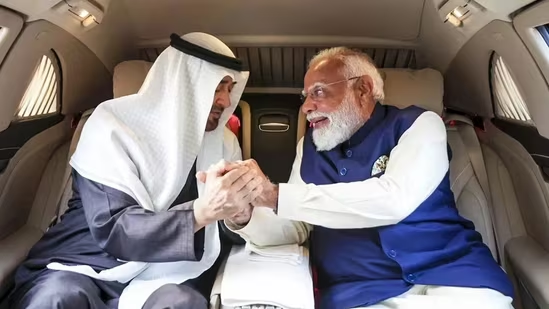
Prime Minister Modi and UAE President Sheikh Mohammed bin Zayed Al Nahyan have significantly expanded bilateral ties in recent years, moving beyond trade and investment into defence, security and technology cooperation.
The two countries had earlier signed a Letter of Intent to work towards a formal Strategic Defence Partnership Agreement.
Officials from both sides are now understood to be exploring deeper collaboration in several areas, including:
- defence industrial cooperation
- military interoperability
- defence innovation and emerging technologies
- cyber security
- counter-terrorism coordination
- special operations cooperation
This strategic convergence has become more significant as geopolitical alignments in West Asia continue to evolve.
Modi’s Upcoming UAE Visit Gains Added Importance
Prime Minister Modi is expected to visit Abu Dhabi later this month while travelling onward to Europe.
The visit is now being closely watched, particularly after the Fujairah attack and amid broader uncertainty over Gulf security.
Diplomatic observers believe the visit could further strengthen political coordination between India and the UAE on regional security, energy cooperation and long-term strategic planning.
Emerging Trade Axis: Mundra-Fujairah-Aqaba
Beyond defence ties, India and the UAE are also increasingly aligning economically.
A new trade and logistics corridor connecting Mundra, Fujairah and Aqaba is gradually emerging as an important regional commercial route.
The UAE recently formalised a major infrastructure agreement to build a 360-kilometre railway line linking Jordan’s phosphate and potash mines to Aqaba Port on the Red Sea.
This is particularly significant for India because phosphate and potash are key raw materials used in fertiliser production — a sector vital for India’s agricultural economy.
The development could strengthen India’s long-term supply chain resilience in food and fertiliser security.
UAE Remains Crucial for India’s Energy Security
The UAE remains one of India’s most important energy partners.
During 2024–25, India imported around USD 13.6 billion worth of crude oil from the UAE, accounting for nearly 10 percent of India’s total crude imports, equivalent to roughly 23 million tonnes.
In addition, India imported LNG and LPG worth USD 7.51 billion from the Emirates.
Given India’s growing energy demand, stable relations with the UAE have become increasingly critical to New Delhi’s economic planning.
Shared Strategic Interests
The current regional situation is pushing India and the UAE even closer.
India seeks long-term energy security, stable maritime trade routes and dependable strategic partners in West Asia.
The UAE, on the other hand, values reliable food supply chains, economic partnerships and strong cooperation against radicalisation and terrorism.
As tensions continue to rise around the Strait of Hormuz, the relationship between New Delhi and Abu Dhabi is expected to acquire even greater geopolitical significance.
The Fujairah attack has therefore become more than a regional flashpoint — it has reinforced the growing strategic logic behind deeper India-UAE cooperation in defence, trade, energy and regional stability.