
Delhi Capitals’ IPL 2026 season has entered a critical phase after successive home defeats exposed growing concerns over their batting fragility, team balance, and inability to control the tempo of matches.
A week after a dramatic collapse against Royal Challengers Bengaluru, Delhi once again found themselves under pressure at home, this time against Chennai Super Kings. On a slow surface that demanded patience and calculated shot-making, the Capitals were reduced to 69/5 after 11 overs, leaving their middle order with the task of damage control rather than acceleration.
That early collapse has become a worrying trend for Delhi this season.
Against RCB, the Capitals had slumped to 8/6 before eventually managing just 75. Against CSK, the story was similar. Their top order failed to adapt to the conditions, forcing the side into defensive mode far earlier than planned.
Impact Player Turns Survival Tool
The IPL’s Impact Player rule is meant to provide tactical flexibility, but for Delhi Capitals it has increasingly become a rescue mechanism.
In both recent home matches, Delhi were forced to bring in an extra batter to prevent total collapse.
Abishek Porel had fought a lone battle against RCB, scoring 30 of Delhi’s 75. Against Chennai, Sameer Rizvi played a crucial counter-attacking knock against his former franchise, top-scoring with 40 off 24 balls and helping Delhi reach a somewhat competitive 155.
However, the cost of using the Impact Player so early was significant.
By strengthening the batting, Delhi weakened their bowling options. Against CSK, that meant leg-spinner Vipraj Nigam remained unused on a pitch where slower bowlers could have made a decisive difference.
Combination Problems Continue to Hurt Delhi
Delhi Capitals began the season with a balanced-looking combination.
The initial plan revolved around overseas batters Pathum Nissanka, David Miller and Tristan Stubbs, alongside KL Rahul at the top, with only one overseas pacer in the XI.
That balance, however, depended heavily on Indian seamers delivering consistently — something that has not happened.
As the season progressed, Delhi were forced to rethink their combinations. Bringing in additional overseas pace options meant sacrificing batting depth and experience. David Miller became the casualty of that tactical reshuffle, further exposing a fragile middle order.
Even Pathum Nissanka, despite producing a match-winning fifty on his return, has struggled for consistency.
Powerplay Numbers Reveal the Real Problem
Delhi Capitals’ biggest weakness this season has been their starts.
Through 10 matches in IPL 2026, Delhi have lost 21 wickets inside the Powerplay, the worst among all teams.
Their numbers during the first six overs underline the problem:
- Average runs per wicket: 23.85
- Run rate: 8.35
- Dot-ball percentage: 46.4%
These figures place Delhi at the bottom of the league in nearly every major Powerplay batting metric.
Too often, they are losing early wickets and forcing their middle order to rebuild instead of dominate.
Tactical Calls Under Scrutiny
The defeat to Chennai Super Kings also highlighted questions around Delhi’s decision-making.
At 69/5, the Capitals opted to use Sameer Rizvi as the Impact Player instead of trusting existing middle-order resources like Ashutosh Sharma.
While Rizvi’s innings gave Delhi something to defend, the move left them short in the bowling department.
Chennai took advantage.
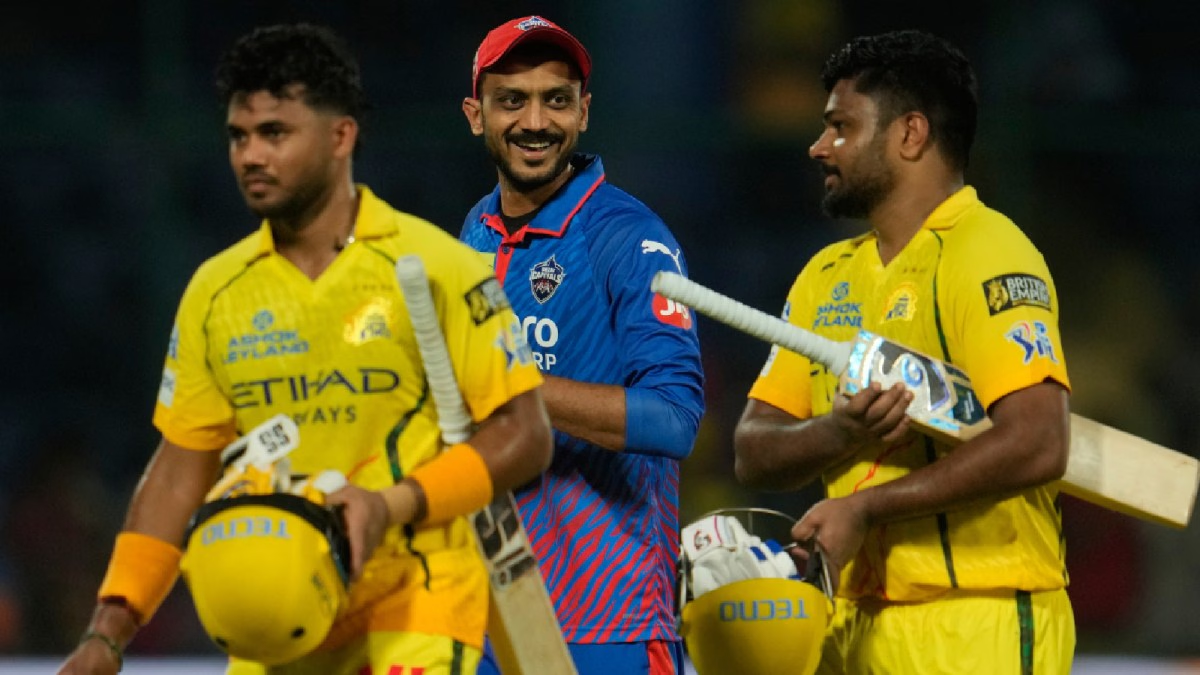
Sanju Samson paced the chase expertly, respecting the better bowlers like Lungi Ngidi and Axar Patel before attacking the weaker links. With limited bowling options available, Delhi’s attack became predictable, allowing CSK to complete a comfortable eight-wicket win.
Hemang Badani Issues Clear Warning
Delhi Capitals head coach Hemang Badani did not hide his disappointment after the defeat.
He admitted the match was effectively lost during the first ten overs, when Delhi once again failed to build a solid platform.
Badani stressed that the issue is no longer about permutations, combinations, or tactical experiments. The team simply needs more players contributing together on the same day.
At present, Delhi have eight points from 10 matches, placing them in a virtual knockout situation.
Every remaining game is now crucial.
Delhi Capitals Enter ‘Perform or Perish’ Stage
With the playoff race tightening, Delhi Capitals no longer have room for repeated batting collapses or tactical compromises.
The road ahead is simple but unforgiving.
If the top order continues to falter, Delhi’s season could unravel quickly. If they can finally put together complete performances with both bat and ball, their campaign can still be revived.
For now, the message inside the Delhi dressing room is clear — perform or perish.