
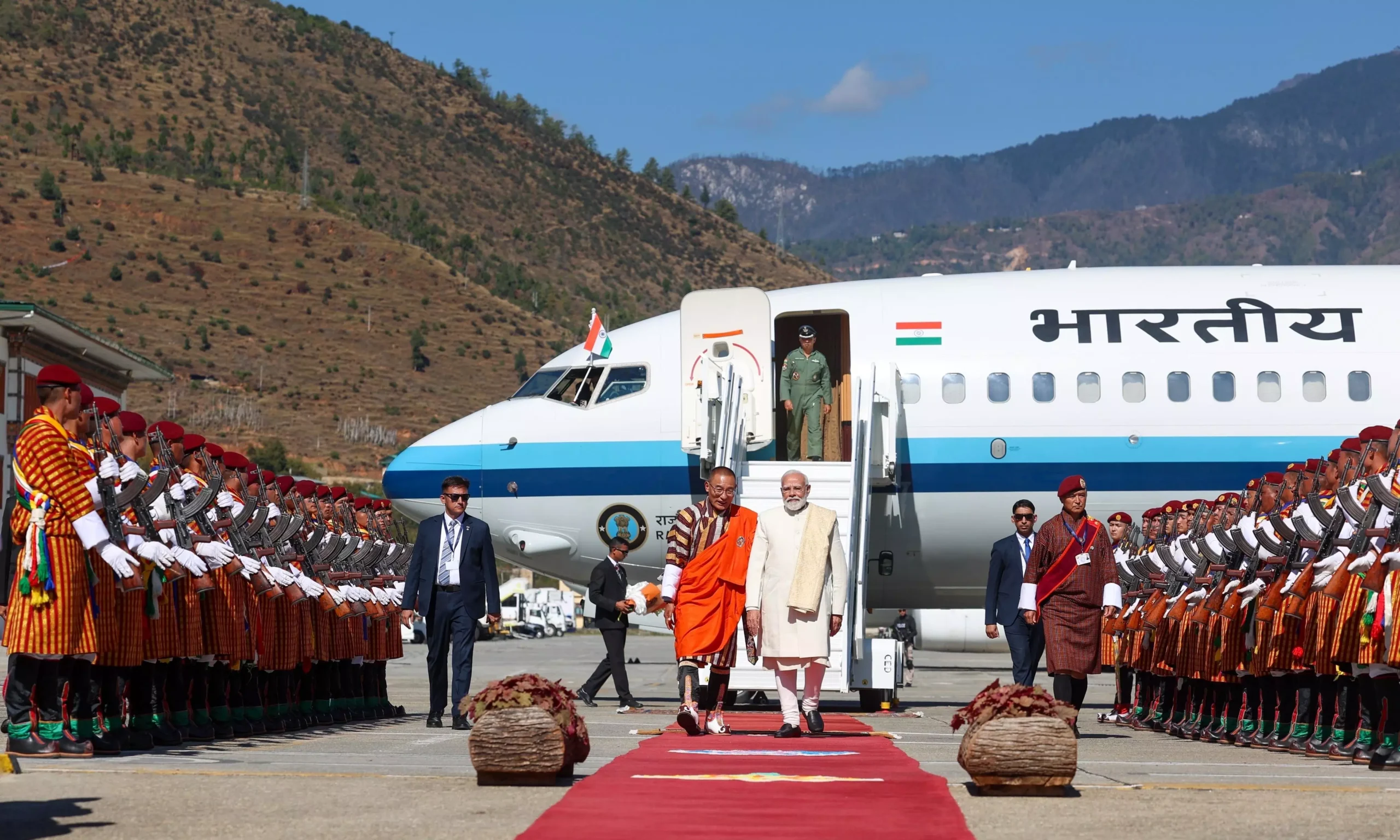
India and Bhutan are deepening their strategic partnership through expanded connectivity, border infrastructure, and renewable energy cooperation, Prime Minister Narendra Modi announced on Tuesday during his visit to Thimphu.
Speaking at an event to mark the 70th birth anniversary of Bhutan’s former King, Jigme Singye Wangchuck, Modi underscored that both nations are building on decades of friendship to create sustainable growth opportunities in the Himalayan region.
Enhancing Connectivity and Border Infrastructure
PM Modi highlighted that connectivity creates opportunities, pointing to India’s recent decision to link Gelephu and Samtse in Bhutan with India’s rail network. “Completion of this project will provide easier access for industries here and Bhutanese farmers to India’s vast market,” he said.
This expansion of infrastructure goes beyond transport. Both countries are also making progress on border infrastructure, aimed at improving trade, tourism, and regional development. Modi announced the establishment of a new immigration checkpoint near Gelephu, designed to streamline the entry of visitors and investors, thereby boosting Bhutan’s ambitious Gelephu Mindfulness City project — a futuristic economic hub envisioned by King Jigme Khesar Namgyel Wangchuck.
India’s ₹10,000-Crore Support for Bhutan’s Development Plan
To demonstrate India’s continued commitment, Modi revealed that New Delhi has contributed ₹10,000 crore to Bhutan’s current five-year plan. The financial assistance is being utilized in sectors such as roads, agriculture, healthcare, and financing, reflecting the interdependence of the two nations’ economic and social growth.
This investment, Modi noted, symbolizes how “the progress and prosperity of both our countries are intertwined.”
Energy Partnership: Powering Bhutan’s Carbon-Negative Vision
The two countries’ long-standing hydropower partnership remains the cornerstone of bilateral cooperation. Bhutan’s clean energy generation has already made it the world’s first carbon-negative nation, and Modi announced new milestones to build on this success.
During his visit, the Prime Minister will inaugurate a 1,020-megawatt hydroelectric project, increasing Bhutan’s total hydropower capacity by nearly 40%. He also confirmed that work will soon resume on another long-stalled hydro project, while India and Bhutan are also expanding their collaboration into solar energy.
Trade, Digital Linkages, and Citizen Welfare
Beyond energy, India has taken multiple steps to ensure steady supply chains for essential goods to Bhutan. The Unified Payments Interface (UPI) facility is being expanded across Bhutan, making digital transactions easier for citizens and businesses.
Modi also noted that the youth of both nations are working together on space technology, including the joint development of a satellite, and collaborating in sectors like education, skill development, innovation, sports, and culture.
Paying tribute to former King Jigme Singye Wangchuck, Modi praised his vision for introducing democratic governance and the philosophy of “Gross National Happiness”, which redefined how nations measure progress globally.
“The friendship between our two countries continues to flourish on the foundation you laid,” Modi said, acknowledging the former monarch’s efforts to promote peace and sustainability.
Cultural Bonds and Spiritual Linkages
Emphasizing the deep-rooted cultural and spiritual ties between India and Bhutan, Modi mentioned the inauguration of the Royal Bhutanese Temple in Rajgir, India, as a symbol of growing cultural exchange. Responding to Bhutanese citizens’ requests, he announced that India has also allocated land in Varanasi for the construction of a Bhutanese temple and guesthouse to welcome pilgrims and visitors.
A Future Built on Trust and Shared Values
Modi’s remarks encapsulated India’s vision for a prosperous, connected, and sustainable South Asia. With joint projects in railways, renewable energy, border management, and digital innovation, both nations are setting an example of mutual trust and partnership in the region.