
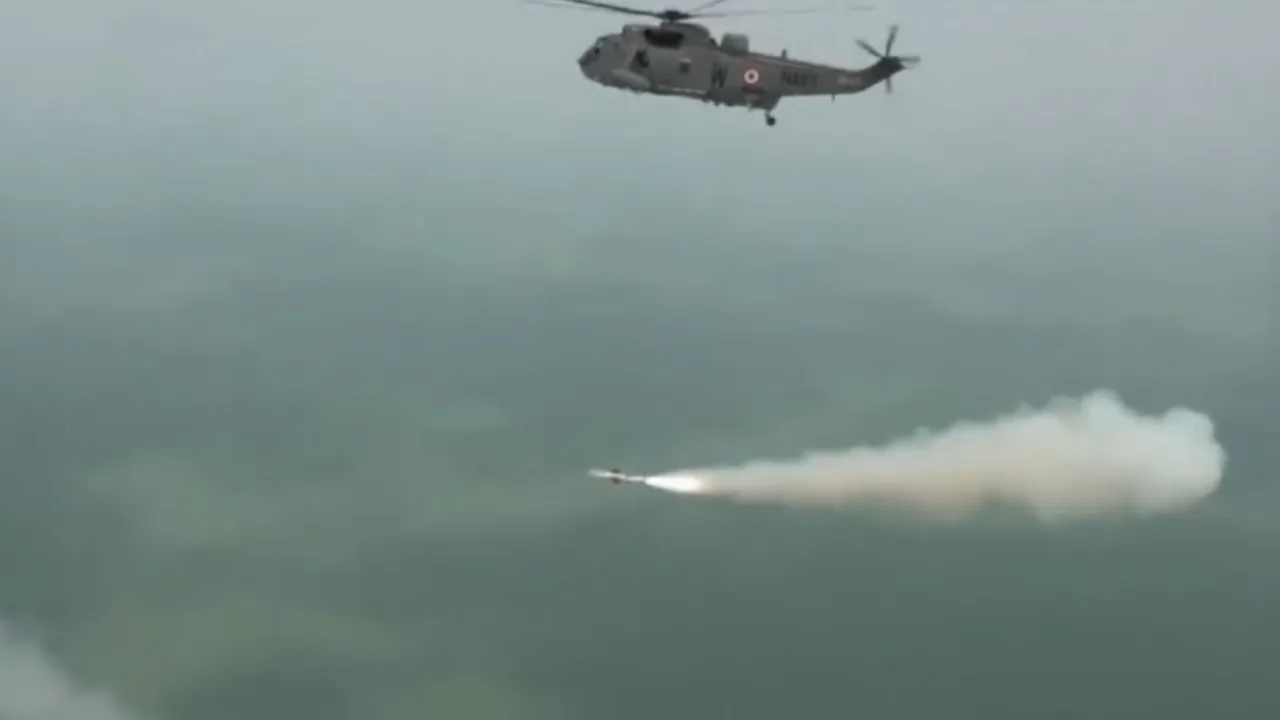
In a significant boost to India’s indigenous defence capabilities, the Defence Research and Development Organisation (DRDO) and the Indian Navy successfully carried out the maiden salvo launch of the Naval Anti-Ship Missile–Short Range (NASM-SR) from a naval helicopter platform over the Bay of Bengal, off the coast of Odisha.
During the trial, two missiles were fired in quick succession from the same helicopter, marking the first-ever salvo launch of an advanced air-launched anti-ship missile system developed in India.
Advanced Naval Testing Demonstrates Global-Standard Capabilities
In a parallel development, DRDO also achieved a major breakthrough in naval engineering by completing advanced hydrodynamic performance assessments for a frontline warship project.
The exercise was led by the Naval Science and Technological Laboratory (NSTL) in collaboration with the Navy’s Warship Design Bureau. The project showcased high-end capabilities in:
- Hull hydrodynamics
- Computational Fluid Dynamics (CFD) simulations
- Experimental model testing
These evaluations covered critical parameters such as resistance, propulsion, sea-keeping, and manoeuvrability, with results matching leading global benchmarks in accuracy and reliability.
Key Defence Project Handover
The project deliverables were formally handed over by Samir V Kamat, Secretary (Defence R&D) and Chairman DRDO, to Sanjay Sadhu, Controller of Warship Production and Acquisition, in the presence of senior officials.
New Armoured Platforms Unveiled
Further strengthening India’s defence ecosystem, DRDO unveiled advanced armoured platforms developed by the Vehicles Research and Development Establishment (VRDE) in Ahilyanagar, Maharashtra.
These next-generation tracked and wheeled platforms feature:
- Indigenously developed 30 mm crewless turret
- Integration with 7.62 mm PKT gun and anti-tank guided missiles
- High power-to-weight ratio and superior mobility
- STANAG Level 4 and 5 ballistic protection
- Amphibious capability with hydro-jet systems
Currently, the platforms have about 65% indigenous content, with plans to increase it to 90% in the future.
Strengthening India’s Defence Self-Reliance
These developments underline India’s growing focus on defence self-reliance and technological advancement under indigenous programmes. The successful missile trials, naval testing, and new combat platforms collectively signal a strong push towards modernising the armed forces and reducing dependency on imports.