
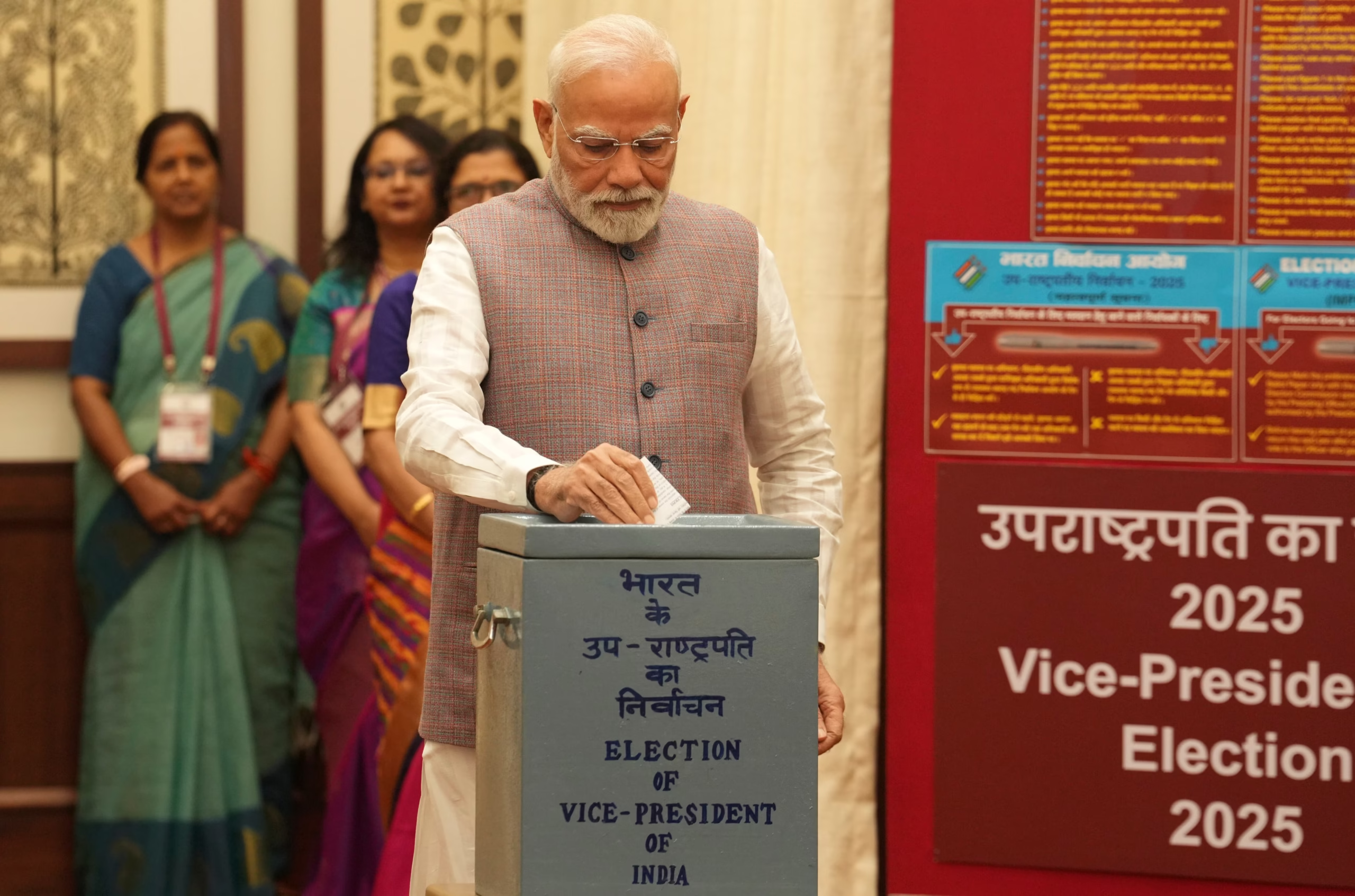
New Delhi, September 9 – The high-stakes Vice Presidential Election 2025 began on Friday morning with Prime Minister Narendra Modi casting the first vote at 10 am inside Parliament House. The election, considered a crucial political battle between the National Democratic Alliance (NDA) and the Congress-led INDIA bloc, will decide the successor to Jagdeep Dhankhar, who resigned as Vice President on July 21 citing health reasons.
Voting is taking place in Room No. 101, Vasudha, Parliament House, and will continue until 5 pm, followed by counting from 6 pm. The results are expected by 7–7:30 pm, making this one of the most closely watched political contests in recent memory.
The Contest: NDA vs INDIA Bloc
The NDA has fielded C P Radhakrishnan, a senior BJP leader from Tamil Nadu known for his organisational skills and long association with the party. Radhakrishnan, who has twice represented Coimbatore in the Lok Sabha, is being projected as a strong Southern face of the ruling alliance.
The opposition INDIA bloc has nominated Justice (Retd.) B Sudershan Reddy, a former Supreme Court judge with a reputation for integrity. His candidature is being seen as the Opposition’s attempt to project credibility and judicial independence in a politically charged election.
With both sides mobilising their full strength, the election has taken on a symbolic importance that goes beyond mere numbers.
Political Numbers and Voting Dynamics
The electoral college for the Vice Presidential election comprises 781 Members of Parliament — 542 from the Lok Sabha and 238 from the Rajya Sabha. With seven seats vacant (one in the Lok Sabha and six in the Rajya Sabha), the majority mark stands at 391.
-
The NDA commands the support of 425 MPs, comfortably above the halfway mark. This includes backing from the YSR Congress Party (11 MPs), though the party is not formally part of the NDA.
-
The INDIA bloc has the support of around 324 MPs, led by the Congress, Trinamool Congress, DMK, RJD, Samajwadi Party, and Left parties.
-
The BJD (7 MPs) and BRS (4 MPs) have decided to abstain from voting.
-
The Shiromani Akali Dal (1 MP) has announced a boycott.
-
Among independents, voting preferences remain uncertain, though RLP MP Hanuman Beniwal and Azad Samaj Party MP Chandrashekhar Azad have hinted support for the opposition nominee.
Given the numbers, Radhakrishnan appears poised for victory, but the INDIA bloc is framing the contest as a battle of principles against the NDA’s numerical dominance.
A Day of High Political Activity
Prime Minister Modi, flanked by Union Ministers Kiren Rijiju, Arjun Ram Meghwal, Jitendra Singh, and L Murugan, was the first to cast his ballot. “Voted in the 2025 Vice President election,” Modi later posted on X, before departing for a scheduled visit to flood-hit Himachal Pradesh and Punjab.
Other prominent leaders who cast their votes early included Defence Minister Rajnath Singh, former Prime Minister H D Deve Gowda, Congress President Mallikarjun Kharge, Congress MP Rahul Gandhi, and UPA Chairperson Sonia Gandhi.
In a rare moment of camaraderie, Nitin Gadkari (BJP) and Mallikarjun Kharge (Congress) were seen walking together hand-in-hand to the polling booth — a symbolic reminder of the democratic process rising above political rivalry.
NDA’s Confidence vs Opposition’s Protest
The NDA has been meticulously preparing for this election. To avoid invalid votes, six Union Ministers were assigned regional responsibilities, ensuring MPs were trained in the voting process. “Not a single vote will be wasted,” said Parliamentary Affairs Minister Pralhad Joshi.
On the other hand, the Opposition has alleged that the special intensive revision (SIR) of voter rolls in Bihar and other states, conducted earlier by the Election Commission, was politically motivated. The Congress and RJD have accused the BJP of attempting to manipulate voter lists in their strongholds.
Though these issues are technically unrelated to the Vice Presidential poll, the Opposition has used the election to raise larger concerns about democratic institutions.
Role and Significance of the Vice President
The Vice President of India is the second-highest constitutional office in the country and serves as the ex-officio Chairperson of the Rajya Sabha. In recent years, the position has gained added significance due to heated debates and frequent disruptions in the Upper House.
The resignation of Jagdeep Dhankhar created an unexpected vacancy, setting the stage for today’s crucial election. Whoever wins will play a critical role in maintaining decorum and facilitating legislative business in the Rajya Sabha.
By evening, the result will be declared, but the election has already underscored the deepening political divide between the NDA and the INDIA bloc, with the Vice Presidency once again reflecting the balance of power in Indian politics.