

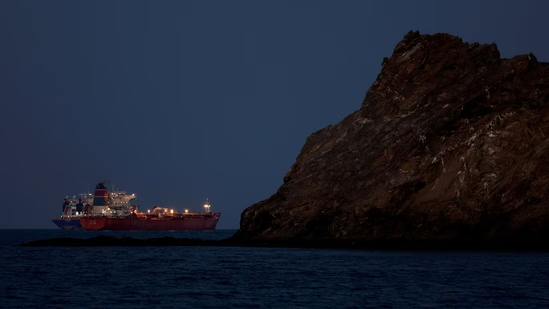
Iran is reportedly planning to charge tolls in cryptocurrency from oil tankers passing through the strategic Strait of Hormuz, tightening its control over one of the world’s most important maritime oil routes even after agreeing to a two-week ceasefire with the United States.
According to Hamid Hosseini, spokesperson for Iran’s Oil, Gas and Petrochemical Products Exporters’ Union, the government intends to collect a transit fee from vessels carrying oil through the narrow waterway while also closely monitoring ship movements.
Hosseini stated that the objective is to track cargo entering and leaving the strait, ensuring that the temporary ceasefire is not used to move weapons into the region.
Toll of $1 Per Barrel for Oil Tankers
Iran reportedly plans to charge $1 per barrel of oil transported by tankers passing through the Strait of Hormuz. Under the proposed system:
- Ships must inform Iranian authorities about their cargo via email before attempting to pass through the strait.
- After reviewing the cargo details, Iranian authorities will notify the vessel of the toll amount.
- The payment must reportedly be made in digital currencies such as Bitcoin.
Hosseini indicated that empty vessels may be allowed to pass without paying any fee.
He also claimed that ships would be given only a few seconds to complete the cryptocurrency payment, which could help prevent transactions from being traced or blocked due to international sanctions.
Iran Tightens Control Over the Strait
The development comes after Iran temporarily reopened the Strait of Hormuz as part of a two-week truce with the United States following heightened tensions involving Israel’s attacks on Hezbollah in Lebanon.
However, Iran has again tightened access to the waterway, warning that vessels must seek prior approval before attempting to transit the strait.
In a reported broadcast message, the Islamic Revolutionary Guard Corps (IRGC) warned ships to follow alternative traffic routes in the strait to avoid risks from possible sea mines and maritime safety threats.
Iran’s Supreme National Security Council will reportedly decide the final conditions for vessels seeking passage through the strategic corridor.
Warning to Ships Without Permission
Authorities have issued strong warnings to ships attempting to cross the waterway without authorization.
“If any vessels try to transit without permission, they will be destroyed,” the broadcast message reportedly stated.
As a result, many shipowners are currently avoiding the route, waiting for clearer guidelines before resuming normal operations.
Hundreds of Ships Waiting Near the Gulf
The uncertainty surrounding the strait has already created a major backlog of vessels.
Industry reports indicate that around 300 to 400 ships are currently waiting in the Gulf region to safely exit through the Strait of Hormuz.
Before the conflict escalated, around 135 ships used the waterway daily. However, maritime experts say that only 10 to 15 vessels per day may currently be able to pass, due to strict inspection procedures and security concerns.
Global Shipping Companies Remain Cautious
Major global shipping companies are closely monitoring the situation.
Maersk, the world’s second-largest container shipping company, said it is urgently seeking clarity on Iran’s conditions for transit.
The company noted that although the ceasefire could create opportunities for passage, it does not yet provide full maritime certainty, and therefore shipping operators are continuing to adopt a cautious approach.
A Critical Global Oil Route
The Strait of Hormuz is one of the world’s most vital energy chokepoints. Roughly one-fifth of global oil shipments pass through the narrow waterway, making any disruption there a major concern for global energy markets.
Analysts warn that the proposed toll system and ongoing geopolitical tensions could further disrupt shipping traffic, delay oil supplies, and increase energy prices worldwide.