

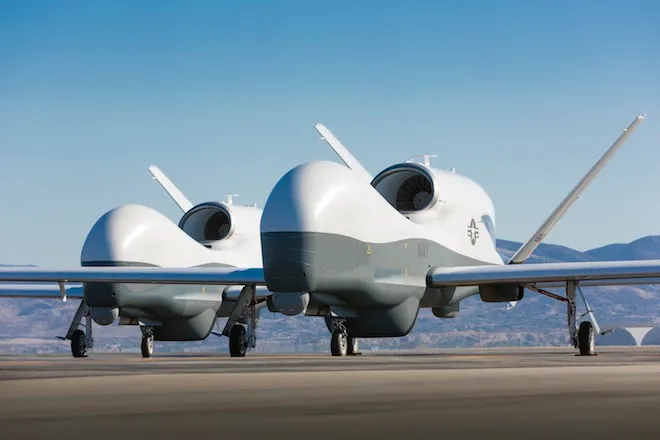
Washington/Tehran: A US Navy MQ-4C Triton surveillance drone, one of the most advanced and expensive unmanned aircraft in the world, reportedly disappeared over the Strait of Hormuz after declaring an in-flight emergency on Thursday.
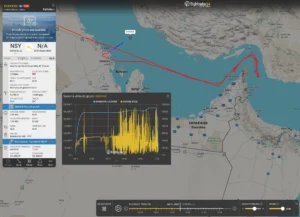
According to flight tracking data and media reports, the drone had completed nearly three hours of surveillance over the Persian Gulf and the Strait of Hormuz before it began its return journey to Naval Air Station Sigonella in Italy.
However, during the return flight, the unmanned aircraft transmitted code 7700, an international aviation signal used to indicate a general emergency.
Drone Lost After Rapid Descent
Flight tracking platform Flightradar24 showed that shortly after issuing the emergency alert, the drone changed course slightly toward Iran and began descending rapidly.
The aircraft was then tracked losing altitude quickly before disappearing from radar.
Officials have not yet confirmed the cause of the incident. It remains unclear whether the drone crashed due to a technical failure or was shot down.
The incident occurred just two days after the United States and Iran agreed to a temporary ceasefire, under which Iran allowed shipping traffic to resume through the strategically vital Strait of Hormuz.
About the MQ-4C Triton Surveillance Drone
The MQ-4C Triton is one of the most advanced maritime surveillance drones operated by the US Navy, with an estimated cost of over $200 million (around ₹1,600 crore) per aircraft.
Designed by Northrop Grumman, the drone plays a critical role in monitoring strategic sea routes and gathering intelligence over large ocean areas.
Key capabilities of the MQ-4C Triton include:
- High-Altitude Long Endurance (HALE) aircraft
- Operational altitude of over 50,000 feet
- Flight endurance exceeding 24 hours
- Range of approximately 7,400 nautical miles
- Advanced sensors for wide-area maritime surveillance
The Triton often works alongside the P-8A Poseidon maritime patrol aircraft, acting as a high-altitude surveillance platform that scans vast areas of ocean and relays intelligence data.
US Fleet of Triton Drones
As of 2025, the US Navy reportedly operates around 20 MQ-4C Triton drones, with plans to expand the fleet by seven additional aircraft in the coming years.
The drone is widely used for monitoring maritime chokepoints, naval activity, and potential threats in strategically sensitive regions such as the Persian Gulf and Indo-Pacific.
Rising Cost of the US-Iran Conflict
The incident comes amid rising military tensions and significant financial costs associated with the ongoing conflict in the region.
According to data from the Stockholm International Peace Research Institute (SIPRI), the United States is spending around $10,300 per second on military operations related to the conflict.
Daily expenditure reportedly includes:
- $320 million per day on munitions and missiles (about 36% of total spending)
- $245 million per day on air operations (about 27.5%)
- $155 million per day on naval operations
- $95 million per day on missile defence systems such as THAAD, Patriot, and Aegis BMD
- $45 million per day on intelligence and cyber operations
- $30 million per day on personnel and logistics
Strategic Importance of the Strait of Hormuz
The Strait of Hormuz remains one of the world’s most critical maritime chokepoints, with nearly 20% of global oil shipments passing through the narrow waterway.
The disappearance of the Triton drone has raised fresh concerns about security and surveillance operations in the region, especially as global shipping and military forces continue to operate in the volatile Gulf area.
Investigations into the incident are expected as authorities attempt to determine what caused the loss of the high-value surveillance drone.