
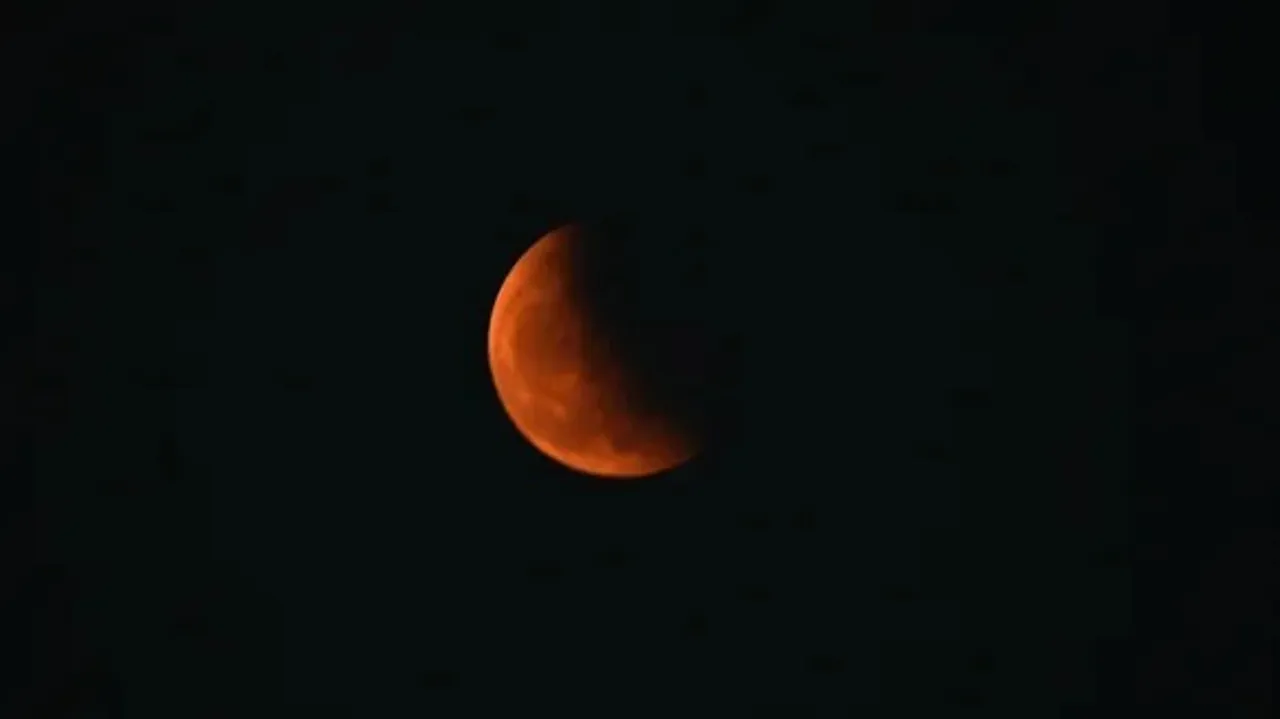
A spectacular total lunar eclipse will light up the skies on Tuesday, March 3, 2026 (12 Phalguna, 1947 Saka Era), offering skywatchers across most parts of India a rare celestial treat. The event has been confirmed by the India Meteorological Department’s Positional Astronomical Centre in Kolkata.
The eclipse will begin in the afternoon (IST), but for most Indian cities, it will be visible during moonrise in the evening hours.
What Is a Total Lunar Eclipse?
A lunar eclipse occurs when the Earth comes directly between the Sun and the Moon on a full moon day, casting its shadow on the lunar surface. In a total lunar eclipse, the entire Moon passes through the Earth’s umbral shadow, often turning a deep coppery-red colour — popularly known as a “Blood Moon.”
With a magnitude of 1.155, this eclipse will see the Moon deeply immersed in Earth’s shadow during totality.
Eclipse Timings (IST)
-
Umbral phase begins: 3:20 PM
-
Totality begins: 4:34 PM
-
Totality ends: 5:33 PM
-
Umbral phase ends: 6:48 PM
-
Magnitude: 1.155
Since the Moon will rise in India during the later stages of the eclipse, visibility will vary from region to region.
North-East & Andaman: Best Viewing in India
Residents of the North-Eastern states and the Andaman & Nicobar Islands will enjoy the most favourable viewing conditions. Cities such as Dibrugarh (5:09 PM moonrise), Sibsagar (5:11 PM), Kohima (5:13 PM), Imphal (5:15 PM), Itanagar (5:15 PM), Shillong (5:23 PM), Guwahati (5:24 PM), Agartala (5:27 PM), Aizawl (5:20 PM) and Port Blair (5:27 PM) will witness the closing stages of totality before it ends at 5:33 PM.
These regions will observe the eclipse for over one hour and 20 minutes, making them the best locations in India to experience the event.
Eastern India: Clear View of Partial Phase
In eastern cities such as Kolkata (5:39 PM), Cooch Behar (5:33 PM), Siliguri (5:37 PM), Patna (5:51 PM), Ranchi (5:51 PM), Bhubaneswar (5:51 PM), Cuttack (5:50 PM), Puri (5:51 PM), Sambalpur (5:58 PM) and Gaya (5:52 PM), the Moon will rise after totality has ended.
Observers here will see the partial phase of the eclipse, with visibility ranging from 45 minutes to over an hour before the event concludes at 6:48 PM.
Northern India: Short but Visible
Cities including Delhi (6:22 PM), Chandigarh (6:19 PM), Amritsar (6:30 PM), Jaipur (6:29 PM), Lucknow (6:07 PM), Varanasi (6:00 PM), Dehradun (6:17 PM), Shimla (6:21 PM), Srinagar (6:28 PM) and Haridwar (6:17 PM) will see the Moon rise close to sunset.
These areas will witness only the final 20–40 minutes of the eclipse before it ends at 6:48 PM.
Central India: Moderate Viewing Window
Cities such as Bhopal (6:24 PM), Nagpur (6:18 PM), Raipur (6:07 PM), Ujjain (6:31 PM) and Allahabad (6:05 PM) will get a viewing window of approximately 25–45 minutes, depending on moonrise timing.
Global Visibility and Future Eclipses
Beyond India, the eclipse will also be visible across Eastern Asia, Australia, the Pacific Ocean and the Americas.
This will be the only lunar eclipse visible from India in 2026. The next lunar eclipse visible in the country will occur on July 6, 2028, and it will be a partial lunar eclipse. The last lunar eclipse visible from India took place on September 7–8, 2025, and it was a total lunar eclipse.
Why This Eclipse Is Special
For many Indian cities, the most captivating moment will be watching a partially eclipsed Moon rise on the eastern horizon — a rare and visually dramatic phenomenon. Weather permitting, the March 3 event promises to be one of the most significant astronomical highlights of 2026.