
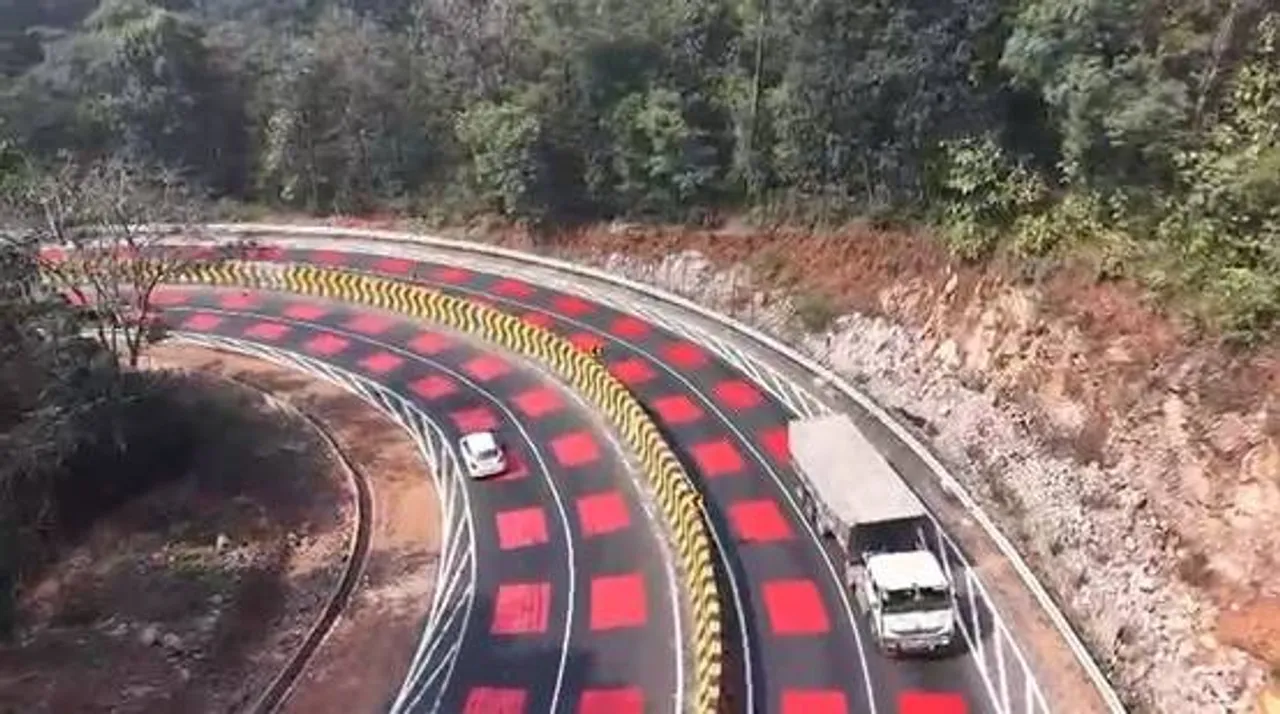
In a major boost to wildlife conservation and sustainable infrastructure, the National Highways Authority of India (NHAI) has introduced India’s first-ever Table-Top Red Marking on a national highway passing through the Veerangana Durgavati Tiger Reserve in Madhya Pradesh. The innovative initiative, inspired by a similar model implemented in Dubai, is designed to alert motorists while ensuring the safe movement of wild animals across a sensitive forest corridor.
The newly developed ‘Red Road’ features a hot-applied thermoplastic red surface laid across the carriageway. The striking colour acts as an immediate visual cue for drivers, warning them that they are entering a designated wildlife zone. Officials said the primary objective is to encourage drivers to reduce speed and remain cautious in an area frequently used by animals, thereby minimising the risk of accidents and wildlife fatalities.
Engineering Innovation with Ecological Sensitivity
Spanning a length of 11.96 kilometers, the highway stretch has been developed with a strong focus on environmental protection. Unlike conventional speed-control measures such as rumble strips or speed breakers, the table-top red marking does not require any changes to the existing road structure. This ensures that the natural habitat and movement patterns of wildlife remain undisturbed.
One of the key advantages of the red marking is reduced noise generation. Traditional rumble strips often create loud sounds that can stress animals and disrupt their behaviour. In contrast, the red road surface allows for smooth vehicle movement while still prompting drivers to slow down. To further improve road safety, NHAI has also added clear white shoulder lines along the stretch, helping motorists maintain lane discipline and avoid drifting off the paved road.
Wildlife Underpasses to Ensure Safe Animal Movement
In addition to the visual warning system, the project includes the construction of 25 dedicated wildlife underpasses along the corridor. These underpasses enable animals to cross the highway safely without coming into contact with vehicular traffic. Such infrastructure is crucial in forested regions, where highways often intersect traditional animal movement routes.
Officials noted that the combined use of the red road marking and wildlife underpasses represents a holistic approach to balancing development with conservation. The system is easy to maintain, cost-effective, and fully reversible if required in the future, making it a sustainable solution for highways passing through protected forest areas.
With this pioneering initiative, NHAI has set a new benchmark for eco-friendly road design in India. The project is expected to serve as a model for similar wildlife-sensitive zones across the country, reinforcing the commitment to protecting biodiversity while meeting infrastructure needs.