
New Delhi: The Indian government is moving to expand private-sector participation in the country’s conventional missile manufacturing ecosystem, marking a significant shift in defence production policy. The move follows Defence Minister Rajnath Singh’s decision to allow Indian private companies to manufacture conventional missiles using technologies developed by the Defence Research and Development Organisation (DRDO) through technology-transfer arrangements.
The initiative is aimed at increasing domestic missile production, strengthening supply chains and reducing dependence on imports while expanding the country’s indigenous defence manufacturing capabilities.
Private Companies To Produce Long-Range Missiles
One of the major systems being considered for private-sector production is the Long Range Land Attack Cruise Missile (LRLACRM), designed for a range of around 1,000–1,500 km.
The Pralay quasi-ballistic tactical missile, with a reported range of approximately 150–500 km, is also among the systems for which private-sector participation is being explored.
The government has already moved ahead with the transfer-of-technology route for the Astra Mk-I and Mk-II beyond-visual-range air-to-air missiles, with proposals issued to Indian private-sector companies.
Several Defence Firms Involved
A number of Indian defence companies and public-sector undertakings are expected to participate in manufacturing different missile and precision-strike systems. These include ICOMM, Bharat Forge, Adani Defence Systems and Technologies Ltd, Bharat Dynamics Ltd and Bharat Electronics Ltd, among others.
The systems identified for greater private-sector participation cover a broad range of capabilities, including air-to-air, air-to-ground, surface-to-air and anti-ship weapons.
These include the Next Generation Anti-Radiation Missile, Rudram-II, UAV-Launched Precision Guided Missile, Long Range Glide Bomb and Smart Anti-Airfield Weapon.
Air Defence And Naval Weapons Also In Focus
The proposed expansion also covers several air-defence and naval missile systems.
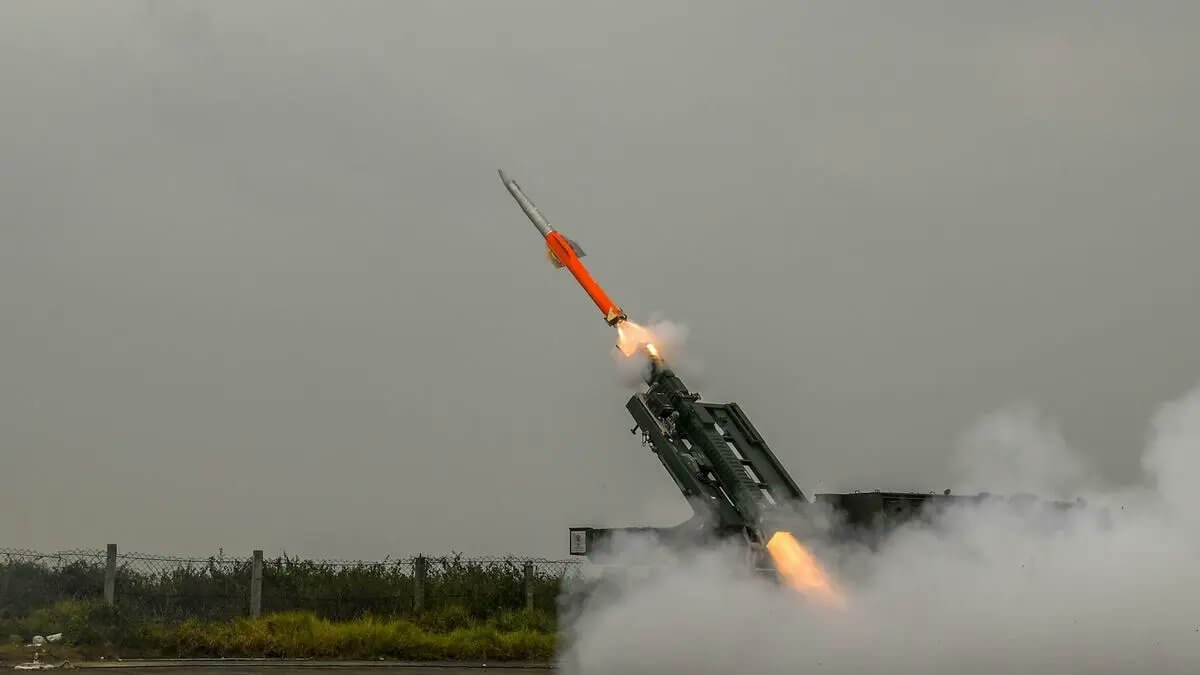
The list includes the Quick Reaction Surface-to-Air Missile system, capable of engaging multiple targets, as well as the Very Short Range Air Defence System, a shoulder-fired system designed to counter aerial threats at relatively short ranges.
In the naval segment, private-sector manufacturing is expected to cover different variants of Naval Anti-Ship Missiles, including short-range helicopter-launched systems and longer-range land- or ship-launched weapons.
A Long Range Anti-Ship Missile is also under consideration, although a private production partner for the system is yet to be identified.
Building A Larger Defence Manufacturing Ecosystem
The government’s decision comes as India seeks to expand domestic defence production and develop a stronger network of private manufacturers and ancillary suppliers.
Private companies are already involved in manufacturing several missile subsystems and components. According to the information provided, around 50 subsystems used in missile integration are currently being supplied by private-sector companies.
Greater participation from private manufacturers could allow production to be scaled up while creating opportunities for smaller companies involved in components, electronics, propulsion, engineering and other defence-related technologies.
Boost For Aatmanirbhar Bharat
The opening of conventional missile production to private companies is being viewed as another step towards strengthening Aatmanirbhar Bharat in defence.
The government expects greater private-sector involvement to increase production capacity, encourage investment in defence technology and expand India’s military-industrial ecosystem.
The development could also intensify competition between public-sector defence companies and private manufacturers, potentially improving manufacturing efficiency and accelerating the delivery of indigenous systems to India’s armed forces.