
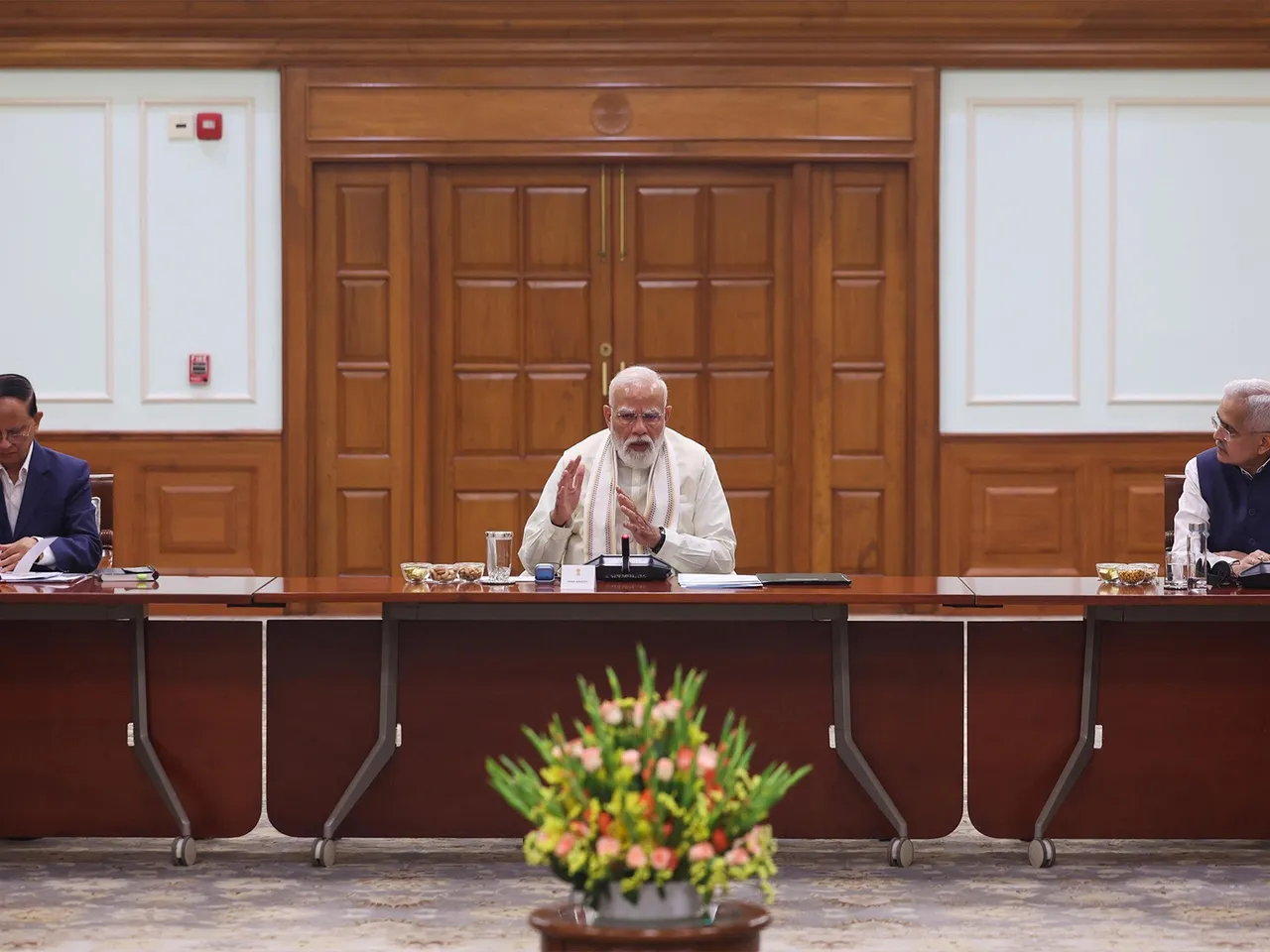
Prime Minister Narendra Modi on Saturday chaired a high-level meeting of the Prime Minister’s Economic Advisory Council (PM-EAC), focusing on strategies to sustain India’s growth momentum and strengthen economic resilience amid ongoing geopolitical tensions and global economic uncertainty.
The meeting brought together leading economists and policy experts to deliberate on measures aimed at accelerating economic growth, improving investment climate, enhancing ease of living, and strengthening India’s position as one of the world’s fastest-growing major economies.
Focus on Economic Growth Amid Global Challenges
During the meeting, Prime Minister Modi and members of the Economic Advisory Council discussed the evolving global economic landscape, including the impact of geopolitical conflicts, trade disruptions, energy price volatility, and supply-chain challenges.
Special emphasis was laid on identifying policy interventions that could help India maintain strong growth despite external headwinds. The Council members shared their assessments on the potential implications of the ongoing West Asia conflict on global markets, crude oil prices, trade flows, and overall economic stability.
The discussions also explored ways to further boost domestic demand, encourage investment, strengthen manufacturing, and expand employment opportunities across sectors.
Ease of Living and Ease of Doing Business Reforms
A significant portion of the meeting focused on reforms aimed at improving the ease of living for citizens and ease of doing business for industries and entrepreneurs.
The government continues to prioritize administrative simplification, digital governance, faster approvals, reduced compliance burden, and improved service delivery mechanisms. Experts discussed ways to make government services more accessible and efficient while creating a more business-friendly ecosystem to attract domestic and foreign investment.
The Council also examined measures to enhance productivity, encourage innovation, and support emerging sectors that can contribute significantly to India’s long-term economic growth.
PM Modi’s Appeal for Economic Resilience
The meeting comes shortly after Prime Minister Modi made a series of appeals encouraging citizens to contribute towards India’s economic resilience in light of global uncertainties arising from the West Asia conflict.
Highlighting the importance of reducing dependence on imported fuels and conserving resources, the Prime Minister urged citizens to adopt sustainable lifestyle practices and support domestic production.
Among the key suggestions made by the Prime Minister were:
- Reducing petrol and diesel consumption.
- Increasing the use of public transport and metro services.
- Promoting carpooling wherever possible.
- Encouraging railway-based freight transportation.
- Adopting electric vehicles.
- Supporting Swadeshi products and local manufacturing.
- Reducing dependence on imported goods.
- Encouraging natural farming practices.
- Limiting unnecessary foreign travel.
- Promoting responsible consumption of resources.
These measures are aimed at reducing India’s vulnerability to external economic shocks while strengthening self-reliance and sustainability.
India’s Economy Continues to Outperform Expectations
The Economic Advisory Council meeting coincides with encouraging economic data released recently, indicating strong momentum in the Indian economy.
According to official estimates released on June 5, India’s real Gross Domestic Product (GDP) grew by 7.8 percent year-on-year during the fourth quarter of FY 2025-26, surpassing market expectations.
For the full financial year 2025-26, India’s economy is estimated to have grown by 7.7 percent, reaffirming its status as one of the fastest-growing major economies globally.
Key Economic Indicators
- Q4 FY26 Real GDP: ₹87.77 lakh crore
- Q4 GDP Growth: 7.8%
- Q4 Nominal GDP Growth: 9.1%
- FY26 Real GDP: ₹323.12 lakh crore
- FY26 GDP Growth: 7.7%
- FY26 Nominal GDP Growth: 8.9%
The figures highlight the resilience of the Indian economy despite challenging international conditions.
Secondary and Services Sectors Drive Growth
Economic data indicates that the secondary and tertiary sectors remained the primary engines of growth during FY26.
Sector-wise Growth Estimates (FY26)
- Secondary Sector: 8.8%
- Services (Tertiary) Sector: 9.3%
- Primary Sector: 3.2%
The manufacturing, construction, trade, transport, communication, and financial services segments contributed significantly to overall economic expansion.
Meanwhile, the primary sector, including agriculture and fisheries, continued to provide stability and support to rural economic activity.
Strong Growth in Gross Value Added (GVA)
Gross Value Added (GVA), a crucial indicator of economic performance, also recorded healthy expansion.
- Real GVA Growth (FY26): 7.9%
- Nominal GVA Growth (FY26): 9.1%
- Q4 Real GVA Growth: 7.9%
- Q4 Nominal GVA Growth: 9.9%
The strong GVA performance reflects broad-based growth across multiple sectors of the economy.
Outlook
With robust GDP growth, continued infrastructure investment, expanding manufacturing capabilities, and a strong focus on reforms, India remains well-positioned to navigate global economic challenges.
The deliberations of the Economic Advisory Council are expected to contribute to future policy decisions aimed at sustaining high growth, improving competitiveness, strengthening energy security, and ensuring long-term economic stability.
As global uncertainties continue to influence markets worldwide, the government’s emphasis on self-reliance, sustainable development, and economic resilience is likely to remain central to India’s growth strategy in the coming years.
Keywords: