
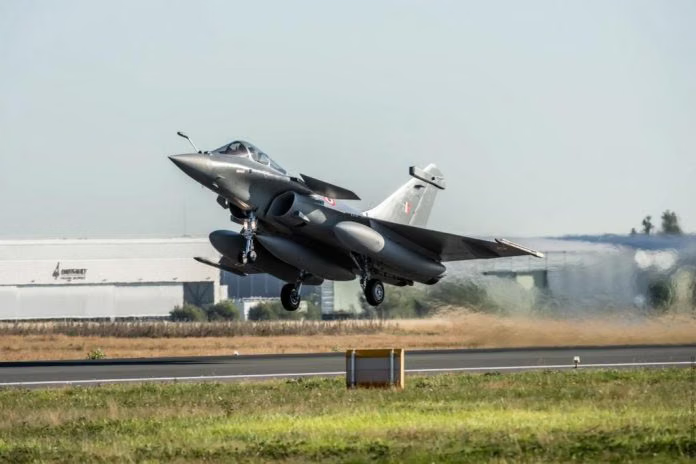
Indian Air Force Chief Air Chief Marshal Amar Preet Singh is on a four-day visit to France amid growing momentum around India’s proposed acquisition of 114 additional Dassault Rafale fighter jets. The proposed purchase is expected to be one of the largest fighter aircraft procurement programmes in the history of the Indian Air Force (IAF).
According to defence sources, India has already submitted an official proposal to the French government for the acquisition of the new Rafale fleet. France is expected to provide details related to pricing, production capacity, technology transfer, and logistics support within the next two to three months, after which formal negotiations are likely to begin.
Strategic Importance of the France Visit
The visit of Air Chief Marshal Amar Preet Singh is being viewed as strategically significant rather than merely ceremonial.
During the trip, he is expected to hold discussions with senior officials of major French defence firms, including Dassault Aviation, the manufacturer of the Rafale fighter jet, and MBDA, which produces advanced weapon systems such as the Meteor beyond-visual-range missile and SCALP cruise missile.
Discussions are expected to focus not only on aircraft procurement but also on technology transfer, local manufacturing, industrial partnerships, and the integration of Indian-made weapons and systems into future Rafale platforms.
Prime Minister’s Possible France Visit
Sources indicate that Narendra Modi may also visit France in mid-June. If the visit materialises, defence cooperation and the Rafale procurement programme are expected to feature prominently in bilateral discussions.
The deal is being pursued through a Government-to-Government framework, making high-level political engagement a crucial component of the negotiation process.
Why the Indian Air Force Needs More Fighters
The Indian Air Force currently faces a significant shortage in its fighter fleet.
While the sanctioned strength of the IAF stands at 42 fighter squadrons, the force currently operates only around 29 squadrons. The gap has widened over the years following the retirement of aging aircraft such as the Mikoyan MiG-21.
To address this shortfall and strengthen combat readiness, the Air Force has initiated plans to induct 114 new multirole fighter aircraft. The Rafale is widely regarded as the leading contender for the requirement, especially given its successful integration into the IAF.
Majority of Aircraft May Be Built in India
One of the most significant aspects of the proposed deal is the emphasis on domestic manufacturing.
Defence sources suggest that up to 94 of the 114 aircraft could be produced in India, with only the remaining jets being delivered directly from France. To facilitate this, Dassault Aviation is expected to partner with an Indian company for local production.
The Defence Ministry is reportedly targeting approximately 50 percent localisation under the project. This could involve the incorporation of Indian-made systems, components, and weapon platforms, providing a major boost to the government’s Make in India and Atmanirbhar Bharat initiatives.
Existing Rafale Fleet Provides Advantage
India’s partnership with France on Rafale fighters began with the 2016 agreement for 36 aircraft. All 36 jets have since been delivered and are operational with the Indian Air Force.
The aircraft are currently deployed at air bases in Ambala and Hasimara, where infrastructure, maintenance facilities, and trained personnel are already in place. Defence experts believe this existing ecosystem will simplify the induction of additional Rafale squadrons.
India Could Operate 176 Rafale Jets
The Indian Air Force currently operates 36 Rafale aircraft. In addition, India has already signed a contract for 26 carrier-based Rafale M fighter jets for the Indian Navy.
If the proposed acquisition of 114 additional Rafales is approved, India’s total Rafale fleet would rise to 176 aircraft.
Such a fleet would significantly enhance India’s air combat capabilities, strengthen deterrence, and improve operational readiness across both the western and northern fronts.