
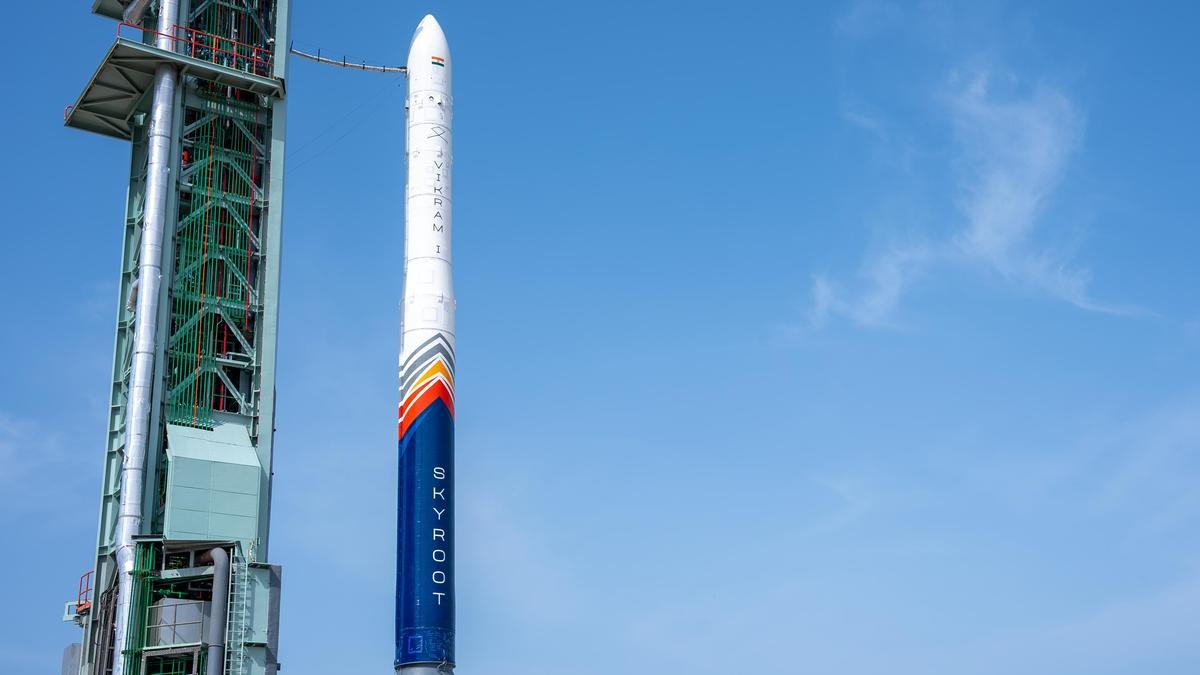
Sriharikota: India achieved a historic milestone in its space journey on Saturday as Vikram-1, the country’s first privately developed orbital-class rocket, successfully lifted off from the Satish Dhawan Space Centre (SDSC), Sriharikota, and placed multiple payloads into Low Earth Orbit (LEO). The landmark mission marks the first time an Indian private company has successfully launched satellites into orbit, ushering in a new era for India’s commercial space sector.
Developed by Hyderabad-based Skyroot Aerospace, the mission, named Mission Aagaman, represents a significant breakthrough for India’s growing private space ecosystem and strengthens the country’s ambitions of becoming a global commercial launch hub.
Historic Launch After Brief Planned Hold
The launch was originally scheduled for 11:30 am, but mission controllers introduced a planned hold just minutes before liftoff to complete final system checks. After ensuring all parameters were within the required limits, Vikram-1 successfully lifted off at 12:05 pm, beginning its maiden orbital mission.
The rocket completed all stages of flight successfully before injecting its payloads into an orbit of approximately 450 kilometres above Earth, confirming the success of India’s first privately developed orbital launch vehicle.
PM Modi Congratulates Skyroot Team
Following the successful mission, Prime Minister Narendra Modi personally spoke with Skyroot Aerospace founders Pawan Kumar Chandana and Naga Bharath Daka to congratulate them on the achievement, according to PTI.
Both founders, who are former ISRO scientists, witnessed the launch from the Mission Control Centre alongside ISRO Chairman V. Narayanan. Former ISRO chiefs, astronaut Shubhanshu Shukla, and Andhra Pradesh Minister Nara Lokesh were also present during the historic launch.
India Joins Elite Global Club
Announcing the success on social media platform X, Skyroot Aerospace wrote:
“ORBIT ACHIEVED. Vikram-1 Test Flight-1 has reached orbit. India’s first privately developed orbital rocket has completed its final burn and injected its payloads into a ~450 km orbit, making India the third country in the world with private orbital launch capability. History is made.”
In another post, the company celebrated the milestone by stating:
“Hello space, we have arrived! Vikram-1’s Test Flight-1 has completed its mission. The first ever Indian private sector launch has been successfully completed.”
The achievement places India among a select group of nations with successful private orbital launch capabilities, highlighting the rapid growth of the country’s commercial space industry following recent policy reforms.
Multiple Payloads Successfully Deployed
After reaching orbit, Vikram-1 successfully deployed several technology demonstration and commercial payloads into Low Earth Orbit.
Among the key payloads were:
- Solaras by Grahaa Space, a compact satellite designed to test advanced technologies in Low Earth Orbit.
- Embrace by Cosmoserve Space, featuring robotic arm technology intended for future space debris removal missions.
- SCOPE, Skyroot Aerospace’s in-house experimental satellite developed to validate technologies for upcoming missions.
- DCUBED’s German technology payloads—uD3PP and mD3RN—for in-orbit technology demonstrations.
The mission also carried several commemorative payloads, including a handwritten postcard from Prime Minister Narendra Modi bearing the message “Vande Mataram”, postcards from Indian scientists, engineers and astronauts, an 18-karat gold miniature rocket, and a unique micro-art installation.
The artwork featured miniature sculptures of Dr Vikram Sarabhai, Sir C.V. Raman, and Dr A.P.J. Abdul Kalam, paying tribute to three of India’s greatest scientific visionaries whose contributions laid the foundation for the nation’s space programme.
Mission Data To Power Future Commercial Launches
According to Skyroot Aerospace, valuable flight data collected during the maiden orbital mission will now be analysed to evaluate the performance of the rocket’s guidance, navigation and control systems.
The mission also successfully validated several indigenous technologies, including Vikram-1’s lightweight all-carbon composite structure and advanced 3D-printed rocket engines, both of which performed as expected under actual flight conditions.
The insights gained from Mission Aagaman will be used to refine future commercial launch vehicles and enhance the reliability of upcoming orbital missions.
A New Chapter For India’s Private Space Industry
The successful flight marks Skyroot Aerospace’s transition from suborbital to orbital launch capability. The company had earlier demonstrated its technological capabilities through the successful launch of Vikram-S, India’s first privately built suborbital rocket, in 2022.
With Vikram-1 now successfully placing payloads into orbit, Skyroot has demonstrated that Indian private companies are capable of developing world-class launch vehicles, opening new opportunities in the rapidly expanding global satellite launch market.
The achievement is expected to boost investor confidence, accelerate private participation in India’s space sector, and strengthen the country’s position as a leading destination for affordable commercial space launches.
As India’s private space ecosystem continues to grow alongside ISRO’s pioneering missions, the successful launch of Vikram-1 marks a defining moment in the nation’s journey towards becoming a major global space power.