

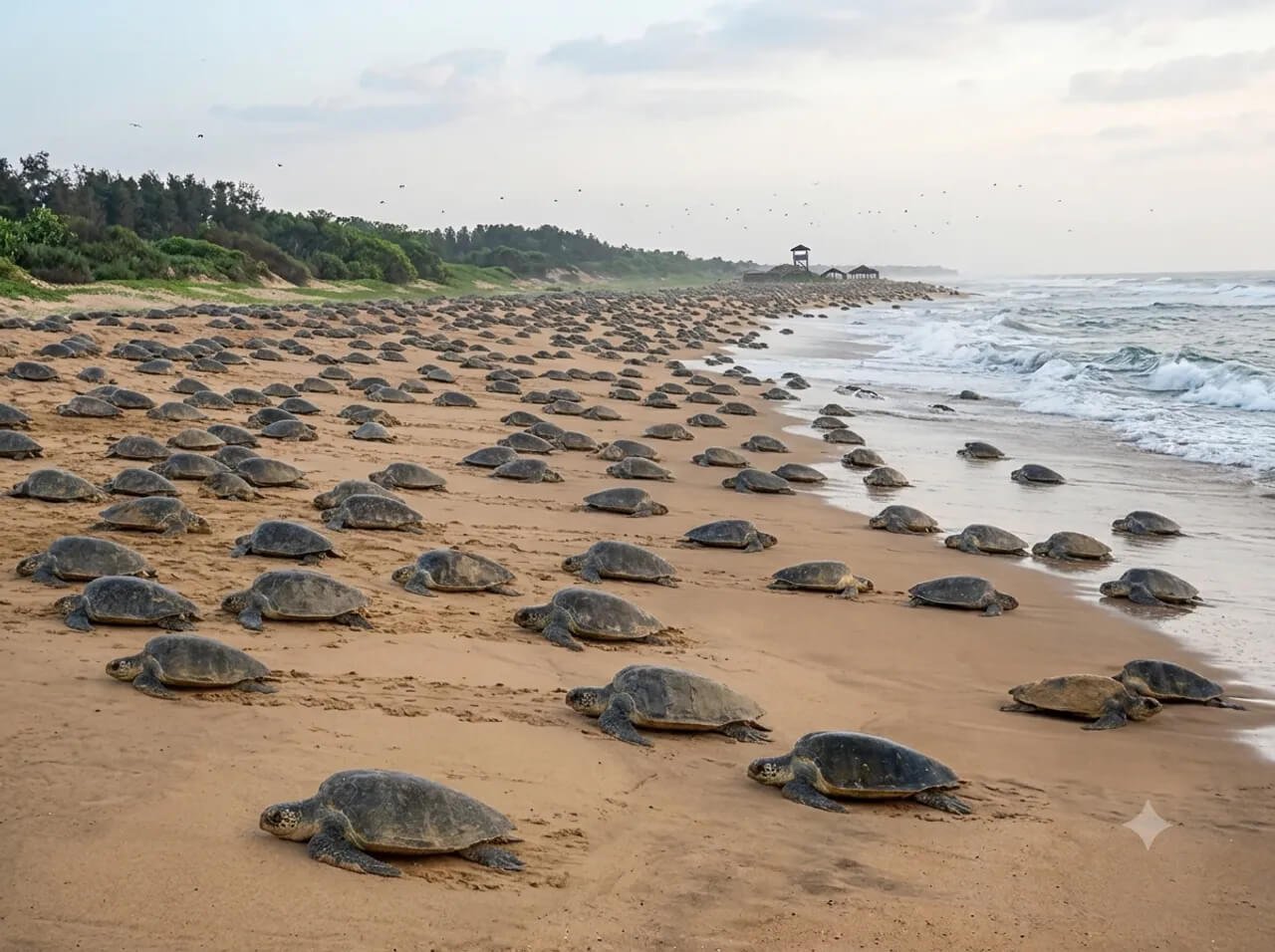
Berhampur: An international research centre dedicated to Olive Ridley sea turtles is planned at Berhampur University in Odisha’s Ganjam district, with the aim of expanding scientific understanding of the species’ migration, breeding and nesting behaviour.
The proposed facility is expected to strengthen research and conservation efforts by bringing together scientists, environmental researchers and academic institutions from India and abroad. The Forest Department, the Department of Environmental Science at Berhampur University and the Zoological Survey of India’s Gopalpur centre have jointly initiated efforts to establish the centre.
The initiative is expected to build on decades of research into Olive Ridley turtles, particularly their seasonal movements and mass nesting along Odisha’s coastline.
Rushikulya Coast: A Major Olive Ridley Nesting Site
The mouth of the Rushikulya River in Ganjam district is internationally known for the mass nesting of Olive Ridley sea turtles. Every year, these marine turtles travel long distances across the ocean before reaching sandy coastal stretches to lay their eggs.
After laying eggs, adult turtles return to the sea, leaving the eggs to incubate in the sand. Hatchlings generally emerge after around 45 to 60 days and instinctively make their way towards the ocean.
Despite years of scientific study, researchers are still working to understand several aspects of the turtles’ life cycle, including their migration routes, breeding behaviour and ability to return to particular nesting locations.
The proposed research centre is expected to provide an institutional platform for studying these questions in greater depth.
Satellite Tagging and Modern Technology to Support Research
Satellite tagging and other modern tracking technologies are already being used to monitor the movements of Olive Ridley turtles across the sea. Such methods can help researchers gather information about migration routes, movement patterns and the relationship between feeding areas and nesting beaches.
The planned centre could expand opportunities for research into the turtles’ annual journeys, breeding processes and nesting behaviour. By bringing together information collected through different studies, researchers may be able to develop a more comprehensive understanding of the species.
The findings could also help conservation authorities identify important habitats and assess how best to protect nesting beaches and marine environments.
International Collaboration to Strengthen Conservation
The proposed centre is expected to encourage collaboration among researchers from India and other countries who are interested in Olive Ridley sea turtles.
According to Sunny Khokhar, Divisional Forest Officer (DFO), Berhampur, Berhampur University, Khallikote University, the Zoological Survey of India and other research institutions will be involved in the project.
“Berhampur University, Khallikote University, the Zoological Survey of India and other research institutes and universities will be involved in this project. Researchers interested in studying Olive Ridley turtles can submit their research proposals to the centre,” Khokhar said.
The participation of multiple institutions is expected to create opportunities for researchers to share scientific findings, develop collaborative studies and explore new approaches to turtle conservation.
Three Decades of Research to Guide Future Studies
Professor Anjan Prusty of the Department of Environmental Science at Berhampur University said research conducted on Olive Ridley sea turtles over the past three decades would provide a foundation for future investigations.
“Research conducted on Olive Ridley sea turtles over the past three decades will form the basis for further studies. We will explore what more can be learned about the turtles, including whether they follow mass or periodic nesting patterns, their arrival patterns and the quality of their habitats,” Prusty said.
Researchers will seek to examine nesting trends, the timing of turtle arrivals and the condition of habitats used by the species. These areas of study could help improve understanding of the factors influencing nesting behaviour and the turtles’ use of coastal environments.
Building on earlier research may also help identify unanswered questions and guide future scientific projects.
Conservation Benefits for Odisha’s Coastline
Olive Ridley turtles are an important part of Odisha’s marine biodiversity, and their mass nesting events attract scientific interest from around the world. Protecting the species requires a better understanding of its behaviour, migration and dependence on suitable nesting habitats.
The proposed research centre could help bridge the gap between scientific research and conservation planning by generating information that can support future protection measures.
Environmentalists have welcomed the initiative as an opportunity to expand research on the species and strengthen cooperation between academic institutions and conservation agencies.
However, the timeline for the centre to become operational has not yet been announced. Further details about its infrastructure and research programmes are awaited.
Once established, the facility is expected to provide a platform for investigating the remaining questions surrounding Olive Ridley turtles’ migration, breeding and annual nesting patterns, while supporting long-term conservation efforts along Odisha’s coast.