
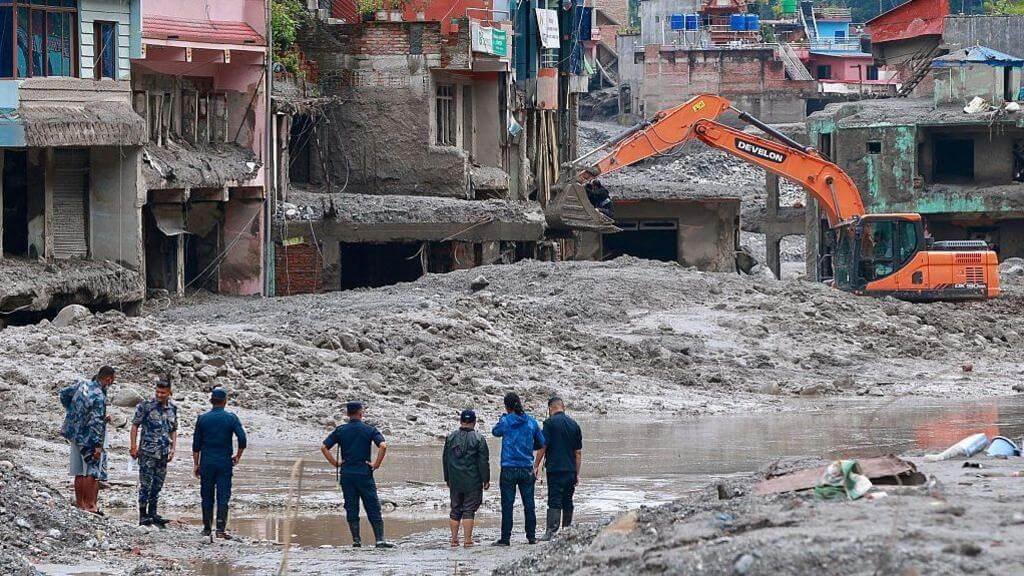
The death toll from the devastating flash floods that struck Nepal’s Rasuwa district and other parts of the country has climbed to 469, while 1,545 people have been rescued, Nepal Police said on Friday. The disaster has triggered large-scale rescue and relief operations, with hundreds of people still reported missing.
The catastrophic flooding occurred on August 26 near the Tibet-Nepal border, unleashing huge volumes of water, mud, sediment and boulders into the Bhote Koshi and Trishuli river systems. Several areas have suffered extensive damage to roads, bridges and other infrastructure.
Chitwan Records Highest Number Of Deaths
According to Nepal Police, Chitwan recorded the highest number of recovered bodies at 178. It was followed by NP East with 110 deaths, Gorkha with 44, Nuwakot with 37, Dhading with 33, Taplejung with 28, NP West with 27 and Rasuwa with 12.
Rescue teams have so far evacuated 644 people from Rasuwa, 898 from Nuwakot and three from Dhading.
The situation remains critical, with 28 police personnel still missing. The National Disaster Risk Reduction and Management Authority (NDRRMA) reported that 977 people were missing as of Thursday, highlighting the scale of the ongoing humanitarian emergency.
Thousands Deployed For Rescue Operations
Nepal Police has deployed 4,348 personnel to assist with search, rescue and relief operations in the affected regions. Emergency teams are continuing efforts to locate missing people and provide assistance to communities cut off by the floods.
The scale of destruction has made rescue operations particularly challenging, with damaged infrastructure and difficult terrain hampering access to several affected locations.
Nepal Government Announces Relief Assistance
The Government of Nepal has released NPR 25 million in emergency relief funds. Of this amount, NPR 10 million each has been allocated to Rasuwa and Nuwakot, while NPR 5 million has been earmarked for Dhading.
The authorities have also established mechanisms to coordinate humanitarian assistance, rescue operations and information sharing as the country deals with the aftermath of the disaster.
US, WHO Extend Support To Nepal
International assistance has also begun reaching Nepal. The United States has announced USD 500,000 in humanitarian assistance, while the World Health Organization (WHO) has dispatched emergency medical supplies to support relief efforts.
Nepal’s Ministry of Foreign Affairs has established an Emergency Control Room to coordinate search and rescue efforts, information verification and consular assistance for foreign nationals affected by the floods.
The control room will particularly assist foreign nationals who are missing, affected by the disaster or otherwise connected to the affected areas.
63 Indians Rescued, 288 Remain Uncontactable
India is also closely monitoring the situation, particularly because a large number of Indian nationals were working at the Trishuli-1 project in Nepal.
The Ministry of External Affairs said 63 Indian nationals have been rescued, while 288 others remain uncontactable. Efforts are continuing to establish contact and ascertain the safety of those still unreachable.
President Droupadi Murmu expressed solidarity with Nepal following the tragedy. Prime Minister Narendra Modi also spoke with Nepal Prime Minister Balendra Shah and assured him that India was ready to extend all possible humanitarian assistance.
Search For Missing Persons Continues
The flash floods have left Nepal facing a major humanitarian challenge, with a high number of deaths, missing persons and displaced communities. Rescue agencies are continuing operations while authorities work to assess the full extent of damage.
As search teams move into affected areas, the immediate priorities remain locating survivors, rescuing stranded people, providing medical assistance and restoring essential connectivity. The final scale of the disaster is expected to become clearer as rescue and recovery operations progress.