
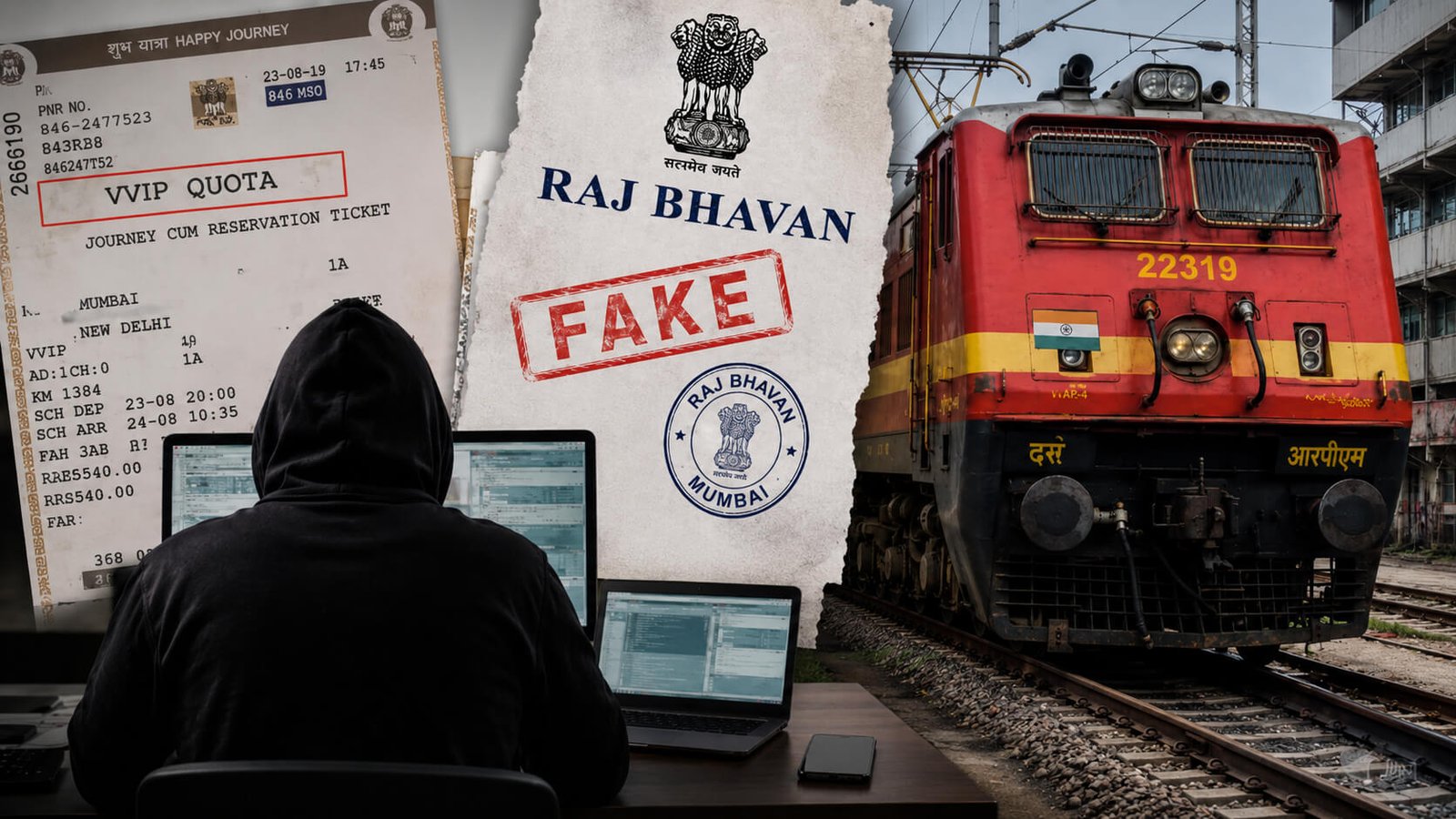
A sophisticated fake VVIP railway ticket racket, allegedly operating for nearly two years, has been uncovered after forged reservation requests were found carrying an outdated Raj Bhavan letterhead instead of the officially renamed Lok Bhavan, exposing an elaborate network that allegedly secured railway reservations through fabricated government documents.
The fraud came to light after railway authorities detected irregularities in VIP quota reservation requests, leading to a police investigation that resulted in multiple arrests and the seizure of forged documents, electronic devices and financial records.
Outdated Letterhead Triggered Suspicion
According to investigators, the alleged scam surfaced in February 2026 when Central Railway received two suspicious requests seeking reservations under the VVIP quota.
The requests were forwarded to Lok Bhavan for verification. During scrutiny, the Governor’s Aide-de-Camp (ADC) confirmed that the letterhead, official seal and signature used in the documents were forged.
Officials also noticed that the documents carried the old Raj Bhavan letterhead instead of Lok Bhavan, the official name adopted earlier, raising immediate suspicion and exposing the alleged fraud.
Following the verification, Lok Bhavan informed railway authorities, after which a complaint was lodged with the Malabar Hill Police, triggering a detailed investigation.
Businessman Allegedly Masterminded the Racket
According to police, the alleged mastermind has been identified as Amrish Thakkar, a garment businessman from Ghatkopar, Mumbai.
Investigators alleged that Thakkar initially obtained genuine VIP quota railway tickets after his business suffered losses during the COVID-19 pandemic.
However, when such requests were no longer entertained, he allegedly began using forged recommendation letters featuring fake government letterheads, fabricated signatures and counterfeit official seals to obtain reservations under the VVIP quota.
Police further alleged that Thakkar operated under the alias “Vimal” and even attempted to divert the investigation by providing information about another suspect, who was later identified as his own brother, Sagar Thakkar.
Arrests and Investigation
Police arrested Sagar Thakkar on July 27 during the investigation.
Officials said a photograph recovered from Sagar’s mobile phone enabled co-accused Vinay Rawat to identify Amrish Thakkar as the alleged mastermind behind the operation.
Amrish Thakkar was arrested on July 28, just before he was allegedly planning to flee.
So far, seven accused have been arrested in connection with the case and have been remanded to judicial custody while investigations continue.
Network Allegedly Spread Across Several States
Investigators claimed that the accused had established an extensive network of more than 200 agents operating across Mumbai, Gujarat and Uttar Pradesh.
Police alleged that the network coordinated its activities through Telegram, using fake identities, anonymous accounts and burner mobile numbers to avoid detection.
During the investigation, police recovered:
- A database containing details of more than 500 passengers who allegedly benefited from the fraudulent reservations.
- 12 mobile phones.
- 16 SIM cards.
- 70 debit and credit cards.
Officials also revealed that one key agent allegedly fled the country after learning about Thakkar’s arrest.
Forged Letterheads and Fake Seals Seized
As part of the investigation, police arrested Akash, an employee of a stationery shop in Fort, who is accused of supplying forged government letterheads for a monthly payment of ₹10,000.
During searches, investigators seized 10 fake government letterheads believed to have been used in the racket.
Police also served a notice to the owner of a Bora Bazaar shop allegedly involved in supplying counterfeit official seals used to prepare forged recommendation letters.
Investigation Continues
Police are continuing to investigate the wider conspiracy to determine the full extent of the racket and identify additional individuals who may have facilitated the fraudulent procurement of VVIP railway tickets.
Officials are also examining financial transactions, communication records and digital evidence recovered during the investigation to trace the complete network and establish whether similar forged documents were used in other parts of the country.
The case has highlighted the need for stronger verification mechanisms for VIP and VVIP quota reservations and tighter safeguards against the misuse of forged government documents.