

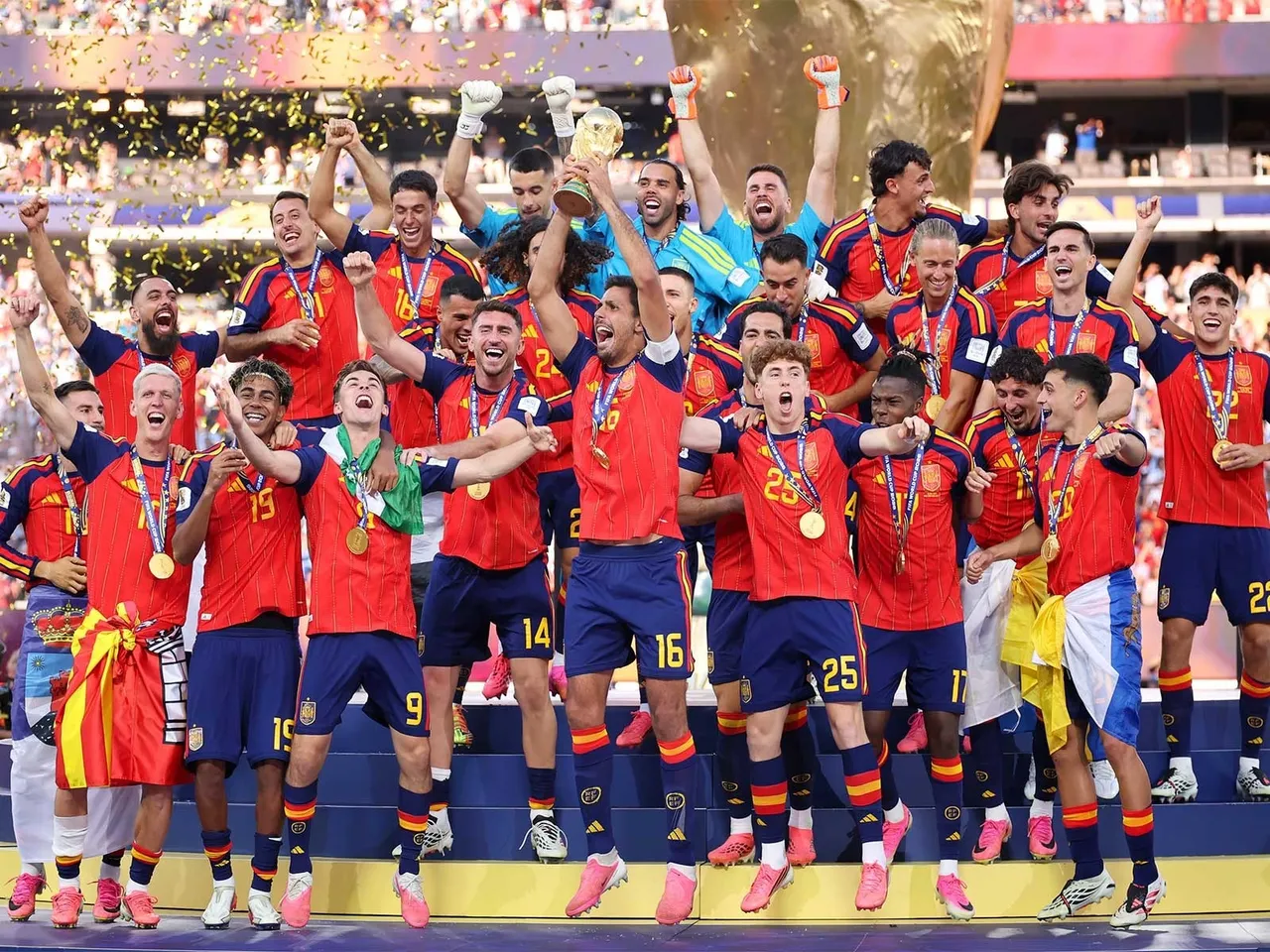
Spain were crowned FIFA World Cup 2026 champions after defeating defending champions Argentina 1-0 after extra time in a gripping final at the New York New Jersey Stadium, reclaiming football’s biggest prize for the first time since 2010. The victory ended Argentina’s title defence and completed a remarkable unbeaten campaign for La Roja, who conceded just one goal in eight matches throughout the tournament.
The tightly contested final remained goalless for 90 minutes before substitute Ferran Torres emerged as Spain’s match-winner. Introduced from the bench, Torres scored the decisive goal in the 106th minute, firing a powerful shot into the roof of the net beyond Argentine goalkeeper Emiliano Martinez to hand Spain their second FIFA World Cup title.
The triumph marks Spain’s first men’s World Cup crown since their historic victory in South Africa in 2010 and signals the arrival of a new golden generation led by teenage sensation Lamine Yamal. At just 19 years old, the Barcelona star lifted football’s biggest trophy, having been only three years old when Spain celebrated their maiden World Cup triumph 16 years ago.
End Of An Era For Lionel Messi And Argentina
The defeat brought an emotional end to Lionel Messi’s World Cup title defence. Argentina entered the tournament as reigning world champions after their memorable triumph in Qatar 2022, while Messi had also guided the Albiceleste to Copa America titles in 2021 and 2024.
Despite another determined campaign, Argentina fell just short in the final against a disciplined Spanish side that controlled large periods of the match. The loss is likely to be remembered as the closing chapter of one of the most successful eras in Argentine football.
Spain Dominate World Football Once Again
Having already won UEFA Euro 2024, Spain now hold both the European Championship and the FIFA World Cup, drawing comparisons with the country’s legendary golden era between 2008 and 2012, when they captured back-to-back European titles along with the 2010 World Cup.
Unlike many champion teams built around one superstar, Spain’s success in the 2026 tournament was driven by collective brilliance.
Although Lamine Yamal scored only once during the competition, his creativity and attacking threat remained crucial throughout the tournament. Midfield general Rodri once again dictated the tempo with composed performances, while Mikel Oyarzabal finished among the tournament’s leading scorers with five goals. Goalkeeper Unai Simon produced several match-winning saves during the knockout stages and was deservedly awarded the Golden Glove as the tournament’s best goalkeeper.
Ferran Torres Creates World Cup History
Torres’ winning goal also secured his place in FIFA World Cup history.
The Barcelona forward became only the fifth substitute ever to score in a FIFA World Cup final and the first since Germany’s Mario Gotze, whose famous extra-time strike defeated Argentina in the 2014 World Cup final.
He also became just the second Barcelona player to score in a men’s FIFA World Cup final after Andres Iniesta’s unforgettable extra-time winner against the Netherlands in 2010.
Spain’s Road To FIFA World Cup Glory
Spain’s title-winning campaign showcased consistency, defensive discipline and tactical superiority from start to finish.
Their journey began with a 0-0 draw against Cape Verde before registering victories over Saudi Arabia (4-0) and Uruguay (1-0) to finish top of Group H.
In the knockout rounds, Spain defeated:
- Austria 3-0 (Round of 32)
- Portugal 1-0 (Round of 16)
- Belgium 2-1 (Quarterfinals)
- France 2-0 (Semifinals)
The final against Argentina proved to be their toughest challenge, but Spain once again displayed composure under pressure to secure the trophy.
Spain Dominate The Final
Spain controlled possession for most of the final and created the better scoring opportunities throughout the contest.
They registered 12 shots, including several dangerous chances, while restricting Argentina to just one shot on target. The balance shifted further in Spain’s favour during extra time when Argentine midfielder Enzo Fernandez was sent off after receiving his second yellow card.
With Argentina reduced to ten men, Spain capitalised on the numerical advantage, and Ferran Torres’ extra-time strike proved enough to seal a famous victory. The Spanish defence then held firm during the closing stages to secure a memorable 1-0 win and lift the FIFA World Cup trophy.
Spain’s triumph not only restored them to the summit of world football but also announced the emergence of a new generation capable of dominating the international game for years to come.