
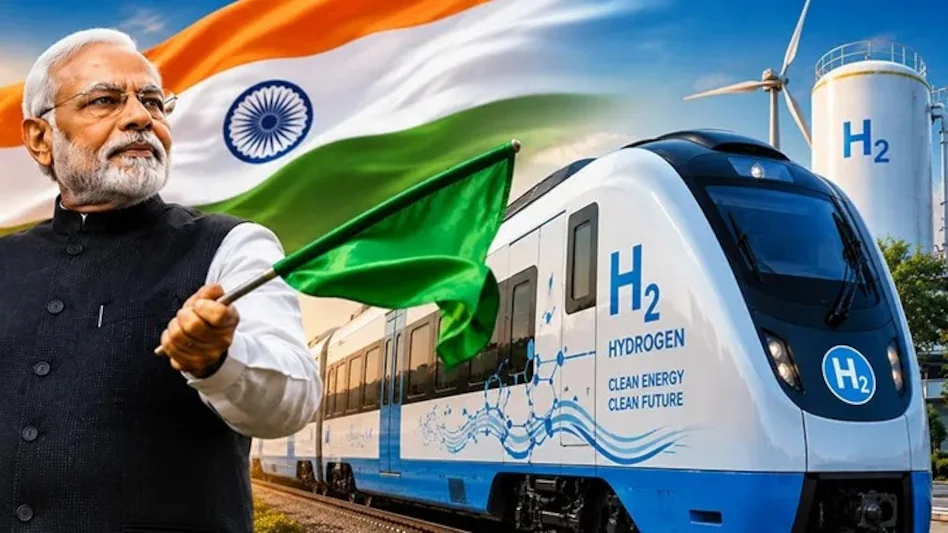
Prime Minister Narendra Modi on Tuesday flagged off India’s first hydrogen-powered train between Jind and Sonipat at Jind railway station in Haryana, marking a significant milestone in the country’s push towards clean energy, green mobility, and sustainable railway transportation.
The launch places India among a select group of nations—including Germany, Japan, China, and the United States—that operate hydrogen-powered trains, highlighting the country’s growing capabilities in advanced railway technology and indigenous innovation.
Major Step Towards Green Rail Transport
The hydrogen-powered train has been designed, engineered and integrated entirely in India using indigenous technology. Powered by hydrogen fuel cell technology, the train converts hydrogen into electricity to propel the engine, producing only water vapour as a by-product and generating zero carbon emissions during operation.
The train will initially operate on the 89-kilometre Jind-Sonipat section, with an operational speed of 75 kmph and a design speed of 110 kmph. Unlike hydrogen trains operating in several other countries, which generally have only two or three coaches, the Indian version has been configured as a 10-coach passenger train capable of carrying around 2,600 passengers, making it one of the longest and most powerful hydrogen-powered trains in the world.
To ensure passenger safety, the train has been equipped with advanced multi-layer safety systems capable of detecting hydrogen leaks, heat, smoke and flames. A dedicated hydrogen production and refuelling facility has also been established at Jind to support safe and reliable operations.
PM Modi Highlights Railway Transformation
Addressing the gathering, Prime Minister Modi said the launch of the country’s first hydrogen train has given Jind a special place in India’s railway history.
He stated that Indian Railways has undergone a massive transformation over the past twelve years and emphasised that hydrogen technology represents the future of rail transport.
The Prime Minister said the hydrogen train has begun operations on the Jind-Sonipat route and will be expanded further in the coming years. He also noted that only a handful of countries currently possess the capability to operate hydrogen-powered trains, making India’s achievement particularly significant.
National Highway Projects Worth ₹12,470 Crore
During the event, the Prime Minister also dedicated and laid the foundation stone for National Highway projects worth over ₹12,470 crore in Haryana.
Among the major projects inaugurated was the 157-kilometre Delhi-Amritsar-Katra Expressway Greenfield Corridor, part of the larger 667-kilometre Delhi-Amritsar-Katra Expressway.
The new expressway is expected to reduce travel time:
- Delhi to Katra: From nearly 14 hours to around 6 hours.
- Delhi to Amritsar: From about 8 hours to nearly 4 hours.
The project is expected to significantly improve regional connectivity, logistics and economic development across northern India.
Railway Minister Calls It Historic Achievement
Union Railway Minister Ashwini Vaishnaw described the launch as a historic achievement in India’s technological journey and a major step towards achieving environmentally sustainable transportation.
He said the hydrogen train is completely environment-friendly as it does not require diesel or petrol and reflects India’s determination to develop indigenous hydrogen technology.
Highlighting the government’s investments in Haryana’s railway infrastructure, Vaishnaw said the state’s railway budget has increased from ₹315 crore in earlier years to around ₹3,500 crore, while railway projects worth nearly ₹18,000 crore are currently under implementation across the state.
India Joins Global Hydrogen Train Network
With the successful launch of the Jind-Sonipat Hydrogen Train, India has entered the league of countries operating hydrogen-powered railway services.
Indian Railways is also exploring the use of hydrogen technology on heritage railway routes, including the Kalka-Shimla Railway, by leveraging the experience gained from the Jind-Sonipat project.
The launch marks a major milestone in India’s efforts to modernise its railway network, reduce carbon emissions, promote clean energy, and strengthen its position as a global leader in sustainable transportation and indigenous railway innovation.