
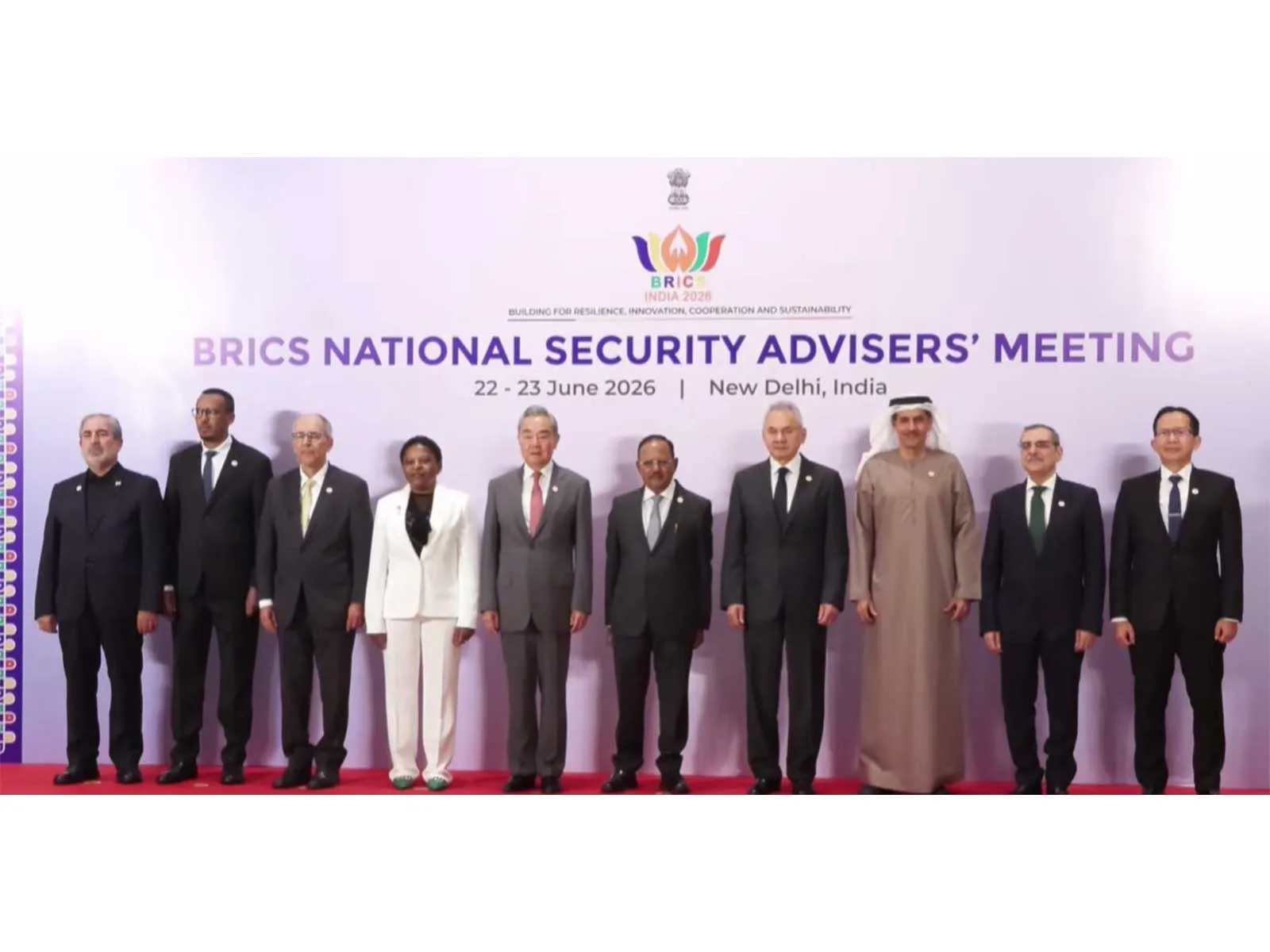
National Security Advisor (NSA) Ajit Doval on Tuesday welcomed representatives from BRICS member and partner countries at the 16th BRICS National Security Advisers’ Meeting, highlighting the growing importance of the bloc amid rising global geopolitical and security challenges.
The meeting brought together senior security and diplomatic officials from the 11-member BRICS grouping, which includes Brazil, Russia, India, China, South Africa, Egypt, Ethiopia, Iran, Saudi Arabia, the United Arab Emirates, and Indonesia.
Among the prominent participants were Russian Security Council Secretary Sergey Shoigu, Chinese Foreign Minister Wang Yi, South Africa’s Minister in the Presidency Khumbudzo Ntshavheni, UAE Supreme Council for National Security Secretary-General Ali Mohammed Hammad Al Shamsi, Egypt’s State Information Service chief Alaa Youssef, and senior representatives from Iran, Ethiopia, Indonesia, and Brazil.
Ajit Doval Calls BRICS a Special Coalition
Addressing the gathering, NSA Ajit Doval described BRICS as a “very special coalition” committed to peace, development, cooperation, and progress. He noted that the bloc has evolved significantly from an economic grouping into an influential platform shaping discussions on global governance and international security.
Doval expressed satisfaction over the expanding influence of BRICS and said the member nations have an increasingly important role in addressing global challenges and strengthening the voice of the Global South.
Concerns Over Global Security and Multilateralism
Highlighting the current international environment, Doval said the world is facing multiple crises, including military conflicts, geopolitical instability, economic pressures, and rapid technological disruptions.
He observed that security threats are becoming more complex while existing international institutions and mechanisms are often struggling to effectively manage or resolve these challenges.
“The world is facing geopolitical uncertainties, economic strains, and disruptive technologies. Threats are multiplying, and traditional institutional mechanisms are increasingly proving inadequate to address these emerging challenges,” Doval said.
He also expressed concern over the decline of multilateralism and stressed the need for greater cooperation among emerging economies to maintain global stability.
BRICS and the Global South
Doval recalled that BRICS was originally formed to promote economic cooperation among emerging economies and provide a stronger voice to developing nations in global decision-making.
According to him, the grouping continues to advocate reforms in global governance institutions while encouraging a more balanced and multipolar world order.
He emphasised that BRICS remains committed to institutional reforms, economic cooperation, sustainable development, and collective action on global issues.
India’s BRICS Chairship in 2026
India currently holds the BRICS Chairship for 2026, marking the fourth time the country has led the grouping after previous chairships in 2012, 2016, and 2021.
The 2026 Chairship is guided by the theme:
“Building for Resilience, Innovation, Cooperation and Sustainability”
The theme reflects India’s focus on strengthening international cooperation, promoting sustainable growth, encouraging innovation, and building resilient institutions capable of addressing future global challenges.
Growing Influence of BRICS
With its expanded membership, BRICS now represents a significant share of the global population, economic output, and energy resources. The bloc continues to gain prominence as emerging economies seek a greater role in shaping international policies and governance structures.
The meeting concluded with participating dignitaries taking part in a group photograph, reaffirming the commitment of BRICS nations to deeper cooperation on security, economic development, and global governance reforms.