

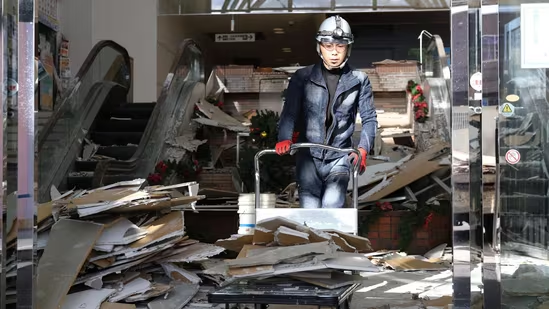
Northern Japan was jolted late Monday night by a strong 7.5-magnitude earthquake, triggering tsunami waves and injuring at least 23 people, according to authorities. The Japan Meteorological Agency (JMA) reported that the quake struck at around 11:15 p.m. local time, with its epicenter located nearly 80 km off the coast of Aomori Prefecture in the Pacific Ocean.
Tsunami of Up to 70 cm Recorded
The earthquake generated tsunami waves measuring 70 centimeters at Kuji port in Iwate Prefecture, while waves of around 50 centimeters hit other coastal areas. The JMA had initially warned of possible surges up to 3 meters, but later downgraded the warning to a tsunami advisory. Officials have urged residents to remain cautious.
The agency also adjusted the quake’s magnitude from an earlier estimate of 7.6 to 7.5, while warning of the possibility of a stronger magnitude 8 earthquake and additional tsunamis in the coming days.
Injuries and Damage Across Northern Regions
Japan’s Fire and Disaster Management Agency confirmed that 23 people were injured, including one seriously. NHK reported that most injuries resulted from falling objects during the intense shaking.
Among the incidents:
-
Several guests were injured at a hotel in Hachinohe.
-
A man in the Tohoku region sustained minor injuries after his car plunged into a hole formed during the quake.
Authorities are continuing to assess the full extent of damage.
Transport Disruptions and Power Outages
Chief Cabinet Secretary Minoru Kihara said that around 800 households were left without power. Multiple train services, including Shinkansen bullet trains, were temporarily suspended in affected areas as safety inspections were initiated.
Travel disruptions also left around 200 passengers stranded overnight at the New Chitose Airport in Hokkaido.
Safety Checks at Nuclear Facilities
Japan’s Nuclear Regulation Authority revealed that around 450 liters of water spilled from a spent fuel cooling pool at the Rokkasho nuclear reprocessing plant in Aomori. However, officials confirmed that water levels remained stable and no safety threat was posed.
Defense Minister Shinjiro Koizumi confirmed that 480 residents took shelter at the Hachinohe Air Base. The Self-Defense Forces deployed 18 helicopters to survey the damage and assist with emergency response.
High Alert for Aftershocks and Stronger Quakes
The JMA issued a strong advisory regarding potential aftershocks in the coming days, cautioning that seismic activity could trigger additional tsunamis. Authorities noted an increased risk of a magnitude 8 earthquake along Japan’s northeastern coastline—from Chiba to Hokkaido.
Residents in 182 municipalities have been advised to review evacuation routes, update emergency kits, and stay alert for further announcements.
Japan, located in one of the world’s most active seismic zones, remains on heightened alert as officials continue damage assessment and safety inspections across the region.