
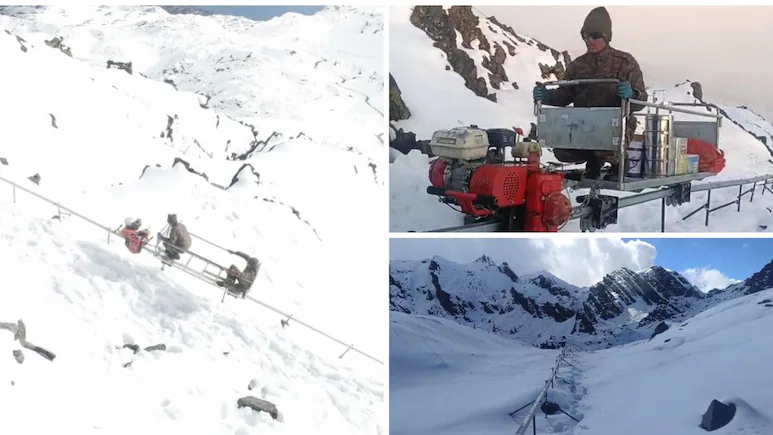
Arunachal Pradesh: In a significant boost to high-altitude logistics, the Indian Army’s Gajraj Corps has successfully operationalised an indigenously developed mono rail system at an altitude of 16,000 feet in the Kameng Himalayas. The breakthrough is being hailed as a major step toward ensuring uninterrupted supply lines to forward posts often cut off due to harsh terrain and extreme weather conditions.
Defence spokesperson Lt Col Mahendra Rawat said the innovative system was conceptualised, engineered, and deployed entirely within the Army to address one of the most challenging operational requirements in the region. Troops stationed in the remote Himalayan expanse frequently face supply disruptions caused by steep cliffs, heavy snowfall, and unpredictable weather.
Capable of Carrying Over 300 kg Per Trip
The newly introduced mono rail can transport more than 300 kg of load in a single run, making it a reliable logistical lifeline for posts with no access to traditional supply routes. According to Lt Col Rawat, the system allows smooth movement of mission-critical supplies such as ammunition, fuel, engineering tools, rations, and other heavy loads across dangerous gradients where vehicles, animals, and manual carriers fall short.
All-Weather, Round-the-Clock Operation
The system has been engineered to function day and night, both with or without escort, and continues to operate during hail, storms, and adverse weather. This ensures that high-altitude forward posts receive uninterrupted support regardless of climatic challenges.
Potential for Casualty Evacuation
Beyond logistics, the mono rail has also proven effective for rapid casualty evacuation, especially in areas where helicopter rescue is not possible due to terrain and where foot evacuation is slow and risky. The Army says this could significantly improve emergency response times in isolated sectors.
A Testament to Army Innovation
Lt Col Rawat described the project as a reflection of the ingenuity and adaptability of the Gajraj Corps. The in-house innovation not only boosts operational readiness but also strengthens sustainability in remote and inaccessible regions. The system underscores the Indian Army’s commitment to developing practical, mission-oriented solutions in some of the nation’s most challenging operational environments.