
New Delhi: Authorities on Thursday removed traffic bollards, barricades and other temporary structures placed outside the Pakistan High Commission in New Delhi, in a development that comes amid heightened diplomatic tensions between India and Pakistan.
The structures, which included traffic barriers and queue-management railings near the mission’s visa section, were reportedly positioned outside the designated perimeter of the diplomatic compound. Officials subsequently removed them from the lane outside the high commission.
The development comes three days after Pakistani authorities removed security barricades outside the Indian High Commission in Islamabad, in what has been viewed as a reciprocal move.
Structures Removed From Visa Section Area
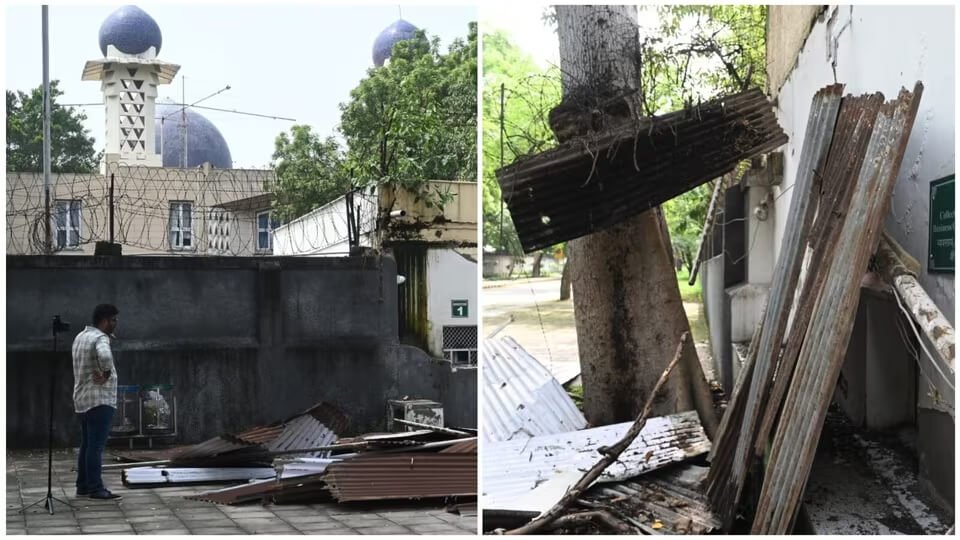
Visuals from outside the Pakistan High Commission showed dismantled railings, gates, metal frames, roofing sheets, bricks and pieces of concrete scattered across the area.
Sections of the outer fencing and roofing were also seen pulled down. The visa section remained visible, with signs directing visitors to different service windows, including those marked “Window 1,” “Pakistani Passport Only” and “Window-5 / Collection of Visa Applications.”
However, there has been no official confirmation that Thursday’s action was directly connected to the diplomatic dispute involving Pakistan and the United States over Jammu and Kashmir.
Authorities have not publicly provided a detailed explanation for the removal of the structures.
Development Follows Barricade Removal in Islamabad
The latest action comes shortly after Pakistani authorities dismantled security barricades outside the Indian High Commission in Islamabad.
The developments at the two diplomatic missions have added another layer to already sensitive India-Pakistan relations, although the exact reasons behind the latest action in New Delhi have not been officially stated.
Diplomatic Row Over US Envoy’s Kashmir Remarks
The removal of the structures comes against the backdrop of a fresh diplomatic disagreement involving Pakistan and the United States over Jammu and Kashmir.
US Ambassador to India Sergio Gor, who is also the US Special Envoy for South and Central Asia, visited Srinagar on Wednesday and described Jammu and Kashmir as an “important part of India” during his interaction with local media.
Gor made the remarks following his meeting with Jammu and Kashmir Chief Minister Omar Abdullah.
The comments triggered a strong reaction from Pakistan, which objected to the US diplomat’s description of Jammu and Kashmir.
Pakistan Summons US Charge d’Affaires
Following the remarks, Pakistan summoned US Charge d’Affaires Natalie Baker in Islamabad.
Pakistan’s Foreign Ministry said it conveyed a strong protest over Gor’s visit and comments, describing his remarks on Jammu and Kashmir as factually incorrect and rejecting the characterisation of the region as part of India.
Islamabad also argued that the comments did not align with what it described as the United States’ longstanding position on the Kashmir issue.
The United States has maintained that differences between India and Pakistan should be resolved through bilateral dialogue. India, meanwhile, has consistently opposed third-party involvement in matters concerning Jammu and Kashmir.
Gor Meets Omar Abdullah in Srinagar
Gor’s Srinagar visit was his first trip to the region in several years. During his meeting with Chief Minister Omar Abdullah, discussions reportedly covered broader India-US relations as well as issues concerning Jammu and Kashmir.
Abdullah said the two sides discussed what Washington could do in relation to Jammu and Kashmir, while also referring to longstanding issues that could be addressed through continued engagement.
The latest developments therefore come at a particularly sensitive time, with diplomatic activity involving India, Pakistan and the United States drawing renewed attention to the Kashmir issue.
For now, officials have not established any direct connection between the removal of structures outside the Pakistan High Commission in New Delhi and the ongoing diplomatic controversy.