

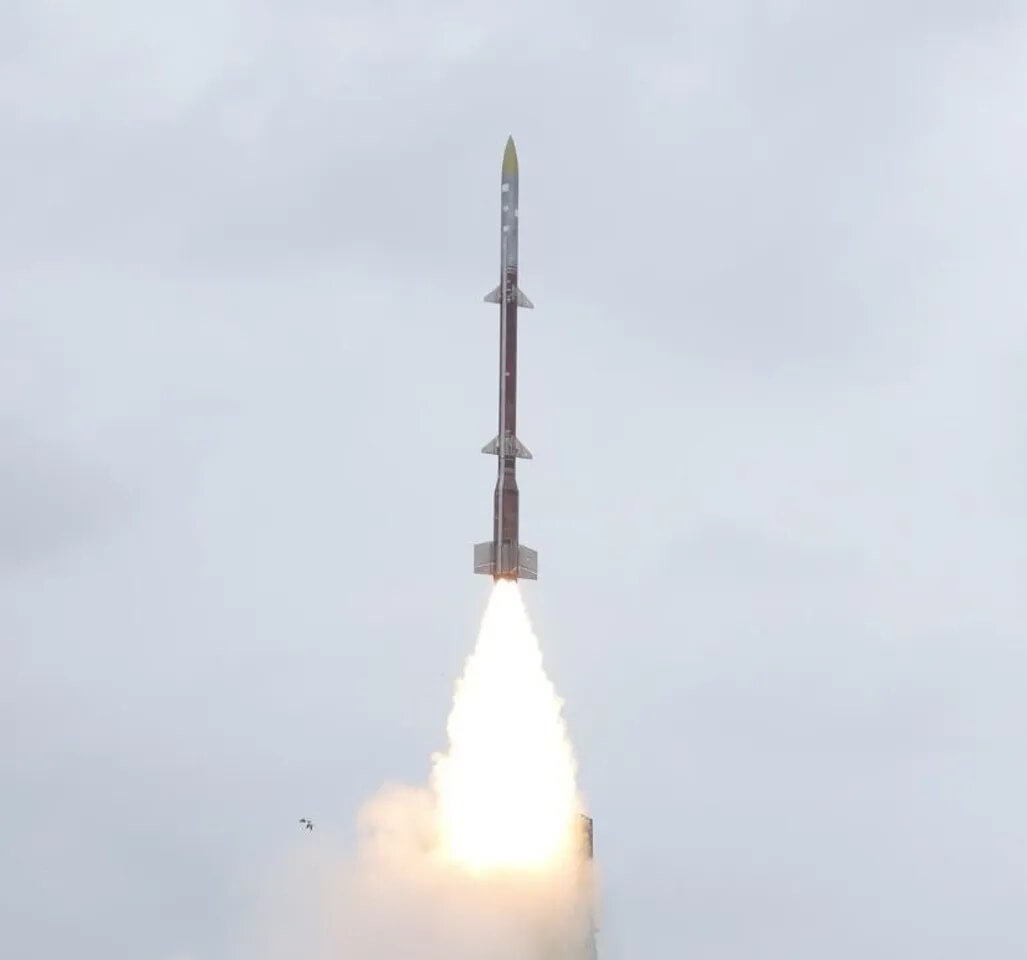
India has achieved a significant milestone in indigenous defence technology with the successful test-firing of the long-range surface-to-air missile (LR-SAM) system ‘Kusha’ from Dr APJ Abdul Kalam Island off the Odisha coast. The successful trial marks a major step forward in strengthening the country’s air defence network and advancing its self-reliance in strategic defence capabilities.
Developed under Project Kusha, the next-generation air defence system is designed to intercept and destroy a wide range of aerial threats, including fighter aircraft, cruise missiles, drones, ballistic targets and other high-value airborne military assets. Defence experts believe the system will play a crucial role in enhancing India’s multi-layered air defence architecture.
Major Boost To India’s Indigenous Defence Capability
The successful test demonstrates India’s growing expertise in developing sophisticated missile defence systems using indigenous technology.
The Kusha air defence system has been developed to provide long-range protection against multiple airborne threats while significantly reducing India’s dependence on imported defence equipment. It forms an important part of the country’s Atmanirbhar Bharat vision, which focuses on strengthening domestic defence manufacturing and technological innovation.
Officials said the successful trial validates the missile system’s performance and represents another major achievement for India’s indigenous defence research programme.
Three Variants With Ranges Up To 400 Kilometres
One of the key highlights of the Kusha programme is its multi-layered interceptor capability.
The air defence system is being developed with three variants of interceptor missiles, each designed for different engagement ranges. Together, they will be capable of neutralising aerial targets at distances ranging from 150 kilometres to 400 kilometres, providing extensive protection against both conventional and advanced airborne threats.
The system’s long operational range is expected to enable the Indian Armed Forces to detect, track and eliminate hostile targets well before they enter critical airspace.
Interceptors Capable Of Mach 5.5 Speed
The interceptor missiles developed under Project Kusha are capable of travelling at speeds of up to Mach 5.5, which is more than five times the speed of sound.
Such high-speed interception capabilities allow the system to respond rapidly to incoming threats, including fast-moving aircraft and cruise missiles, significantly improving India’s defensive readiness during potential aerial attacks.
Compared With World’s Leading Air Defence Systems
Defence analysts have drawn comparisons between the Kusha air defence system and some of the world’s most advanced missile defence platforms, including Russia’s S-400 Triumf and the United States’ Patriot missile system.
While Project Kusha is an indigenous programme tailored to India’s operational requirements, its long-range interception capability and advanced technology are expected to place it among the most sophisticated air defence systems developed by the country.
Rajnath Singh Congratulates DRDO
Following the successful test, Defence Minister Rajnath Singh congratulated the Defence Research and Development Organisation (DRDO) and all scientists associated with the project.
He described the successful trial as a landmark achievement that would significantly strengthen India’s defence preparedness and reinforce the country’s growing capabilities in indigenous defence technology.
Strengthening India’s Air Defence Network
Once fully inducted into the armed forces, the Kusha missile system is expected to become a critical component of India’s integrated air defence network.
The system will enhance the country’s ability to safeguard strategic installations, military bases and vital infrastructure from emerging aerial threats while reducing reliance on foreign defence platforms. It also represents another major milestone in India’s journey towards becoming a global leader in indigenous defence manufacturing and advanced military technology.