
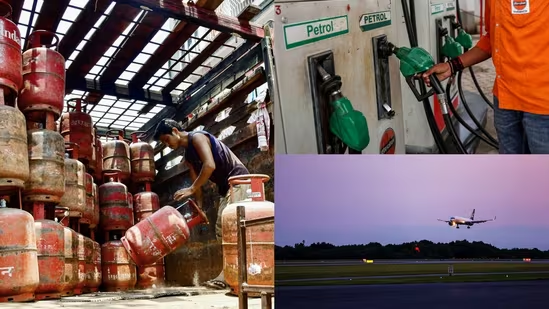
New Delhi: Consumers and businesses across India received significant relief on Wednesday as prices of commercial liquefied petroleum gas (LPG), petrol, diesel, and aviation turbine fuel (ATF) were reduced following a decline in global crude oil prices. The price cuts come as geopolitical tensions between the United States and Iran show signs of easing, improving confidence in global energy markets.
The reduction follows reports of positive diplomatic engagement between the two countries, with American negotiators Jared Kushner and Steve Witkoff holding discussions in Qatar. According to a senior Trump administration official quoted by Bloomberg, technical-level talks with Iran have been progressing positively, raising hopes of a lasting resolution to the conflict.
West Asia Tensions Had Triggered Global Energy Crisis
Global oil markets have remained volatile since late February after escalating tensions in West Asia disrupted energy supplies through the Strait of Hormuz, one of the world’s busiest oil transit routes.
The uncertainty pushed crude oil prices sharply higher, affecting fuel prices across several countries, including India. Rising international oil prices resulted in higher rates for commercial LPG, petrol, diesel, and aviation turbine fuel, increasing operational costs for businesses and transportation sectors.
With diplomatic efforts now showing progress and fears of supply disruptions easing, international crude prices have softened, paving the way for fuel price reductions.
Commercial LPG Price Reduced by ₹183.50
Oil marketing companies have reduced the price of 19-kg commercial LPG cylinders by ₹183.50, offering major relief to restaurants, hotels, caterers, and other commercial establishments.
Following the revision, a commercial LPG cylinder now costs ₹2,930 in New Delhi. The reduction comes after commercial LPG prices had climbed to a record high of ₹3,113 per cylinder last month.
Commercial LPG prices are revised on the first day of every month based on the average international benchmark prices during the previous month.
Commercial LPG prices (19-kg cylinder):
- New Delhi – ₹2,930
- Mumbai – ₹2,885.50
- Kolkata – ₹3,081.50
- Chennai – ₹3,106
- Bengaluru – ₹3,021
- Hyderabad – ₹3,191
Nayara Energy Cuts Petrol and Diesel Prices
Private fuel retailer Nayara Energy also announced a reduction in retail fuel prices across its nationwide network.
The company has cut petrol prices by ₹5 per litre and diesel prices by ₹3 per litre at more than 7,000 fuel stations across India.
The revised rates came into effect on Wednesday, although prices may differ from state to state depending on local taxes and value-added tax (VAT).
Public sector oil marketing companies, however, have not announced any change in petrol and diesel prices.
Notably, Nayara Energy had earlier become one of the first private retailers to increase fuel prices during the peak of the West Asia crisis.
Petrol and Diesel Prices Across Major Cities
Following the latest revisions, fuel prices at Nayara outlets in major cities are as follows:
- New Delhi: Petrol ₹102.12 | Diesel ₹95.20
- Mumbai: Petrol ₹111.21 | Diesel ₹97.83
- Kolkata: Petrol ₹113.51 | Diesel ₹99.82
- Chennai: Petrol ₹107.76 | Diesel ₹99.55
- Bengaluru: Petrol ₹111.68 | Diesel ₹99.56
- Hyderabad: Petrol ₹115.69 | Diesel ₹103.82
Aviation Turbine Fuel Also Becomes Cheaper
The aviation sector has also received relief with the price of aviation turbine fuel (ATF) being reduced by approximately ₹5 per litre.
According to industry sources, jet fuel now costs around ₹110 per litre in New Delhi.
This marks the first decline in ATF prices since the escalation of the West Asia conflict triggered a sharp increase in aviation fuel costs earlier this year.
At the height of the crisis, ATF prices in Delhi had surged dramatically before government intervention prompted oil marketing companies to moderate the increase for domestic airlines. The reduction is expected to ease operational expenses for airlines, particularly as passenger traffic continues to grow.
Strait of Hormuz Situation Improves
The improvement in fuel prices has largely been driven by easing tensions around the Strait of Hormuz, a critical global oil shipping route through which nearly one-fifth of the world’s oil supply passes.
Following the reported 14-point memorandum of understanding between the United States and Iran and recent diplomatic talks in Qatar, oil tanker movement through the region has shown signs of returning to normal.
The improved geopolitical outlook has also led to a decline in international crude oil prices.
On Wednesday, Brent crude was trading above $73 per barrel, while West Texas Intermediate (WTI) hovered near $70 per barrel, both significantly lower than levels seen during the peak of the crisis.
Experts Expect Oil Market to Stabilise
Market analysts believe that if diplomatic progress continues and energy shipments through the Strait of Hormuz fully normalise, global oil supplies could soon exceed demand.
Samantha Dart, Co-Head of Global Commodities Research at Goldman Sachs Group Inc., expressed optimism that the conflict-related disruptions could largely be resolved by the end of July.
She noted that once oil flows return to normal, the market could move into an oversupply phase, placing further downward pressure on crude prices.
Iran has also announced that it has exported more than 40 million barrels of oil since restrictions on its ports were eased, while Russian oil shipments have reportedly reached record levels, further contributing to increased global supply.
The latest decline in fuel prices is expected to benefit consumers, transport operators, the hospitality industry, airlines, and businesses that depend heavily on petroleum products, while also easing inflationary pressures linked to higher energy costs.