
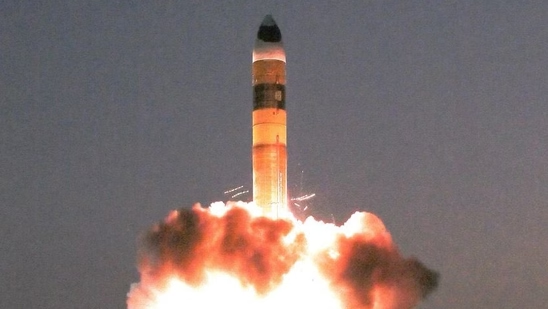
Chandipur, Odisha: In a major breakthrough for India’s indigenous defence programme, the Defence Research and Development Organisation (DRDO) successfully conducted a flight test of the Long Range Land Attack Cruise Missile (LRLACM) from Dr APJ Abdul Kalam Island off the Odisha coast on June 15. The successful trial marks a significant milestone in strengthening India’s long-range precision strike capabilities and enhancing its strategic deterrence posture.
The missile successfully met all mission objectives during the test, with its performance closely monitored through tracking systems deployed by the Integrated Test Range (ITR) at Chandipur. Defence officials described the trial as a major step forward in India’s efforts to develop advanced indigenous missile systems capable of addressing future security challenges.
Successor to the Nirbhay Programme
The LRLACM is widely regarded as the successor to the earlier Nirbhay cruise missile project, which faced several developmental challenges during its testing phase. Defence experts believe the latest missile incorporates major improvements in navigation, guidance, propulsion and mission reliability, helping overcome limitations encountered during previous programmes.
Developed entirely within India, the missile integrates technologies created by multiple DRDO laboratories and Indian industry partners. The Aeronautical Development Establishment (ADE), Bengaluru, serves as the nodal agency for the project.
Enhancing India’s Long-Range Strike Capability
Cruise missiles play a critical role in modern warfare due to their ability to fly at low altitudes, evade enemy radar networks and deliver precision strikes deep inside hostile territory. Unlike ballistic missiles that follow a predictable trajectory, cruise missiles travel close to the ground, making them difficult to detect and intercept.
Defence analysts believe the successful development of the LRLACM will provide India with an important stand-off weapon capable of targeting strategic assets, command centres, military infrastructure and high-value installations at long distances while minimizing risks to frontline forces.
The missile is expected to significantly strengthen India’s conventional deterrence capabilities, particularly in an increasingly complex regional security environment.
Multi-Platform Launch Capability
One of the key advantages of the LRLACM is its versatility. The missile has been designed for deployment from multiple platforms, including mobile ground launchers and frontline naval warships. This flexibility will allow the Indian Armed Forces to integrate the weapon across various operational scenarios.
The successful test was witnessed by senior DRDO officials as well as representatives from the Indian Navy and the Indian Air Force, highlighting the missile’s potential role in joint-force operations.
Indigenous Technology Push
The successful trial further strengthens India’s push towards defence self-reliance under the vision of Atmanirbhar Bharat. DRDO stated that all critical subsystems of the missile have been developed indigenously through collaboration between research laboratories and domestic industry partners.
Defence Minister Rajnath Singh congratulated the DRDO team and industry partners on the achievement, describing it as a major boost to India’s indigenous defence capabilities. Defence Secretary and DRDO Chairman Rajesh Kumar Singh also commended the scientists and engineers involved in the programme.
Road Ahead
The LRLACM programme is expected to undergo additional developmental and user trials before being inducted into the Indian Armed Forces. Once operational, the missile is likely to become a key component of India’s long-range conventional strike arsenal, complementing existing missile systems and enhancing the country’s ability to respond to evolving security threats.
The successful test underscores India’s growing expertise in advanced missile technologies and marks another important milestone in the country’s journey towards becoming a global leader in indigenous defence innovation.