
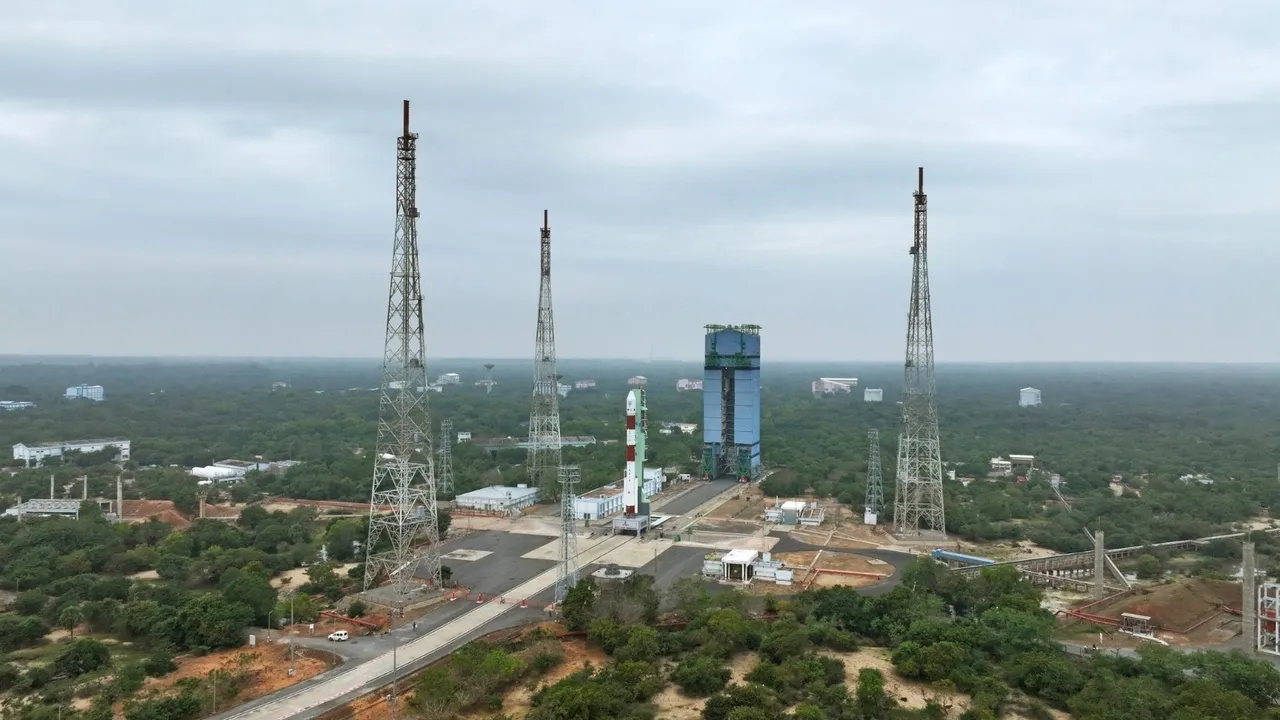
India formally kicked off its 2026 space mission calendar with the launch of PSLV-C62 from the Satish Dhawan Space Centre (SDSC), Sriharikota, at 10:18 am on Monday, January 12. The mission marked a crucial return for the Polar Satellite Launch Vehicle (PSLV) after its previous flight in 2025 was aborted due to a technical issue, reaffirming ISRO’s efforts to maintain launch momentum amid growing commercial and scientific commitments.
The 260-tonne PSLV-C62 rocket was tasked with placing the EOS-N1 Earth Observation Satellite, also known as Anvesha, into a polar sun-synchronous orbit a few hundred kilometers above Earth. The satellite is designed to enhance India’s Earth-observation capabilities, supporting applications such as environmental monitoring, disaster management, agriculture assessment and urban planning.
Countdown, Launch and Mission Profile
The mission countdown began at 12:48 pm on Sunday, spanning 22 hours and 30 minutes, with all pre-launch checks proceeding as scheduled. Along with EOS-N1, the PSLV carried 14 co-passenger satellites from domestic and international customers, arranged through NewSpace India Limited (NSIL), ISRO’s commercial arm. All satellites were planned to be deployed within 17 minutes of lift-off, demonstrating PSLV’s capability for precise multi-satellite deployment.
More than two hours after launch, ISRO scientists planned to restart the rocket’s fourth stage (PS4) to conduct an in-orbit de-boost and re-entry demonstration of the Kestrel Initial Technology Demonstrator, a 25-kg capsule developed by a Spanish startup. The capsule, along with the PS4 stage, was expected to splash down in the South Pacific Ocean, showcasing technologies relevant to orbital maneuvering and controlled re-entry.
Anomaly Detected During Flight
However, during the mission, ISRO detected an anomaly towards the end of the third-stage (PS3) burn. ISRO Chairman V. Narayanan confirmed that while the flight progressed normally until the latter phase of PS3, a disturbance was observed, followed by a deviation in the vehicle’s flight path.
In a statement posted on X, ISRO said it is analysing flight data in detail to understand the cause of the disturbance. “We are analysing the data and will share details at the earliest,” Narayanan said, adding that the four-stage PSLV, comprising two solid and two liquid stages, otherwise performed as expected during most phases of the mission.
Backbone of India’s Space Programme
PSLV-C62 was the 64th flight of the PSLV, a launch vehicle widely regarded as the backbone of India’s space programme. Over the years, PSLV has successfully launched landmark missions such as Chandrayaan-1, Mars Orbiter Mission (Mangalyaan) and Aditya-L1, earning global recognition for its reliability and cost-effectiveness.
The mission was also significant as the ninth dedicated commercial Earth-observation launch conducted by NSIL, highlighting India’s expanding footprint in the global space market.
Growing Private-Sector Participation
The launch underscored the increasing role of private Indian space startups. Hyderabad-based Dhruva Space contributed seven satellites, including four built in-house. Co-founder and CFO Chaitanya Dora Surapureddy said the satellites are designed for low data-rate communication and can be used by amateur radio operators, serving as a vital technology demonstration for future commercial applications.
Despite the anomaly, ISRO officials emphasised that the mission reflects India’s continued push toward advanced space technologies, commercial launches and international collaboration, with further details expected once the analysis is completed.