

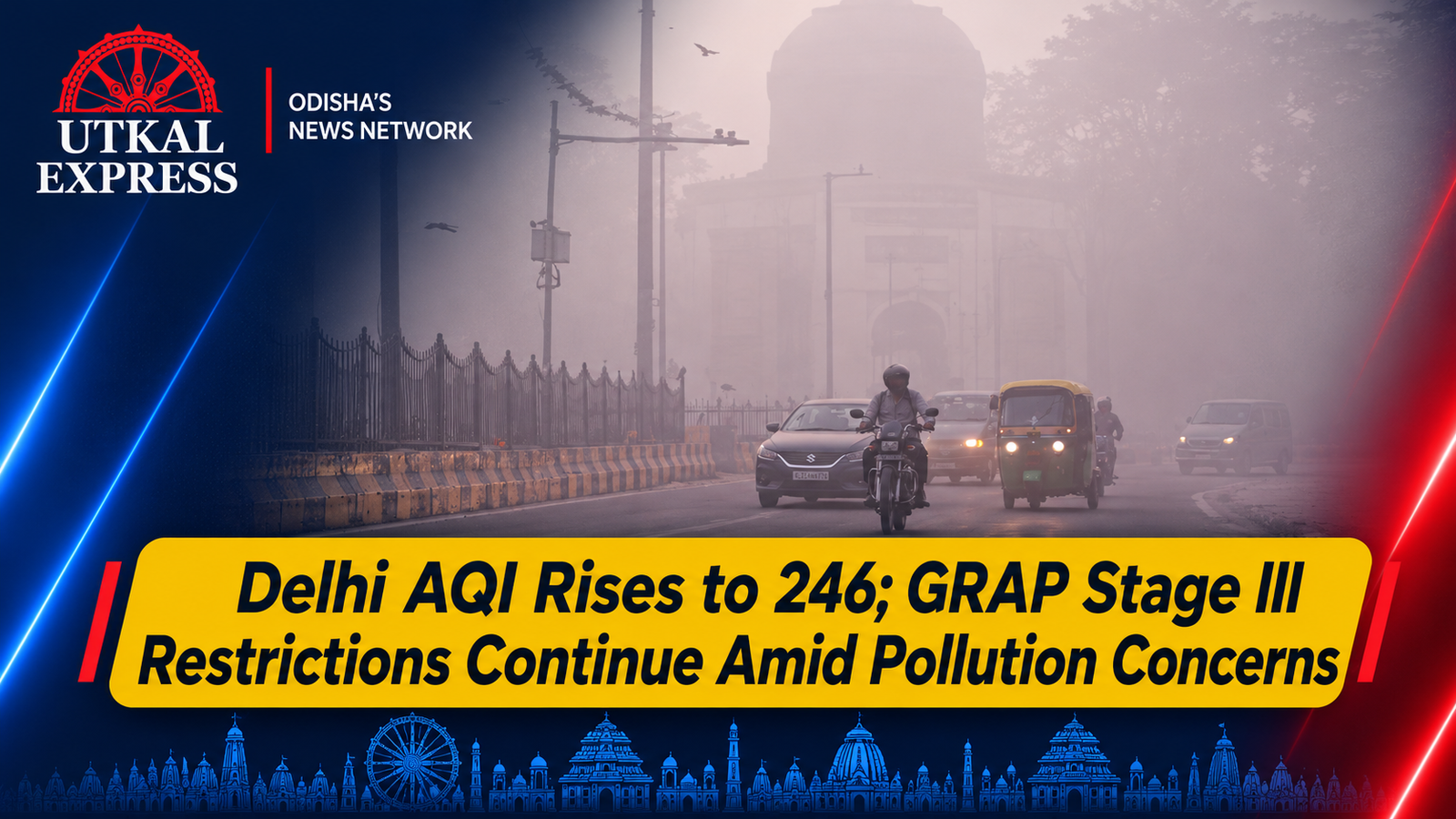
New Delhi: Delhi’s air quality remained in the ‘poor’ category on Tuesday morning, with the city-level Air Quality Index (AQI) rising to 246 at 7 am from 216 recorded on Monday, according to real-time data from the Central Pollution Control Board (CPCB). PM2.5 emerged as the prominent pollutant, highlighting the continued presence of fine particulate matter in the national capital’s air.
The latest readings indicate widespread pollution across Delhi, with 52 of the 58 monitoring stations recording AQI levels above 200. Eleven monitoring locations reported readings above 300, although none entered the ‘severe’ category.
Sirifort Records Delhi’s Highest AQI at 341
Among Delhi’s monitoring stations, Sirifort recorded the highest AQI at 341, placing it in the ‘very poor’ category. Commonwealth Sports Complex followed with 338, while NSUT Jaffarpur registered 336.
Other locations reporting high pollution levels included ITO at 335 and Talkatora Garden at 326. Pusa, monitored by the Indian Institute of Tropical Meteorology, recorded an AQI of 322, followed by Burari Crossing at 318, Chandni Chowk at 316 and Narela at 313.
On the other hand, the Cantonment Area recorded the lowest AQI in the capital at 151. The Delhi Pollution Control Committee’s Pusa monitoring station reported 165, while IMD Lodhi Road registered 182.
These locations remained in the ‘moderate’ category, reflecting considerable differences in air quality across various parts of the city.
Understanding the CPCB Air Quality Index Categories
According to the CPCB’s National Air Quality Index classification, air quality is divided into six categories based on AQI readings.
- Good: 0–50
- Satisfactory: 51–100
- Moderate: 101–200
- Poor: 201–300
- Very Poor: 301–400
- Severe: 401–500
With Delhi’s city-level AQI at 246, the capital remained in the ‘poor’ category on Tuesday morning. However, several individual monitoring stations recorded ‘very poor’ readings, indicating more serious pollution in specific neighbourhoods.
Air Pollution Remains Elevated Across Delhi-NCR
Pollution levels also remained high in several neighbouring cities across the National Capital Region (NCR), with locations in Haryana reporting some of the highest readings.
Sonipat recorded an AQI of 312, followed by Gurugram at 297 and Bhiwadi at 278. Bahadurgarh registered 247, while Manesar reported 241.
Among other NCR cities, Ghaziabad recorded an AQI of 191, Noida 187, Faridabad 184 and Greater Noida 174.
Sonipat, Gurugram, Bhiwadi, Bahadurgarh and Manesar remained in the ‘poor’ category, while Ghaziabad, Noida, Faridabad and Greater Noida were in the ‘moderate’ category.
Haryana Cities Lead National Pollution Readings
The national pollution data also showed elevated AQI levels in several cities, particularly in Haryana.
Among 280 cities with valid readings in the CPCB’s 7 am dataset, Ballabgarh in Haryana recorded the highest AQI at 344. Sonipat followed at 312, while Panchgaon registered 311.
Other cities reporting high pollution levels included Bikaner in Rajasthan at 305, Gurugram at 297, Khairthal in Rajasthan at 291 and Gajraula in Uttar Pradesh at 283.
In contrast, Sivasagar in Assam recorded the lowest AQI at 30, followed by Eloor in Kerala at 33 and Leh in Ladakh at 35. Naharlagun in Arunachal Pradesh also reported 35, while Srinagar in Jammu and Kashmir recorded 39. All these locations remained in the ‘good’ air quality category.
GRAP Stage III Restrictions Continue Across Delhi-NCR
Meanwhile, Stage III of the Graded Response Action Plan (GRAP) continues to remain in force across Delhi-NCR, despite the capital’s city-level AQI being below the 300 mark on Tuesday morning.
The Commission for Air Quality Management (CAQM) had invoked Stage III restrictions on November 6 after Delhi’s daily average AQI reached 382. The decision followed forecasts indicating that pollution levels could deteriorate further and enter the ‘severe’ category.
GRAP restrictions are implemented in stages depending on pollution levels and forecast conditions. The continuation of Stage III measures reflects concerns over the possibility of further deterioration in air quality across the region.
Air Purifier Sales Surge as Pollution Worsens
The deteriorating air quality has also triggered a significant increase in demand for air purifiers, with retailers and e-commerce platforms reporting a sharp rise in sales.
Amazon India said sales of air purifiers on its platform doubled during the week leading up to November 15. Tata Group-owned Croma reported that sales volumes had more than doubled in 2026, while Xiaomi India said its air purifier sales had increased nearly fourfold year-on-year.
Although demand remains strongest in Delhi-NCR, the trend is gradually spreading to other parts of the country, including Mumbai, Bengaluru, Karnataka, Tamil Nadu and Telangana.
The rising demand indicates growing consumer interest in indoor air quality products as concerns over pollution extend beyond the national capital.
With Delhi continuing to record ‘poor’ air quality and several monitoring stations reporting ‘very poor’ levels, pollution remains a concern for residents. The continuation of GRAP Stage III restrictions and the rising demand for air purifiers underline the wider impact of deteriorating air quality across Delhi-NCR and other urban centres.