
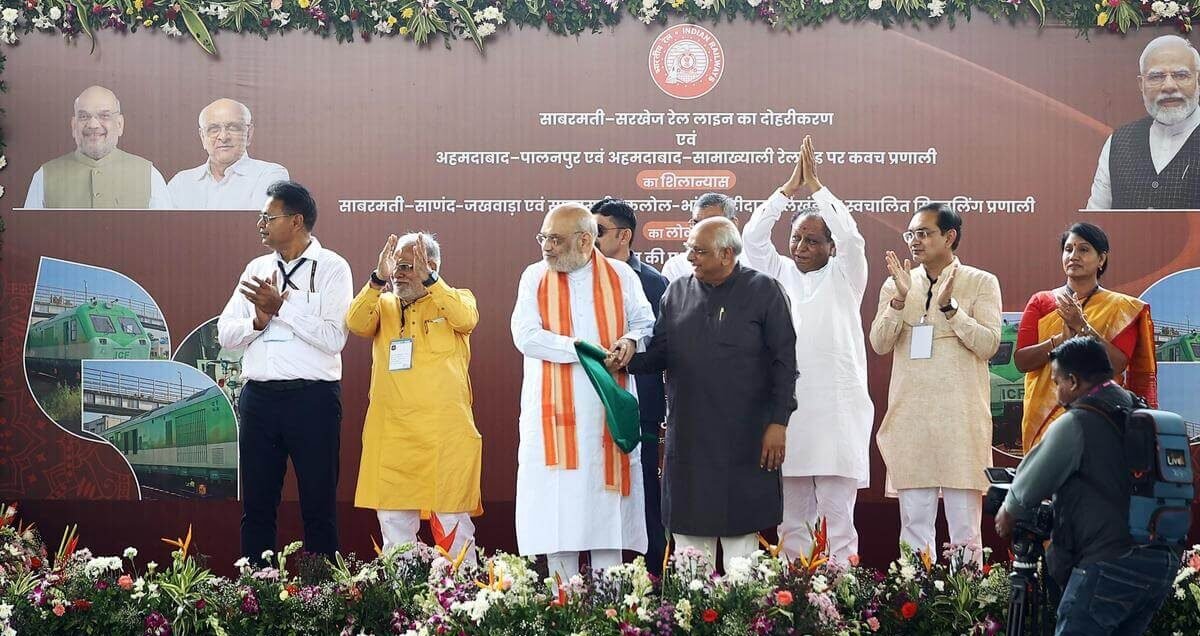
Ahmedabad: India has taken a step towards expanding the use of alternative fuels in railway operations with the flagging off of the country’s first LNG-powered train from Sabarmati on Sunday.
Union Home and Cooperation Minister Amit Shah and Gujarat Chief Minister Bhupendra Patel jointly flagged off the train, which uses a dual-fuel system combining liquefied natural gas (LNG) and diesel.
The initiative is aimed at reducing dependence on conventional diesel and exploring cleaner and potentially more economical fuel options for railway operations.
Diesel-LNG Dual-Fuel Technology
The train’s propulsion system uses a diesel-plus-LNG configuration developed for its Driving Power Cars (DPCs).
Two 1,400 HP DPCs based at the Sabarmati Integrated Coaching Depot have been converted to operate using the dual-fuel technology. The system allows LNG to be used alongside diesel while retaining the conventional engine’s operating capability.
The technology has already undergone extensive field testing. According to the Railways, the two converted DPCs have completed more than 2,000 kilometres of trials to evaluate the system’s performance and reliability.
LNG Can Replace Part of Diesel Consumption
Under the dual-fuel arrangement, LNG can replace up to around 40% of diesel consumption, according to trial data released by the Railways.
The use of LNG is expected to reduce fuel consumption and associated operating costs. The trials have also indicated potential reductions in emissions, including carbon dioxide, nitrogen oxides and particulate matter.
The system has been designed to enable the locomotive engine to continue delivering the required operational performance while partially substituting diesel with LNG.
Potential Savings in Fuel Costs
The railway assessment conducted earlier estimated annual savings of approximately ₹11.9 lakh for a single DPC.
For an eight-coach rake, the estimated annual saving was around ₹23.9 lakh, based on the earlier assessment.
Actual savings would depend on factors such as fuel prices, operating conditions, LNG consumption and the proportion of LNG used during operations.
Dual-Fuel System Provides Operational Flexibility
One of the features of the technology is the ability to operate using either LNG or diesel depending on fuel availability.
This provides operational flexibility and allows the train to continue running even when LNG is not available.
The system is intended to combine the established operational characteristics of diesel-powered engines with the potential benefits of partial LNG substitution.
LNG Tanks Provide Extended Operating Range
Each converted Driving Power Car has been equipped with an LNG tank with a capacity of approximately 2,200 litres.
The tank can hold around 850-900 kg of usable LNG, while a full LNG load is expected to provide sufficient fuel for approximately 1,600 kilometres of operation, depending on operating conditions.
The extended range could reduce the frequency of refuelling requirements during operations.
Multiple Railway Projects Launched in Ahmedabad
The LNG train launch formed part of a larger programme of railway projects inaugurated and launched during Amit Shah’s visit to Ahmedabad.
The package includes projects with a combined value of more than ₹1,542 crore, covering areas such as railway safety, signalling, line capacity and freight infrastructure.
Earlier in the day, Shah inaugurated a ₹700-crore WAG-12 locomotive maintenance shed at Sabarmati and flagged off a WAG-12 electric locomotive.
Kavach and Signalling Projects Also Commissioned
The programme also included the commissioning of the indigenous Kavach train protection system on the Ahmedabad-Palanpur and Ahmedabad-Samakhiyali sections.
Automatic signalling was also introduced on two railway sections as part of efforts to improve railway operations and line capacity.
In addition, the doubling work on the Sabarmati-Sarkhej section was launched.
Railways Explores Alternative Fuel Options
The introduction of the LNG-powered train represents an effort by Indian Railways to examine alternative fuels that could reduce diesel consumption while maintaining existing operational capabilities.
The technology’s long-term usefulness will depend on factors including fuel economics, infrastructure availability, operational reliability and the ability to maintain LNG supply and refuelling facilities.
For now, the Sabarmati-based dual-fuel train provides the Railways with an operational platform to further assess LNG technology and its potential role in reducing conventional fuel consumption.