
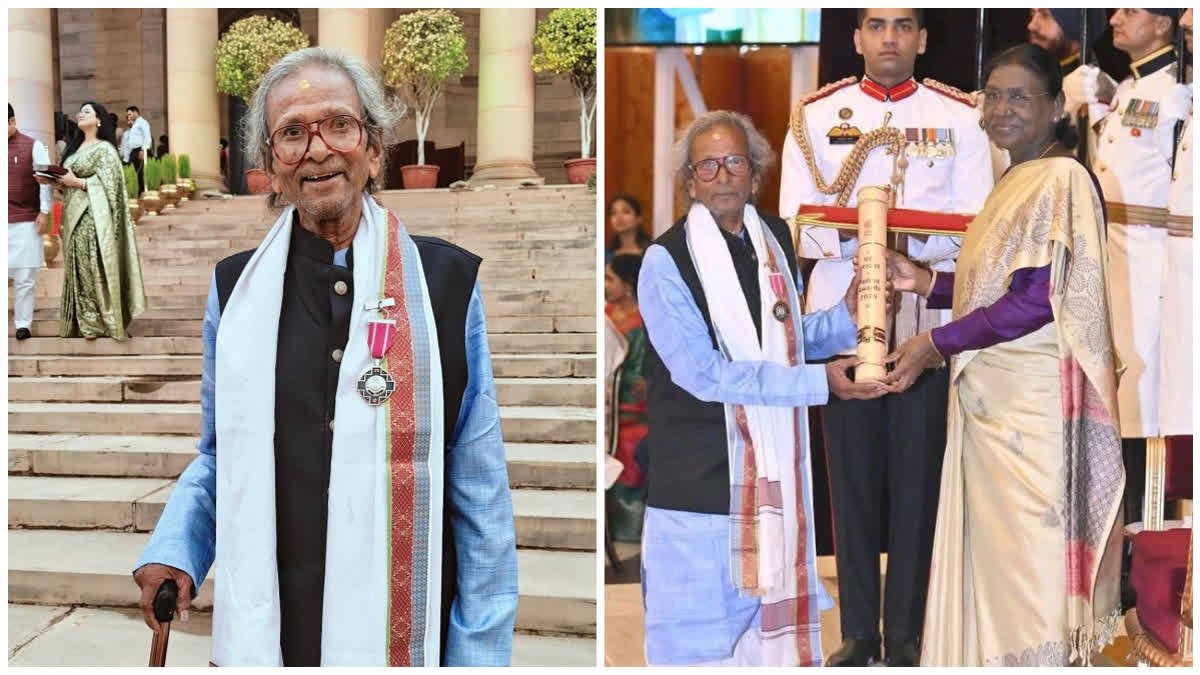
Berhampur: When 98-year-old Guru Simanchal Patra walked onto the stage at Rashtrapati Bhavan to receive the Padma Shri from President Droupadi Murmu, it was more than a personal honour. It was national recognition for a lifetime devoted to preserving Prahlada Nataka, one of Odisha’s oldest and most demanding folk theatre traditions.
As the veteran artiste returned to his native Bomokei village in Ganjam district, he was welcomed with heartfelt celebrations. Villagers, fellow artistes, students, and admirers gathered to felicitate the cultural icon whose relentless efforts have kept the centuries-old art form alive despite immense personal hardships.
For many in Odisha’s cultural fraternity, Guru Simanchal is not just an accomplished performer but the man who carried Prahlada Nataka from village stages to the national spotlight.
A Childhood Shaped by Poverty
Born on July 7, 1927, to farmer Sur Patra and Bangaridevi, Guru Simanchal’s early life was marked by extreme poverty.
At the age of just ten, he spent his days grazing goats so his family could afford a meal.
“Only if I grazed the goats would I get food at home,” he recalls with quiet humility, remembering the struggles that defined his childhood.
Yet, hardship could not diminish his passion for the performing arts.
After completing his daily chores, the young boy would quietly make his way to the village akhada, where rehearsals of Prahlada Nataka were held every evening. Hidden among the audience, he carefully observed every dialogue, gesture, melody, and movement.
Once the performers left, he would step onto the empty stage and recreate the entire performance from memory.
Those solitary rehearsals became the first lessons of a remarkable artistic journey.
Mastering One of India’s Toughest Folk Theatre Traditions
Prahlada Nataka is widely regarded as one of India’s most challenging traditional theatre forms.
Unlike conventional drama, a single performer must sing, dance, act, narrate verses, explain their meaning, and maintain musical rhythm simultaneously throughout the performance.
Shows often continue uninterrupted for 12 to 16 hours, with some extending close to 24 hours.
Guru Simanchal mastered every aspect of this demanding art.
He became proficient in singing, acting, classical movement, percussion, and traditional musical instruments while also mastering more than 35 ragas and hundreds of devotional and dramatic compositions.
Among his many celebrated roles, none became more iconic than King Hiranyakashipu, whose commanding voice and powerful stage presence earned him admiration from audiences across Odisha.
The Man Who Refused to Let the Tradition Die
While his performances won widespread acclaim, Guru Simanchal believes his greatest contribution came away from the spotlight.
Recognising that Prahlada Nataka was gradually losing practitioners, he dedicated his life to teaching the next generation.
He travelled extensively across villages in Ganjam district, establishing akhadas, mentoring aspiring artistes, and encouraging young performers to embrace Odisha’s traditional theatre.
Those who know him say his commitment knew no limits.
According to villagers, he even sold portions of his ancestral property to fund performances, train students, and keep the tradition alive when financial support was scarce.
His unwavering dedication ensured that an art form on the verge of decline continued to thrive.
A Lifetime of Recognition
Guru Simanchal’s extraordinary contribution has been acknowledged through several prestigious honours over the decades.
His accolades include:
- Sangeet Natak Akademi Award (1990)
- Odisha Sangeet Natak Akademi Award (1997)
- Guru Gangadhar Das Memorial Award (2024)
- Padma Shri (2026)
Receiving the Padma Shri remains the defining moment of his illustrious career.
“For me, this honour is recognition of nearly nine decades of selfless service to India’s cultural heritage,” he says with emotion.
A Family’s Pride
His younger son, Saheb Patra, who accompanied him to the Padma Shri ceremony, describes the moment as the proudest in the family’s history.
Although advancing age has prevented the veteran artiste from performing regularly, and financial challenges remain, Guru Simanchal carries no sense of regret.
“I have received everything life intended for me. I have no complaints. I am happy with what life has given me,” he says with remarkable contentment.
An Inspiration Beyond the Stage
Those who travelled with him to Rashtrapati Bhavan remain deeply inspired by his determination.
Folk dance guru Alok Bishoyi recalls how, despite being 98 years old, Guru Simanchal walked confidently to receive the nation’s fourth-highest civilian honour.
Educationist Siddhartha Shankar Padhi believes the recognition has brought global attention not only to the legendary artiste but also to Prahlada Nataka, one of India’s richest folk theatre traditions.
A Legacy That Will Endure
Guru Simanchal Patra’s journey—from a young boy grazing goats for a single meal to standing proudly at Rashtrapati Bhavan as a Padma Shri awardee—is a story of resilience, sacrifice, and unwavering devotion to culture.
His life proves that greatness is not measured by wealth or privilege but by perseverance, selfless service, and the determination to preserve a priceless legacy for future generations.
The Padma Shri bestowed upon Guru Simanchal Patra is not merely an honour for an individual. It is a tribute to the enduring spirit of Odisha’s folk traditions and a reminder that cultural heritage survives because of extraordinary individuals who dedicate their lives to protecting it.