
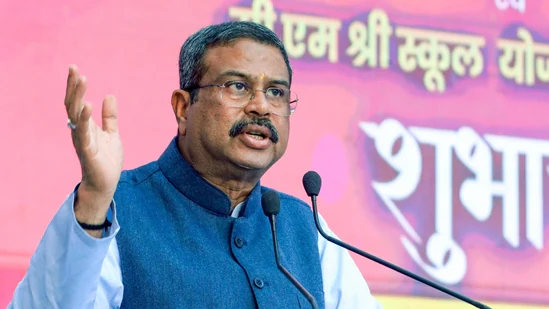
Amid growing controversy surrounding the Central Board of Secondary Education Class 12 results and allegations linked to the new On-Screen Marking (OSM) system, Union Education Minister Dharmendra Pradhan on Thursday announced that the board has officially started the revaluation process while roping in top institutions including Indian Institute of Technology Kanpur and Indian Institute of Technology Madras to oversee the technology framework.
Speaking to reporters during a CBSE review meeting, Pradhan said the government has acknowledged discrepancies reported during the result process and assured that corrective measures are being implemented to address student concerns.
“CBSE has involved top agencies, including IIT Kanpur and IIT Madras, to oversee the technology. Four PSU banks — SBI, Indian Bank, Bank of Baroda, and Canara Bank — have integrated payment gateways to support the process,” Pradhan stated.
CBSE Collaborates With PSU Banks For Payment Integration
The minister said the board has partnered with four major public sector banks — State Bank of India, Indian Bank, Bank of Baroda and Canara Bank — to create integrated payment gateways that will support revaluation and related student services.
According to officials, the upgraded payment infrastructure is aimed at reducing transaction failures and ensuring smoother access to post-result services.
Pradhan also assured that no student grievance would be ignored.
“The government acknowledges some discrepancies, accepts responsibility, and promises corrective measures. Officials will ensure that no student query is left unresolved and accountability will be ensured at all levels,” he said.
Massive Scale Of Digital Evaluation
The CBSE revealed that around 17 lakh students appeared for the Class 12 board examinations this year, generating nearly 98 lakh answer sheets amounting to approximately 40 crore scanned pages.
For the first time, the board implemented the On-Screen Marking (OSM) system for Class 12 evaluation, under which physical answer sheets were digitally scanned and evaluated online.
CBSE said the move was introduced to improve transparency, reduce manual errors and make the evaluation process more student-centric.
Students have also been allowed to access scanned copies of their answer sheets online to verify marks and raise objections if required.
According to the board, nearly four lakh students have already downloaded their scanned answer sheets covering around 11 lakh copies.
CBSE Defends OSM System
Amid criticism over alleged glitches, CBSE issued a clarification through social media platform X, asserting that the OSM system operates on a secure and robust IT platform.
The board stated that no security breaches or vulnerabilities were reported during the actual evaluation process and maintained that answer sheets underwent multiple quality-control checks before finalisation.
CBSE further emphasised that the digital evaluation system was designed to strengthen transparency and minimize human intervention during assessment.
Why The OSM System Came Under Fire
The controversy surrounding the new evaluation system intensified after several students alleged discrepancies in the scanned copies uploaded by CBSE during the re-evaluation process.
Some students claimed the answer sheets available online did not appear to match their handwriting, raising concerns over possible answer-sheet mismatches and evaluation errors.
Teachers and school administrators also expressed reservations about the rapid implementation of the system.
Several educators reportedly argued that many evaluators, especially in government schools, lacked adequate digital infrastructure and technical training required for smooth adoption of the new platform.
Some school principals suggested the system may have benefited from a phased rollout with additional training and preparation before nationwide implementation.
What Is On-Screen Marking (OSM)?
The On-Screen Marking system was introduced by CBSE for the 2026 Class 12 board examinations as part of its digital evaluation reforms.
Under OSM:
- Students continue writing exams in physical answer books
- Answer sheets are digitally scanned after examinations
- Evaluators assess copies online instead of manual checking
- The system aims to reduce calculation errors and improve efficiency
- Digital access allows students to view scanned answer sheets during revaluation
The board believes the system could eventually modernise India’s large-scale examination evaluation process, though the initial rollout has triggered concerns over technological readiness and implementation challenges.