
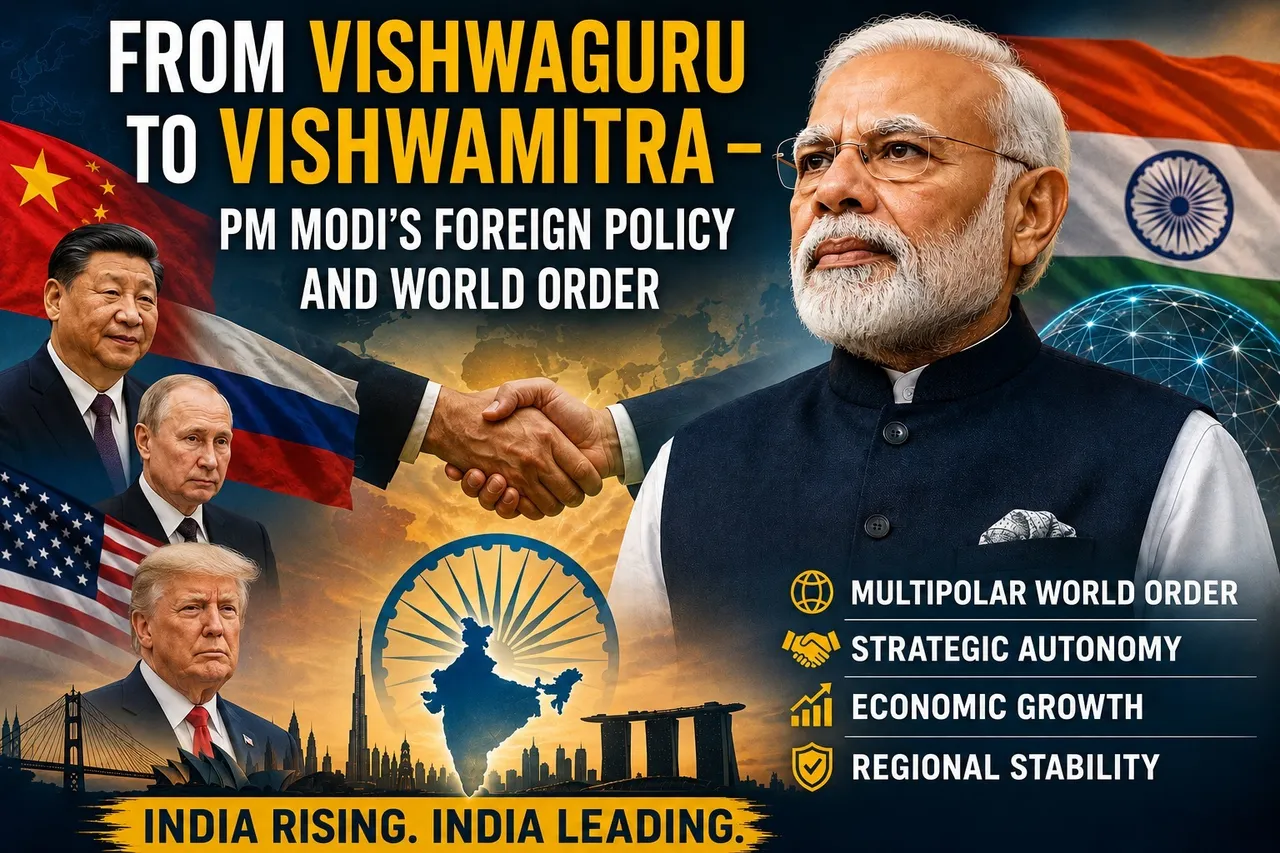
Prime Minister Narendra Modi’s foreign policy between 2024 and 2026 has been shaped by a careful balancing of major global powers, as India seeks to strengthen its position in an increasingly multipolar world.
Over the past two years, New Delhi has focused on expanding strategic partnerships, safeguarding national interests, and projecting itself not merely as a balancing power but as a country capable of shaping global outcomes. The approach reflects India’s attempt to combine diplomatic flexibility with economic ambition, military preparedness, and regional influence.
India’s Push for a Larger Global Role
Under Prime Minister Modi, India has consistently emphasised that it wants to emerge as a leading voice in global affairs. The government has framed this vision around the idea that India should play the role of a trusted and constructive partner in international politics.
This broader foreign policy objective has been backed by active engagement with neighbouring countries, deeper ties with Southeast Asia, growing involvement in West Asia, and strategic partnerships with major global players such as the United States, Russia, and China.
India’s “Neighbourhood First” and “Act East” policies have remained central to this strategy, with the government attempting to position the country as a stabilising force in the Indo-Pacific and a bridge between emerging and developed economies.
India-China Relations: Dialogue with Caution
India’s relationship with China has seen cautious engagement during this period.
In 2024, New Delhi and Beijing made progress toward easing tensions along the Line of Actual Control in eastern Ladakh. A disengagement arrangement announced in October 2024 was seen as an important step toward reducing military friction after nearly four years of standoff.
By 2025, diplomatic engagement deepened. Prime Minister Modi’s visit to China in August 2025, his first in six years, marked a notable moment in bilateral relations. During the visit, he held talks with Chinese President Xi Jinping on the sidelines of the Shanghai Cooperation Organisation summit.
The two countries also resumed direct flights after a five-year gap, while India eased visa procedures for Chinese nationals. These steps signalled a limited but meaningful effort to normalise relations.
Despite the thaw, strategic caution remains firmly in place. India continues to closely monitor Chinese infrastructure activity in contested areas and Beijing’s expanding presence in the Indian Ocean region.
As 2026 unfolds, diplomats and analysts believe confidence-building measures may continue, but the long-standing trust deficit is unlikely to disappear quickly.
India-Russia Ties Remain Strategically Important
India’s relationship with Russia has also remained significant during this period.
In 2024, India re-engaged more actively with Moscow, particularly in defence cooperation. Russia delivered two Project 11356 stealth frigates to the Indian Navy, reinforcing defence ties.
The momentum continued in 2025 when Russian President Vladimir Putin visited New Delhi. The visit underlined the importance both sides attach to the partnership despite global geopolitical tensions.
Military cooperation also expanded. The return of the INDRA joint military exercises, including naval and army components, reflected renewed operational coordination.
Trade ties deepened sharply as well. India’s oil imports from Russia rose significantly, highlighting New Delhi’s pragmatic energy strategy despite Western pressure over Moscow’s international isolation.
However, India also remains aware of the growing closeness between Russia and China. Moscow’s strategic alignment with Beijing in the Indo-Pacific has added complexity to India’s efforts to maintain its long-standing partnership with Russia without compromising its own security interests.
Strategic Autonomy at the Core
One of the defining features of Modi’s foreign policy in this period has been the continued emphasis on “strategic autonomy.”
India has sought to preserve working relationships with competing global powers simultaneously. While it has deepened defence and technological cooperation with the United States, it has also maintained close ties with Russia and pursued diplomatic engagement with China.
This approach allows India to respond to international developments based on national interest rather than bloc politics.
It has also helped New Delhi navigate global crises, including the conflicts in Ukraine and West Asia, where India has often adopted carefully calibrated positions rather than fully aligning with any one side.
Economic Diplomacy Driving Foreign Policy
Economic interests have increasingly become central to India’s diplomatic outreach.
With India crossing the $4 trillion GDP mark in 2024, the government has intensified efforts to expand trade partnerships, attract investment, and secure energy supplies.
The target of doubling foreign trade to $2 trillion by 2030 has pushed India to diversify markets and reduce dependence on any single region.
New Delhi’s diplomacy has therefore increasingly linked foreign policy with trade, infrastructure, energy security, and technology cooperation.
A Foreign Policy Shaped by a Multipolar World
Between 2024 and 2026, Prime Minister Modi’s foreign policy has reflected India’s attempt to adapt to a rapidly changing world order.
Rather than choosing sides in an increasingly fragmented international system, India has pursued flexible partnerships, issue-based cooperation, and strategic balancing.
The broader objective remains clear: to transform India from a regional power into a major global actor capable of influencing international institutions, geopolitical conversations, and economic frameworks.
As the global balance of power continues to shift, India’s foreign policy under Modi is increasingly being defined not by alignment, but by calculated autonomy and expanding ambition.