
New Delhi: India will begin its long-awaited national census from Wednesday, marking one of the largest administrative exercises in the world. With the country’s population now estimated at over 1.4 billion, the scale and complexity of the census operation are unprecedented.
More than three million government officials and enumerators will be deployed across the country over the next year to collect data from cities, towns, villages, and remote regions. The census is expected to play a critical role in guiding government policies, planning welfare schemes, and allocating resources effectively in a country facing rapid population growth and urbanisation.
Census to Support Policy and Governance
The government has described the $1.24 billion census exercise as a “gigantic exercise of national importance” that will provide essential data for inclusive governance and evidence-based policymaking.
Beyond simply counting the population, the information gathered will help authorities understand housing conditions, access to basic amenities, demographic trends, and economic realities across the country. The findings will directly influence how public resources are distributed and how social welfare programmes are designed.
Rising Pressure on Urban Infrastructure
India’s growing population has already begun to strain urban infrastructure in several major cities. Many metropolitan areas are currently facing water shortages, increasing air and water pollution, housing shortages, and the expansion of informal settlements and slums.
Experts say that an accurate and updated population count is essential to address these challenges and ensure that development policies match the country’s changing demographic landscape.
First Census Since 2011
The upcoming census will be the first national population count since 2011, when India’s population stood at around 1.21 billion.
The next census was originally scheduled for 2021, but it was postponed due to the COVID-19 pandemic, creating a significant data gap in demographic information.
Since then, international estimates, including those from the United Nations, indicate that India has surpassed China to become the world’s most populous country, further highlighting the importance of updated population data.
Census to Be Conducted in Two Phases
The census will be carried out in two major phases, combining traditional door-to-door surveys with digital technology to improve accuracy and efficiency.
Phase One:
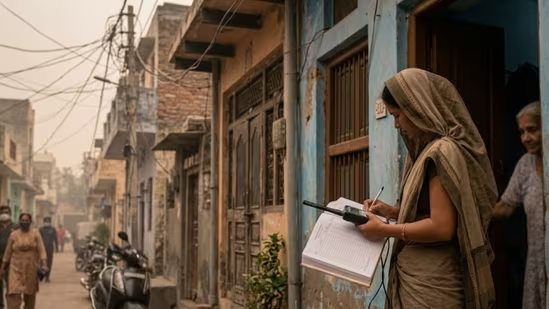
The first phase, beginning Wednesday and continuing until September, will focus on housing conditions and access to basic amenities. Enumerators will conduct household visits across the country, while citizens will also have the option to submit information through a dedicated mobile application.
The digital platform will be available in 16 languages and supported by satellite imagery, enabling authorities to map settlements and housing patterns more accurately.
Phase Two:
The second phase will focus on population-specific information, including demographic, social, and economic data such as age, education, employment, and migration patterns.
Caste Data Likely to Draw Attention
One of the most closely watched aspects of the upcoming census will be the possible inclusion of caste-related data, which remains a sensitive and politically significant issue in India.
Caste continues to influence access to education, employment opportunities, and government benefits, despite decades of social and policy reforms. However, collecting and publishing caste data has historically been controversial.
Although a caste-based survey was conducted in 2011, its results were never officially released due to reported inconsistencies.
The last time India collected comprehensive caste data as part of an official census was in 1931 during British rule. Since independence, successive governments have largely avoided updating these figures due to administrative complexities and concerns about social tensions.
Different Timeline for Himalayan Regions
Due to India’s diverse geography and climatic conditions, the census timeline will vary across regions.
In most parts of the country, population enumeration will take place in the weeks leading up to March 1, 2027, which has been designated as the official reference date.
However, in high-altitude Himalayan regions, including parts of Jammu and Kashmir, enumeration will be conducted earlier, before October 1, 2026, to avoid disruptions caused by heavy snowfall.
One of the Largest Administrative Exercises
Conducting a census in a country as vast and diverse as India presents enormous logistical challenges. Even the 2024 general elections — often considered the largest democratic exercise in the world — were conducted in seven phases over six weeks.
The census, however, will stretch across several months and require coordination at every level of government, involving millions of officials and advanced technological support.
Once completed, the census is expected to provide vital insights into India’s demographic transformation, helping policymakers plan for the country’s future development and address the challenges posed by rapid population growth.