
In a significant move aimed at easing tensions in the Middle East, Masoud Pezeshkian, President of Iran, has apologised to neighbouring countries and announced that Tehran will refrain from launching missile strikes against regional states unless attacks on Iran originate from their territory.
The announcement follows escalating hostilities triggered by joint military strikes carried out by the United States and Israel last weekend, which reportedly killed Iran’s Supreme Leader Ayatollah Ali Khamenei along with hundreds of others.
Iran Announces Suspension of Attacks
Speaking on state television, Pezeshkian said Iran’s temporary leadership council had approved a decision to suspend attacks on neighbouring countries as a gesture to reduce regional tensions.
“I must apologise on my own behalf and on behalf of Iran to the neighbouring countries that were attacked by Iran,” Pezeshkian said, according to AFP.
However, the Iranian president also made it clear that Tehran would not surrender to its adversaries.
“The enemies must take their wish for the surrender of the Iranian people to their graves,” he stated in the televised address.
Explosions and Alerts Across Gulf Cities
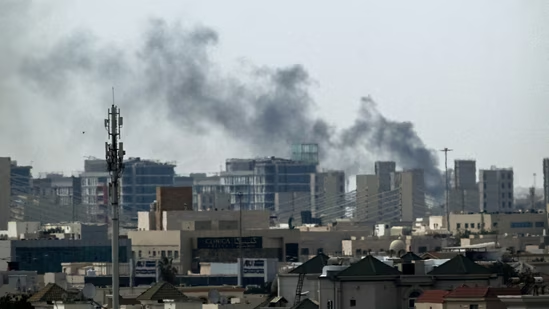
Despite the announcement, tensions remain high across the Gulf region. Cities such as Dubai and Abu Dhabi in the United Arab Emirates have continued to witness explosions, missile alerts and air raid sirens in recent days as defence systems intercept drones and missiles linked to the ongoing conflict.
Operations at Dubai International Airport were temporarily suspended on Saturday following what authorities described as a “minor incident.”
The Dubai Media Office confirmed the temporary suspension in a statement, saying the move was taken to ensure the safety of passengers, airport staff and airline crews. The halt reportedly followed a loud explosion heard by passengers sheltering at the airport.
Widespread Impact Across the Region
The conflict, which began with the US-Israel strikes on February 28, has triggered widespread disruption across the Middle East. Airspace closures across Gulf countries have led to thousands of flight cancellations, while missiles and drones have targeted military facilities and bases in several countries.
Reports indicate that installations in Qatar, Bahrain, Saudi Arabia, Kuwait and the UAE have been affected during the escalating exchanges.
Meanwhile, Israeli warplanes have continued airstrikes targeting locations in Tehran and areas in Lebanon believed to be allied with Iran.
According to reports cited by the Associated Press, the ongoing conflict has resulted in at least 1,230 deaths in Iran, more than 200 in Lebanon, and around a dozen casualties in Israel, while six US soldiers have also reportedly been killed.
Analysts say Iran’s latest statement could be the first diplomatic signal of de-escalation, though the region remains on edge as military operations continue.