
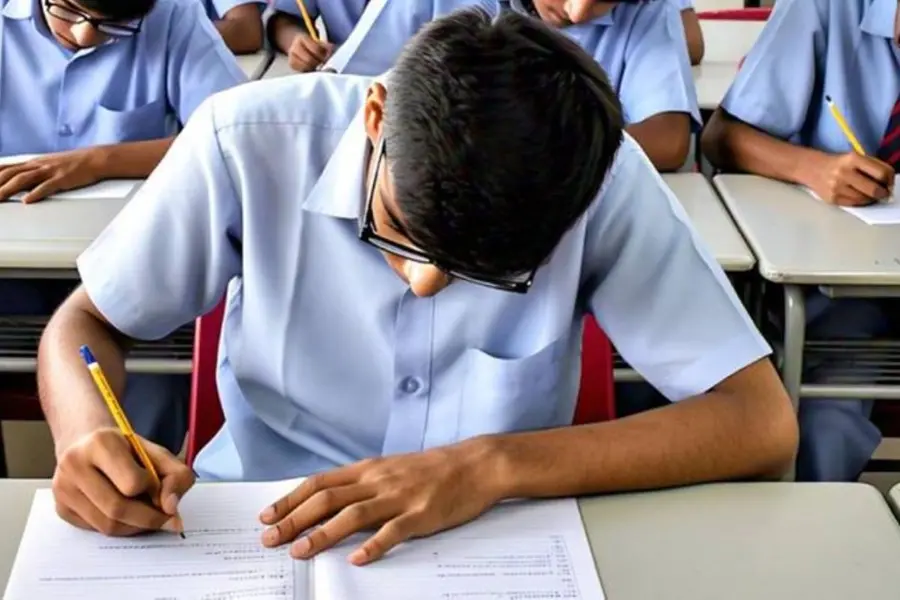
New Delhi: The Central Board of Secondary Education (CBSE) has announced that it will implement On-Screen Marking (OSM) for the evaluation of Class 12 answer books starting from the 2026 board examinations, marking a major shift towards digital assessment in India’s school examination system.
The decision has been formally communicated to all CBSE-affiliated schools through an official notification, giving institutions sufficient time to prepare for the transition. The Board said the move is aimed at improving the speed, accuracy, transparency, and efficiency of the evaluation process.
Class 10 Exams to Continue With Physical Evaluation
Clarifying concerns among students and parents, CBSE stated that Class 10 answer books will continue to be evaluated in physical mode in 2026, as per the existing system. At present, on-screen marking will be limited to Class 12 examinations only, with any future expansion to be decided later.
Why CBSE Is Moving to Digital Evaluation
According to CBSE, the introduction of on-screen marking is part of its broader effort to modernize examination and evaluation systems. Digital evaluation is expected to significantly reduce totalling and calculation errors, minimize manual intervention, and enable faster declaration of results.
The Board also believes that automated calculation and coordination through the OSM platform will eliminate the need for post-result verification of marks, thereby enhancing trust and transparency in the results process.
Benefits for Teachers and Schools
One of the key advantages of the on-screen marking system is that teachers will be able to evaluate answer scripts from their own schools, allowing them to continue with regular academic responsibilities without the need for travel to distant evaluation centers.
The system is also expected to increase participation of evaluators, including teachers from CBSE-affiliated schools abroad, strengthening the evaluation pool.
In addition, CBSE noted that digital marking will help reduce transportation time and costs, lower manpower requirements, and support environment-friendly practices by limiting the handling and movement of physical answer books.
Infrastructure Requirements for Schools
To ensure smooth implementation, CBSE has instructed schools to be fully equipped with the required digital infrastructure. This includes:
-
Computer laboratories with public static IPs
-
Desktops or laptops running Windows operating systems
-
Adequate RAM and storage capacity
-
Updated web browsers and Adobe Reader
-
Stable internet connectivity with a minimum speed of 2 Mbps
-
Uninterrupted power supply (UPS)
Schools have been advised to begin preparations well in advance to avoid last-minute issues.
Training and Preparation for Teachers
To familiarise evaluators with the new system, CBSE will allow teachers with OASIS IDs to log in and explore the on-screen marking platform. The Board plans to conduct multiple dry runs, organize training programmes, release instructional videos, and establish a dedicated call center to address technical queries and issues.
Detailed Guidelines to Follow
CBSE has said that activity-wise guidelines and timelines will be issued separately. The early announcement, the Board added, is intended to give schools, teachers, and evaluators enough time to adapt smoothly to the digital evaluation process ahead of the 2026 board examinations.