
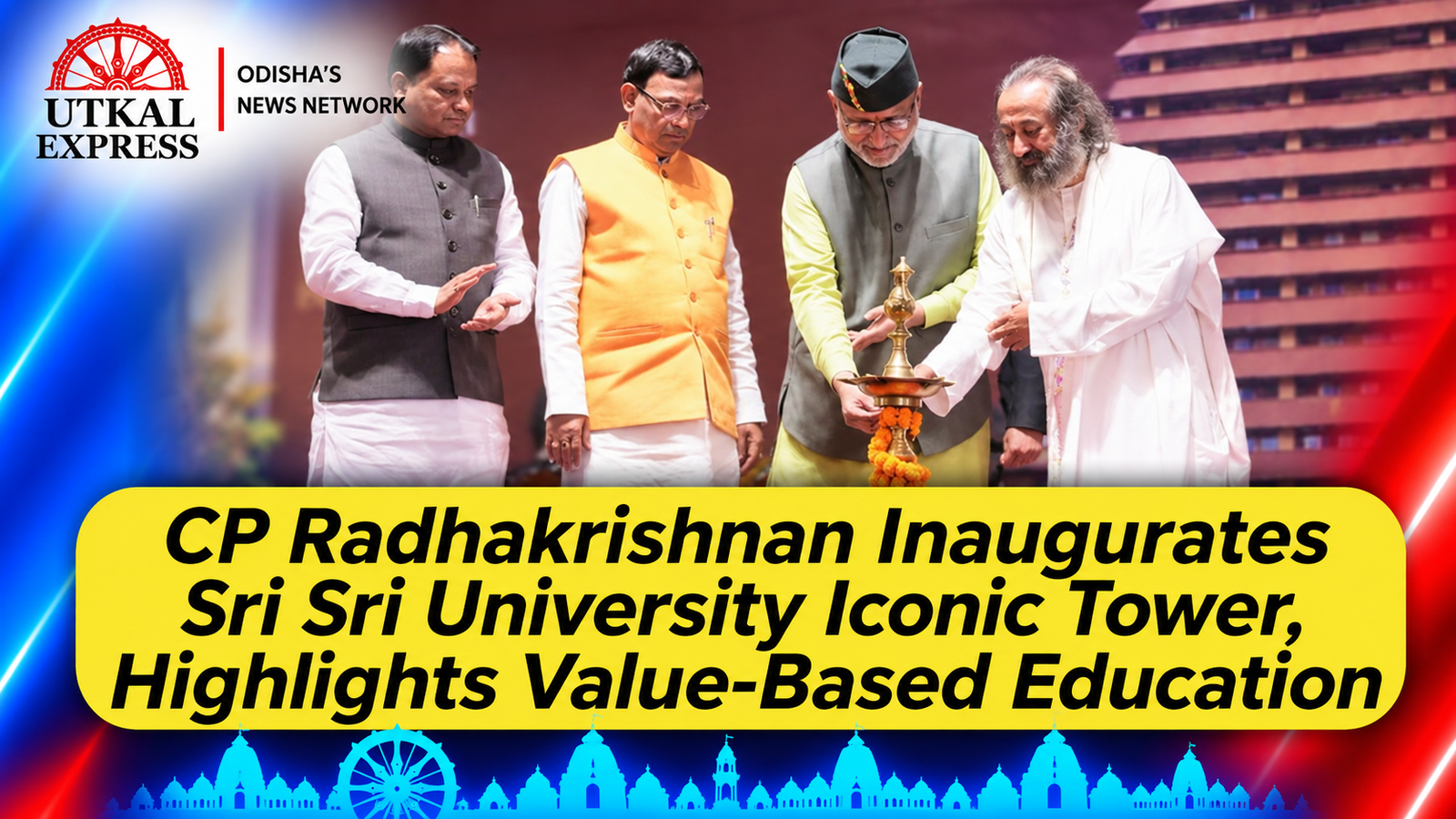
Bhubaneswar: Vice-President C. P. Radhakrishnan on Monday inaugurated the Iconic Tower at Sri Sri University in Cuttack, Odisha, highlighting the importance of value-based education, India’s rich cultural heritage and the role of educational institutions in achieving the vision of a developed nation.
The inauguration ceremony was attended by Odisha Governor Braj Mohan Ram, Chief Minister Mohan Charan Majhi and Gurudev Sri Sri Ravishankar, Founder and Lifetime President of Sri Sri University.
Addressing the gathering, the Vice-President said the inauguration was not merely the opening of a new building but a celebration of an educational vision that seeks to combine India’s traditional wisdom with contemporary knowledge and prepare future generations for greater responsibilities.
Iconic Tower Reflects Odisha’s Rich Architectural Heritage
Referring to Odisha’s architectural and cultural legacy, Radhakrishnan said the temples of Puri, Bhubaneswar and Konark represented the extraordinary achievements of Indian civilisation in art, science, spirituality and architecture.
He observed that the design of the newly inaugurated Iconic Tower drew inspiration from this heritage. The structure, he said, symbolised the journey from knowledge to wisdom and enlightenment.
The Vice-President expressed confidence that the tower would become a lasting symbol of learning, aspiration and Odisha’s cultural identity, inspiring generations of students to contribute towards building a prosperous, compassionate and developed India.
Educational Institutions Crucial to Viksit Bharat 2047
Underscoring the national vision of Viksit Bharat by 2047, the Vice-President said educational institutions would play a crucial role in transforming India into a developed nation.
Highlighting the expansion of India’s higher education sector over the past 12 years, he pointed to significant growth in the number of universities and premier educational institutions.
According to the figures cited by him, the number of universities in the country had increased from 760 in 2014–15 to more than 1,400 at present. Similarly, the number of Indian Institutes of Technology (IITs) had risen from 16 to 23, while Indian Institutes of Management (IIMs) had increased from 13 to 22.
The number of All India Institutes of Medical Sciences (AIIMS) had also grown from seven to 20 during the period.
Radhakrishnan further noted that student enrolment in higher education had increased from 3.42 crore in 2014–15 to more than 4.50 crore, reflecting the growing reach of higher education across the country.
VP Calls for School Connect Programmes for Tribal Children
Highlighting the need to improve access to education among tribal communities in Odisha, Radhakrishnan urged government and private universities across the state to introduce School Connect programmes for tribal children.
He said such initiatives could help students from tribal backgrounds remain connected to the education system, prevent school dropouts and motivate them to pursue higher studies.
The Vice-President stressed that expanding educational opportunities for disadvantaged communities was essential for inclusive development. He encouraged educational institutions to take a more active role in reaching children from remote and underserved areas.
‘Nation First – Rashtra Pratham’: Message to Students
Addressing students, the Vice-President emphasised the importance of national identity, self-reliance and responsible citizenship.
He said India must emerge as a strong and capable nation to safeguard its sovereignty, dignity and national interests.
Radhakrishnan also urged students to follow the principle of ‘Nation First – Rashtra Pratham’ and stay away from drugs.
Offering guidance on personal growth, he said an individual’s stature should be measured not by external achievements alone but by the depth of knowledge, strength of character and breadth of compassion.
He encouraged students to develop a balanced outlook that combines academic excellence with ethical values, social responsibility and concern for others.
Sri Sri University Aims to Blend Eastern Wisdom With Western Knowledge
Describing Sri Sri University as the realisation of Gurudev Sri Sri Ravishankar’s vision, the Vice-President said the institution’s founding philosophy went beyond conventional academic education.
He noted that the university focused on nurturing character, consciousness and compassion alongside academic learning.
Established in 2012, Sri Sri University seeks to integrate Eastern wisdom with Western knowledge, creating an educational environment that combines traditional values with contemporary learning.
Appreciating the university’s identity as the ‘Happiest Campus in the World’, Radhakrishnan said happiness was a universal aspiration deeply rooted in India’s cultural traditions.
He highlighted the importance of creating educational spaces that promote not only intellectual development but also emotional well-being and a sense of purpose.
Vice-President Visits State-of-the-Art Planetarium
During his visit, Radhakrishnan also toured the state-of-the-art planetarium housed within the newly inaugurated Iconic Tower.
The facility highlights the role of scientific curiosity, discovery and innovation in modern education. The visit also underscored the importance of encouraging students to explore scientific ideas and develop an interest in research and technological advancement.
Knowledge, Wisdom, Innovation and Service as Guiding Principles
Calling upon the university fraternity to uphold the ideals represented by the Iconic Tower, the Vice-President outlined a vision for education rooted in knowledge, wisdom, innovation, compassion and service.
He said knowledge should form the foundation, wisdom serve as the guiding light, innovation act as the instrument, compassion provide strength and service remain the ultimate purpose.
He expressed confidence that Sri Sri University would continue to inspire students to combine academic achievement with moral values and a commitment to society.
The inauguration of the Iconic Tower marked an important milestone for the university, bringing together Odisha’s cultural heritage and a forward-looking vision of education. The Vice-President’s address highlighted the need for institutions to prepare young people not only for professional success but also for responsible participation in nation-building.