
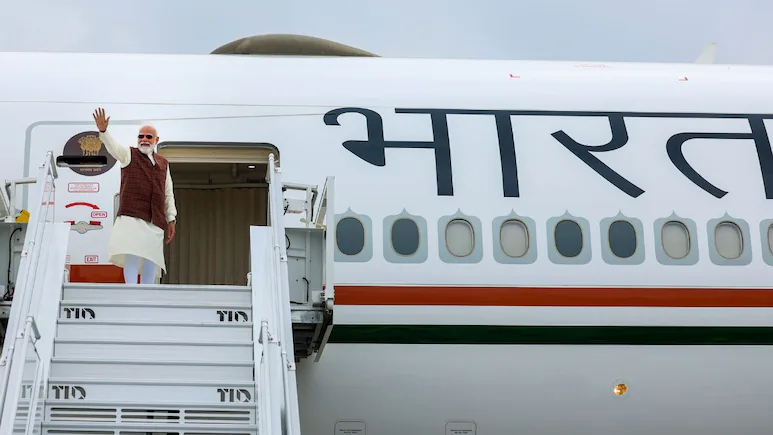
Prime Minister Narendra Modi’s recent visit to Sweden marked a major shift in India’s economic and strategic engagement with Europe, as India and Sweden elevated bilateral ties to a Strategic Partnership and adopted a Joint Action Plan for 2026-2030.
During the meeting in Gothenburg, PM Modi, Swedish Prime Minister Ulf Kristersson and European Commission President Ursula von der Leyen outlined a future-focused roadmap centred on artificial intelligence, defence manufacturing, green energy, digital infrastructure, semiconductors, space cooperation and resilient supply chains.
The strategic upgrade reflects India’s growing effort to align with innovation-driven European economies to strengthen long-term economic growth, technological capabilities and manufacturing competitiveness.
Four Pillars Of The New Strategic Partnership
The India-Sweden Strategic Partnership has been built around four major pillars:
- Strategic dialogue for security and stability
- Next-generation economic partnership
- Emerging technologies and trusted connectivity
- Cooperation on people, sustainability, health and resilience
The agreement is expected to deepen collaboration in high-value sectors beyond traditional trade and create long-term industrial and technological partnerships between the two countries.
India Eyes Technology Transfer And Industrial Collaboration
One of the key highlights of the partnership is India’s push for technology transfer and co-manufacturing rather than a traditional buyer-seller relationship.
Sweden is home to globally recognised companies in telecom, clean technology, mobility, defence systems, mining technology and life sciences. India is seeking to leverage Swedish expertise to strengthen domestic manufacturing under the “Make in India” initiative.
PM Modi emphasised that the increasing number of Swedish companies establishing production facilities in India reflects a transition towards deeper industrial collaboration and long-term investment partnerships.
AI, Semiconductors And Deep-Tech Cooperation To Expand
A major component of the partnership is the launch of the Sweden-India Technology and AI Corridor (SITAC), aimed at connecting startups, research institutions, industries and universities from both countries.
The corridor will focus on cooperation in:
- Artificial Intelligence (AI)
- 6G telecommunications
- Quantum computing
- Semiconductor development
- Digital infrastructure
The initiative aligns closely with India’s AI Mission and semiconductor manufacturing ambitions, which aim to position India as a global technology and innovation hub.
Green Transition And Critical Minerals Gain Focus
The partnership also strengthens cooperation in sustainable technologies and clean energy sectors.
Sweden’s expertise in electric mobility, green hydrogen, smart urban infrastructure and sustainable mining is expected to support India’s transition toward cleaner energy systems and environmentally sustainable industrial growth.
Critical minerals and resilient supply chains have emerged as strategic priorities for both countries amid growing global geopolitical uncertainties.
Defence Manufacturing And Space Collaboration To Increase
India and Sweden also agreed to enhance defence manufacturing cooperation, with Swedish defence firms expected to expand production and technology partnerships in India.
The move supports India’s goal of boosting indigenous defence manufacturing and reducing dependence on imports.
In the space sector, the two countries announced collaboration between their respective space agencies for an instrument related to India’s upcoming Venus Orbiter mission, highlighting growing trust in high-technology cooperation.
Trade And Investment Target Set To Double In Five Years
Swedish Prime Minister Ulf Kristersson announced an ambitious goal to double bilateral trade and investment between the two countries within the next five years.
The announcement comes alongside the recently concluded India-European Union Free Trade Agreement, which leaders described as a transformative step for future India-Europe economic relations.
The partnership is expected to:
- Improve Indian access to European markets
- Increase Swedish investment in Indian manufacturing
- Diversify global supply chains away from geopolitical risks
- Expand cooperation in advanced industrial sectors
India is already Sweden’s third-largest trading partner in Asia, and the new strategic framework aims to accelerate growth in high-value industries.
Sweden Emerging As Strategic Gateway To Europe
Despite its relatively small population, Sweden is regarded globally as a technology and innovation powerhouse with leadership in:
- Sustainable mining technology
- Electric mobility ecosystems
- Telecom and digital connectivity
- Life sciences and medical technology
- Defence electronics and aerospace
- Smart city infrastructure
Analysts believe Sweden could become an important gateway for India’s deeper engagement with European markets and technology ecosystems.
Geopolitical Significance Of The Partnership
The India-Sweden partnership also carries significant geopolitical importance amid rising global instability, including the Russia-Ukraine conflict and tensions in West Asia.
Both countries stressed the importance of:
- Resilient supply chains
- Economic security
- Counter-terrorism cooperation
- Reform of multilateral institutions
The strategic alignment reflects India’s broader positioning as a trusted manufacturing, research and digital partner for Europe in an increasingly fragmented global economy.
Existing Institutional Mechanisms To Drive Cooperation
Several bilateral mechanisms are already operational between India and Sweden, including:
- Joint Commission for Economic, Industrial and Scientific Cooperation (JCEISC)
- Joint Working Groups on defence, healthcare, renewable energy, digital technology and environment
- India-Sweden Business Leaders Round Table
- LeadIT climate transition initiative
The newly adopted Joint Action Plan is expected to provide sharper economic targets and faster implementation across sectors.
What The Partnership Could Mean For India
Experts believe the strategic partnership could accelerate:
- Swedish manufacturing investments in India
- Growth of India’s semiconductor and AI ecosystem
- Expansion of clean energy and EV infrastructure
- Startup and SME collaboration
- Job creation and technology innovation
- Stronger India-Europe trade integration
The partnership is being viewed as a major milestone in India’s long-term strategy to strengthen technology-driven growth and position itself as a leading global manufacturing and innovation destination.