
New Delhi: The Centre on Friday notified the TV Ratings Policy 2026, replacing the decade-old 2014 television ratings framework and expanding the scope of audience measurement to include OTT platforms, connected TVs, and other digital viewing formats.
The revised policy aims to modernise the television ratings ecosystem in India and address long-standing concerns regarding limited audience measurement, manipulation risks, and the growing dominance of digital viewing platforms.
Ratings to Include Digital Viewing Platforms
One of the most significant changes in the new framework is the expansion of viewership measurement beyond traditional television broadcasting.
The policy now allows ratings to capture audiences watching content through:
- OTT streaming platforms
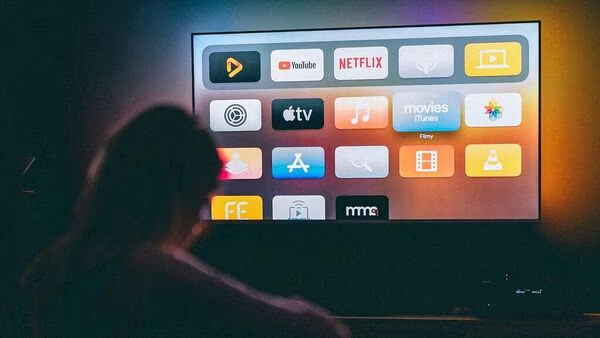
- Connected or smart TVs
- Mobile applications and digital viewing platforms
This move comes as the government acknowledged that the previous system did not fully reflect modern viewing habits, especially with the rapid growth of digital streaming services and smart devices.
Autoplay Views on Landing Pages Excluded
To address concerns about potential manipulation of ratings, the new policy clearly states that views generated from landing pages will not be counted.
Landing pages often automatically play certain channels or content when a television is switched on. Such autoplay views will now be excluded from official audience ratings, ensuring a more accurate representation of genuine viewer engagement.
Larger Sample Size for Ratings
The policy also significantly expands the sample size used to measure television viewership.
- Under the 2014 policy, ratings were calculated based on 20,000 homes, with scope to expand to 50,000 homes.
- The 2026 policy mandates a minimum of 80,000 homes, with plans to gradually increase this to 1.2 lakh households.
Officials say the expansion will help improve accuracy and represent diverse viewing patterns across India.
Governance Changes for Rating Agencies
The new policy introduces several governance reforms to improve transparency and neutrality in the ratings ecosystem.
Key provisions include:
- At least 50% of the board of rating agencies must be independent directors
- Independent directors must not have ties to broadcasters, advertisers, or advertising agencies
- Rating agencies are prohibited from undertaking consultancy roles that may create conflicts of interest
- Agencies must publish their methodology, disclose limitations, and share anonymised data with the government
The minimum net worth requirement to start a ratings agency has been reduced from ₹20 crore to ₹5 crore, potentially allowing more companies to enter the ratings market.
Dedicated Oversight and Audit Mechanism
While the earlier policy allowed inspections by the government and Telecom Regulatory Authority of India (TRAI), the new framework introduces a dedicated Ministry-level Audit and Oversight Team.
This team will conduct regular and risk-based audits of rating agencies, examining their systems, methodologies, and field operations.
Graded Penalty Framework Introduced
The TV Ratings Policy 2026 also introduces a graded enforcement system.
Unlike the earlier framework that mainly relied on financial penalties or licence cancellation, the new policy introduces suspension of ratings as the first step in disciplinary action, followed by stricter penalties for repeated violations.
Privacy Rules Linked to Data Protection Law
The policy strengthens privacy safeguards for households participating in audience measurement.
It requires rating agencies and stakeholders to comply with the Digital Personal Data Protection (DPDP) Act, 2023, whose rules were notified in February 2026.
Authorities stressed that the privacy of metered households must be strictly protected, with proper mechanisms in place to ensure compliance with data protection laws.
Revised Complaint Handling System
The complaint resolution framework has also been updated.
Under the new policy:
- Complaints must be acknowledged within three days
- Issues must be resolved within 10 days
- Rating agencies must appoint a nodal officer for grievance handling
- An Appellate Authority must be established to address escalated disputes
Government’s Objective
The government said the new framework is aimed at creating a fair, competitive, and transparent broadcasting environment that protects the interests of viewers, broadcasters, advertisers, and other stakeholders.