
The ongoing conflict involving United States, Israel and Iran has entered its 11th day, with no signs of de-escalation as Iran continues launching ballistic missiles and kamikaze drones targeting US interests and allied nations across the Middle East and Gulf region.
The attacks are being carried out primarily by Iran’s elite military force, the Islamic Revolutionary Guard Corps (IRGC), which has intensified strikes on strategic locations linked to US forces and regional allies.
Iran Uses Low-Cost Drones and Missiles
Iran has reportedly relied heavily on low-cost unmanned aerial vehicles and ballistic missiles during the conflict. One such weapon, the Shahed-136 drone, is believed to cost as little as $35,000, making it significantly cheaper than the expensive interceptor missiles used by the United States and its allies to shoot them down.
Defence analysts say this strategy forces opponents to spend millions of dollars in defensive missile systems to counter relatively inexpensive drones and short-to-medium range ballistic missiles.
Despite more than a week of intense airstrikes by US and Israeli forces, Iran’s drone and missile arsenal appears far from exhausted, indicating the country had built a substantial stockpile of stand-off weapons in preparation for potential conflict.
Strait of Hormuz Crisis Raises Energy Concerns
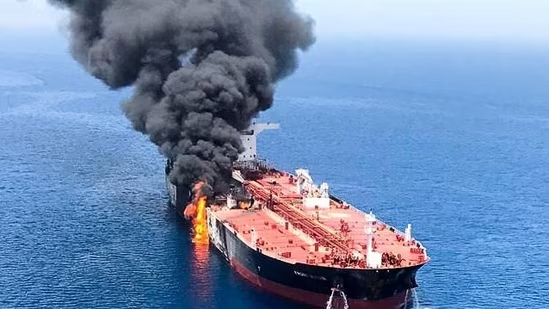
The escalating war has also heightened fears of a global energy crisis. Iran has placed the strategic Strait of Hormuz under threat, a critical maritime route through which a large portion of the world’s oil supply passes.
Any prolonged disruption in oil shipments through the strait could significantly impact global energy markets and raise fuel prices worldwide.
Emergence of a ‘No-Contact’ Warfare Model
Military observers say the conflict is showcasing a new model of high-intensity, technology-driven warfare where direct battlefield engagement is limited.
Instead, the war is largely being fought using long-range stand-off weapons, drones, ballistic missiles and advanced missile defence systems. Intelligence gathering and remote targeting have become central to modern combat strategies.
Some analysts believe the conflict reflects the evolving nature of warfare similar to recent operations such as Operation Sindoor, where precision strikes and long-range capabilities played a decisive role.
Lessons for Global Defence Powers
Experts say the conflict also highlights the importance of self-reliance in defence production. Despite being under heavy international sanctions for decades, Iran has managed to develop indigenous missile and drone capabilities, reportedly through reverse engineering technology originally developed in China and Russia.
The country has reportedly succeeded in mass-producing missile engines, fuel systems and GPS-guided delivery platforms, allowing its arsenal to maintain operational effectiveness even under sustained attacks.
Strategic Pressure on the US
Analysts believe Iran may be widening the scope of the conflict by targeting US allies in the Gulf region in order to create economic and political pressure on Washington.
Countries such as Saudi Arabia, United Arab Emirates and Qatar have already reported drone and missile threats in recent days.
The broader goal, experts say, could be to trigger a global energy crisis that would force the US administration led by Donald Trump to reconsider its military strategy.
Regime Change Seen as Unlikely
While the US and Israel continue targeting Iranian military infrastructure, analysts say the possibility of a regime change in Tehran remains uncertain.
Since the Iranian Revolution, the country’s political system has been dominated by a theocratic leadership structure that maintains strong internal control.
Observers believe that in times of external conflict, Iranian society often rallies around its leadership, making internal political upheaval less likely.
As the war continues, the situation remains volatile, with growing fears that the conflict could expand further across the Middle East and significantly impact global energy markets and geopolitical stability.