
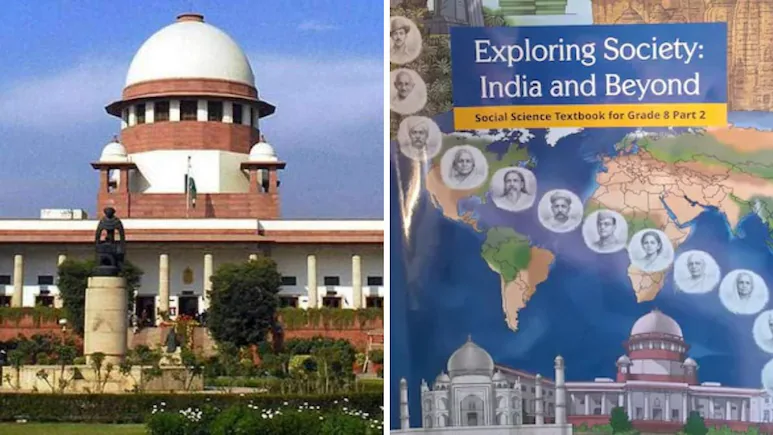
The National Council of Educational Research and Training (NCERT) has issued an unconditional public apology two weeks after the Supreme Court of India imposed a blanket ban on a Class 8 social science textbook that contained a controversial chapter related to the judiciary.
The apology, published in newspapers, stated that NCERT had recently released the textbook “Exploring Society: India and Beyond – Grade 8 (Part II), which included Chapter IV titled “The Role of Judiciary in Our Society.”
In its statement, NCERT said the director and members of the council “tender an unconditional and unqualified apology” for the content of the chapter. The organisation also confirmed that the entire book has been withdrawn from circulation and is no longer available.
Controversy Over Chapter on Judiciary
The controversy erupted after a section of the chapter reportedly referred to “corruption in the judiciary,” triggering strong reactions from the Supreme Court.
Media reports on the issue prompted sharp remarks from Chief Justice of India Surya Kant, who expressed serious concern over the content of the textbook.
He stated that no one would be allowed to undermine the integrity of the judiciary. The Chief Justice emphasised that the institution’s credibility must be protected and warned that strict action would be taken against those responsible.
Supreme Court Orders Ban and Seizure
Taking suo motu cognisance of the matter, the Supreme Court ordered a complete ban on the textbook. The court also directed authorities to seize all physical copies and remove digital versions of the book from circulation.
The court stressed that such content, if left unchecked, could damage public trust in the judiciary and weaken institutional credibility.
Centre Also Apologises
Earlier, Tushar Mehta, the Solicitor General of India, appeared before the court and conveyed an unconditional apology on behalf of the Ministry of Education.
He informed the court that two individuals responsible for including the reference to corruption in the judiciary would not be associated with the University Grants Commission (UGC) or any government ministry in the future.
However, the Chief Justice expressed dissatisfaction with this explanation, stating that such actions were insufficient given the seriousness of the issue.
NCERT Admits Error in Judgment
NCERT officials later acknowledged that “inappropriate textual material” had inadvertently been included in the chapter due to an error of judgment.
As part of corrective measures, the organisation halted the distribution of the book and withdrew all copies from the market.
The development has triggered a wider debate on academic content, institutional accountability and the role of educational bodies in shaping public understanding of constitutional institutions.