
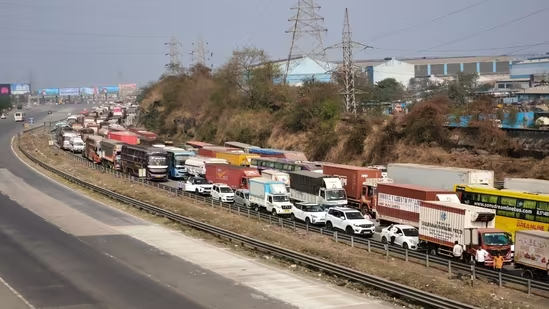
Days after a massive 33-hour traffic gridlock left over one lakh motorists stranded on the Mumbai-Pune Expressway, the Maharashtra State Road Development Corporation (MSRDC) has decided to refund ₹5.16 crore in toll charges collected during the disruption.
The traffic chaos unfolded on February 3 after a gas tanker met with an accident on the Khopoli stretch near the Adoshi tunnel, bringing vehicular movement to a near-complete halt. Thousands of vehicles remained stuck for hours, with passengers reporting shortages of water, food and basic amenities.
Toll Refund for Affected Motorists
As the congestion worsened, authorities ordered suspension of toll collection. However, by that time, toll deductions had already been processed for several vehicles via FASTag.
A senior MSRDC official confirmed that the entire amount collected after the halt order will be refunded. The ₹5.16 crore refund will be directly credited to the FASTag accounts of affected vehicle owners in the coming days.
The toll operator has been instructed to submit detailed FASTag transaction records to facilitate scrutiny. Officials stated that some transactions had already been processed before the suspension directive reached toll booths, prompting the decision to return the collected amounts.
“All such transactions are being verified, and the deducted toll amounts will be transferred back to the concerned motorists,” the official said.
What Caused the 33-Hour Traffic Jam?
The 95-kilometre Mumbai-Pune Expressway witnessed the unprecedented disruption after a tanker carrying highly inflammable propylene gas overturned near the Adoshi tunnel. The accident required specialized handling, as authorities had to safely transfer the gas before removing the damaged tanker.
The complex operation to clear the site and restore safe passage took several hours, with normal traffic resuming only by early February 5.
Key Artery Between Mumbai and Pune
Operational since April 2002, the Mumbai-Pune Expressway was designed to reduce travel time between the two cities from five to six hours via the old highway to approximately three hours. It remains one of India’s busiest and most critical access-controlled expressways.
The recent incident has once again highlighted the vulnerability of high-density corridors to hazardous material accidents and the need for rapid-response protocols to minimize commuter hardship.