
New Delhi: India’s Padma Shri 2026 list carries a powerful sporting heartbeat, reflecting not only elite international achievement but also the quieter, enduring contributions of coaches, custodians of traditional martial arts, and builders of grassroots sporting culture. In a press note dated January 25, 2026, the Ministry of Home Affairs (MHA) announced that the President has approved 131 Padma awards, with 113 recipients honoured with the Padma Shri for “distinguished service” across fields.
Among them, eight awardees belong to the field of sports, presenting a rich cross-section of modern champions, historic icons, para-sport heroes, legendary coaches, and guardians of India’s indigenous physical traditions.
Cricket Icons Lead the 2026 Sports List
Rohit Sharma (Maharashtra)
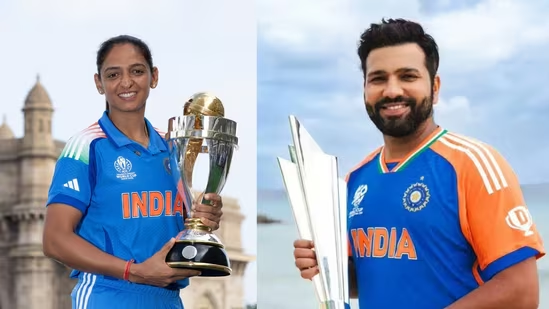
Rohit Sharma’s Padma Shri marks recognition of both performance and leadership. Beyond his extraordinary run-scoring legacy, his most defining recent milestone remains captaining India to the Men’s T20 World Cup title in 2024. The ICC has formally acknowledged him as a two-time Men’s T20 World Cup winner (2007 and 2024), placing him among the most decorated leaders in Indian cricket history.
His honour reflects an era of transformation in Indian cricket — tactical evolution, leadership stability, and global dominance across formats.
Harmanpreet Kaur Bhullar (Punjab)
India women’s cricket captain Harmanpreet Kaur represents the institutional recognition of women’s cricket’s rise from promise to global power. Under her leadership, India achieved a historic milestone by winning the Women’s ODI World Cup in 2025, firmly establishing India as a dominant force in women’s international cricket.
Her Padma Shri is not just personal recognition, but a symbolic acknowledgement of the transformation of women’s sport in India — from marginal coverage to national pride.
Hockey: Guardians of India’s Goalposts and Golden Legacy
Savita Punia (Haryana)
One of India’s most consistent goalkeepers, Savita Punia has been the backbone of the national women’s hockey team for nearly a decade. As vice-captain during the Tokyo 2020 Olympics, she played a pivotal role in India’s historic fourth-place finish — the best-ever Olympic performance by the women’s team.
Her Padma Shri honours not just medals, but the invisible grind of elite goalkeeping — discipline, resilience, and years of consistency at the highest level.
Baldev Singh (Punjab)
A name from India’s golden hockey lineage, Baldev Singh represents the sport’s historical spine. He was part of India’s men’s hockey squad at the 1976 Montreal Olympics and featured in World Cup tournaments during the 1970s.
His recognition reconnects modern India with a generation of athletes whose contributions often live only in archives and memory — now restored to national honour.
Para-Sport Excellence: Redefining Possibility
Praveen Kumar (Uttar Pradesh)
Paralympic high-jump champion Praveen Kumar embodies India’s para-sport revolution. His achievements speak in numbers and records:
-
Tokyo Paralympics – Silver medal, Asian record 2.07m
-
Paris Paralympics 2024 – Gold medal, Asian record 2.08m
His journey reflects the evolution of para-sports in India — better training ecosystems, global exposure, scientific coaching, and athletes who don’t just defend medals but upgrade them.
Tradition, Teaching and Cultural Preservation
Bhagwandas Raikwar (Madhya Pradesh)
Recognised for preserving Bundeli folk traditions and traditional combat arts, Bhagwandas Raikwar represents India’s deep-rooted akhara culture — indigenous training systems, weapon-based disciplines, and physical heritage passed down generations. His honour acknowledges sport not only as competition, but as cultural identity and discipline.
K Pajanivel (Puducherry)
A lifelong custodian of Silambam, the ancient Tamil martial art, K Pajanivel’s Padma Shri celebrates heritage preservation. His work blends teaching, community organisation, cultural safeguarding, and transmission of traditional physical knowledge to younger generations.
Coaching Legacy Beyond Borders
Vladimer Mestvirishvili (Georgia) – Posthumous
The late Vladimer Mestvirishvili, a Georgian coach who became a pillar of Indian wrestling, is honoured posthumously. Arriving in India in 2003, he shaped India’s elite wrestling ecosystem for over two decades.
His recognition highlights an often-invisible truth in sport: coaches build medals long before athletes win them. His contribution lives inside the success stories of countless Indian wrestlers.
A Broader Meaning of National Sporting Contribution
The Padma Shri 2026 sports list delivers a layered national message:
✔ Champions and captains
✔ Goalkeepers and defenders
✔ Paralympic trailblazers
✔ Coaches and mentors
✔ Traditional martial art custodians
✔ Cultural preservers
It moves from global arenas — World Cups, Olympics, Paralympics — to grassroots spaces: akhara culture, indigenous martial arts, coaching academies, and community training systems.
This year’s honours redefine what “sporting contribution” means:
Not only winning medals, but building ecosystems, preserving traditions, shaping generations, and strengthening the cultural spine of Indian sport.
In that sense, the 2026 Padma Shri sports selections are not just awards — they are a statement of national values: excellence, continuity, heritage, discipline, and service beyond spotlight.