
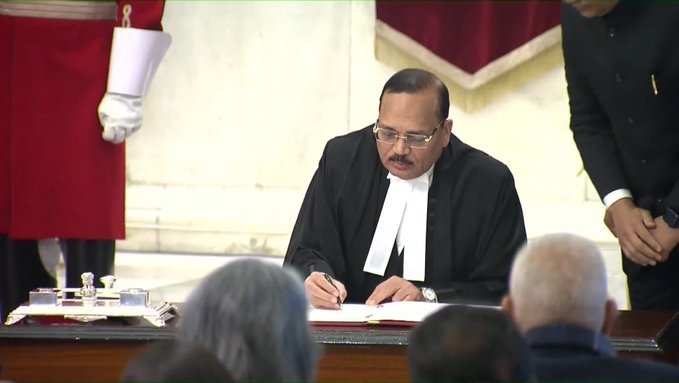
Justice Surya Kant was sworn in as the 53rd Chief Justice of India (CJI) on Monday, marking an inspiring rise from the rural fields of Haryana to the nation’s highest judicial office. President Droupadi Murmu administered the oath at Rashtrapati Bhavan in the presence of Vice-President CP Radhakrishnan, Prime Minister Narendra Modi, cabinet ministers, and senior dignitaries.
Justice Surya Kant brings to the role a remarkable legacy shaped by decades of judicial expertise, administrative leadership, and a strong humanistic philosophy. During his six-year tenure at the Supreme Court, he has been part of several landmark rulings, including judgments on the abrogation of Article 370, the Pegasus spyware case, revision of Bihar’s electoral rolls, and the Section 6A Citizenship Act verdict. He also served on the bench that granted interim bail to former Delhi Chief Minister Arvind Kejriwal.
Early Life and Legal Journey
Born on February 10, 1962, in Petwar village of Hisar district, Haryana, Justice Surya Kant completed his schooling locally before obtaining his law degree from Maharshi Dayanand University, Rohtak, in 1984. He began his legal practice in the Hisar district courts and later established himself as a constitutional and civil law specialist at the Punjab and Haryana High Court.
His rise was swift—at age 38, he became the youngest Advocate General of Haryana in 2000. He was designated a Senior Advocate in 2001 and elevated to the Punjab and Haryana High Court bench in 2004. He later served as Chief Justice of the Himachal Pradesh High Court before his elevation to the Supreme Court in May 2019.
In 2024, he earned a master’s degree in law from Kurukshetra University, securing first-class first while serving as a judge.
A Prolific Judge with Human-Centered Philosophy
Over his Supreme Court tenure, Justice Kant has authored more than 300 judgments, many in high-profile constitutional matters. He describes his judicial approach as humanistic, balancing legal realism with compassion. He often reflects on how his rural upbringing helped shape his philosophy: “A farmer’s patience taught me that justice, like a harvest, cannot be forced—it must be cultivated with care, time, and respect for due process.”
He believes empathy is critical to judging, explaining that a “poet’s empathy” enables him to see the human stories behind legal disputes. He emphasizes that while the law provides structure, humanity and fairness must guide judicial interpretation.
Reform, Efficiency, and Technology: His Vision for the Supreme Court
Justice Kant assumes office at a time when the Supreme Court is grappling with a backlog of nearly 90,000 pending cases. He identified arrears as one of his top priorities, stressing the need for optimized judicial strength, faster case disposal, and disciplined case management.
He advocates the revival of healthy practices, urging litigants to approach lower courts first while ensuring that constitution benches are timely constituted to prevent judicial bottlenecks.
He has also emphasized:
-
Use of technology to streamline proceedings
-
Digitization and infrastructure upgrades for faster disposals
-
Punctuality, preparedness, and institutional discipline across the judiciary
-
Strengthening mediation as a key solution to reduce judicial burden
As Executive Chairman of NALSA, Justice Kant launched the Veer Parivar Sahayata Yojana 2025 to offer free legal aid to soldiers, veterans, and their families.
A Leader Focused on Empathy, Discipline, and Efficiency
Justice Kant believes that the judiciary’s credibility relies not just on individual judges but on the institution’s collective discipline, consistency, and integrity. He hopes to lead a judiciary that is efficient, technologically adept, accessible, and deeply humane.
His tenure as the 53rd Chief Justice of India begins with widespread expectations for transformative judicial reforms grounded in empathy, discipline, and efficiency.