

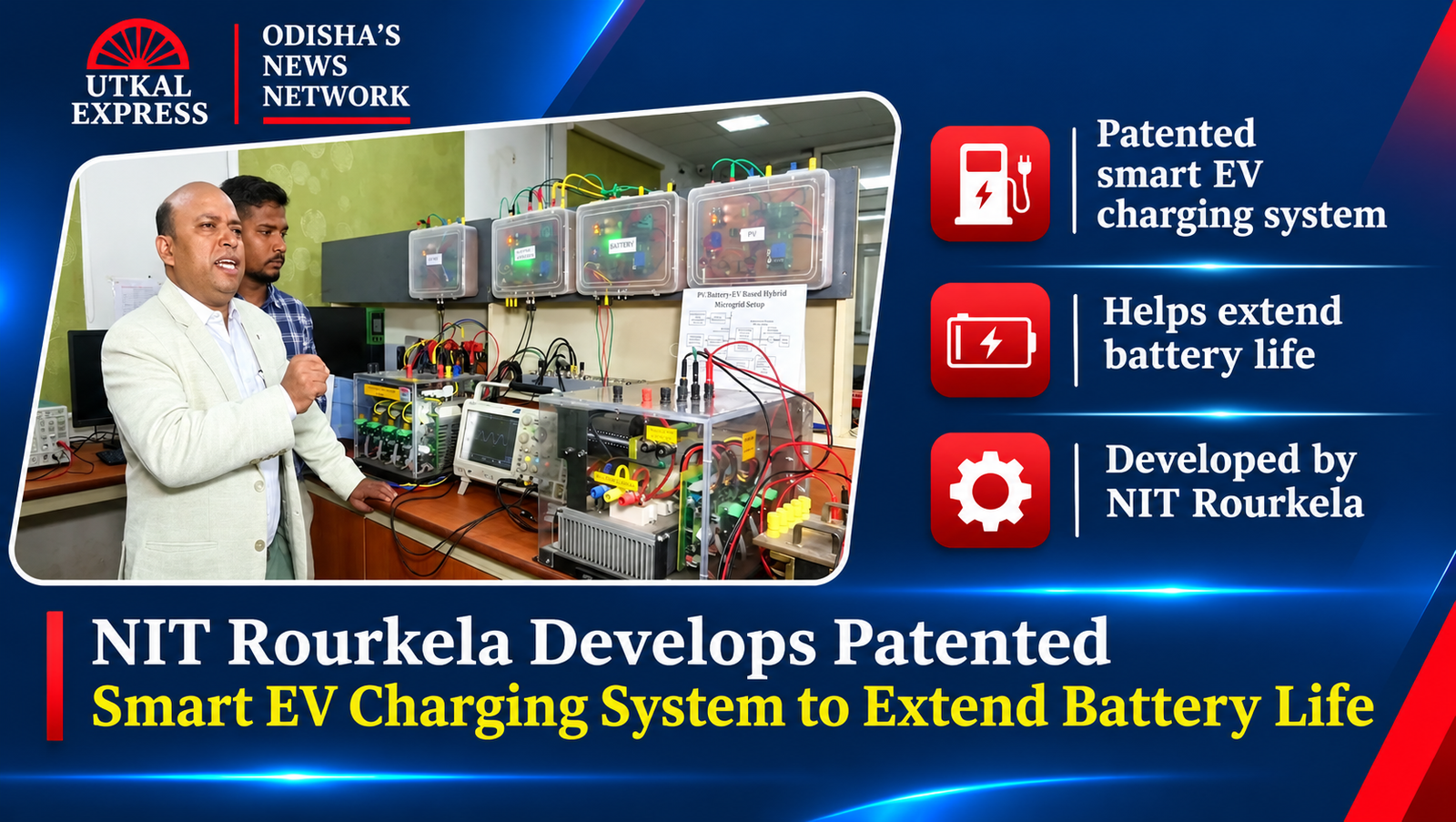
The National Institute of Technology (NIT) Rourkela has developed a smart electric vehicle (EV) charging system designed to extend battery life, reduce charging costs and ease pressure on the electricity grid. The technology, which integrates solar power, batteries and supercapacitors, has secured a patent and could offer a more sustainable solution for EV charging infrastructure.
With electric vehicle adoption increasing across India, demand for charging stations is also growing. However, simultaneous charging of multiple vehicles can put considerable pressure on the power grid. Fluctuations in solar power generation and frequent battery charging and discharging can also affect system efficiency and battery lifespan.
Solar Power and Supercapacitors to Reduce Battery Stress
The technology has been developed by a research team led by Professor Prabhat Kumar Ray, along with Arnab Ghosh and Dr Anindya Bharati.
Explaining the objective behind the innovation, Professor Prabhat Kumar Ray said the team aims to reduce EV charging costs while making the system more reliable and sustainable.
“Our aim is to reduce EV charging costs and make the system more reliable and sustainable. We are using different power management algorithms and hardware techniques. The system combines batteries and supercapacitors and uses different converters controlled through power management algorithms,” he said.
The charging system integrates solar panels, the electricity grid, batteries and supercapacitors to manage energy more efficiently.
While batteries supply power for longer-duration requirements, supercapacitors handle sudden fluctuations and peak power demand. This arrangement reduces the load on batteries, minimises stress caused by frequent charging and discharging, and could help extend battery life.
Vehicle-to-Grid Technology Offers Additional Flexibility
The patented system also incorporates Vehicle-to-Grid (V2G) technology, enabling electric vehicles to supply stored electricity back to the power grid whenever required.
This feature could help balance electricity demand, improve grid flexibility and make EVs an additional source of energy during periods of peak demand.
Professor Arnab Ghosh highlighted the broader advantages of the technology, including cost-effectiveness and reduced dependence on fossil fuels.
“The main advantages are cost-effectiveness and reduced dependence on fossil fuels, which is better for the environment. This technology can also be used at homes and in remote locations,” he said.
Rs 10 Lakh Investment, Two Years of Research
Researcher Aradhana Khilo said the project has been underway for around two years, with approximately Rs 10 lakh spent on its development.
“The government is looking for eco-friendly and pollution-free alternatives. That is why we have developed this system using renewable energy sources,” she said.
The research team has developed and tested a prototype of the smart charging system. Researchers now plan to enhance its capacity and conduct trials under real-world conditions to evaluate its performance on a larger scale.
Innovation Could Strengthen India’s EV Infrastructure
The patented innovation could contribute to the development of more efficient EV charging infrastructure by combining renewable energy, intelligent power management and energy storage technologies.
Its potential applications include residential charging facilities, remote locations and charging stations where managing electricity demand and reducing dependence on conventional power sources are important.
The development also aligns with India’s broader efforts to promote electric mobility, reduce pollution, increase renewable energy adoption and achieve its net-zero emissions target by 2070.