

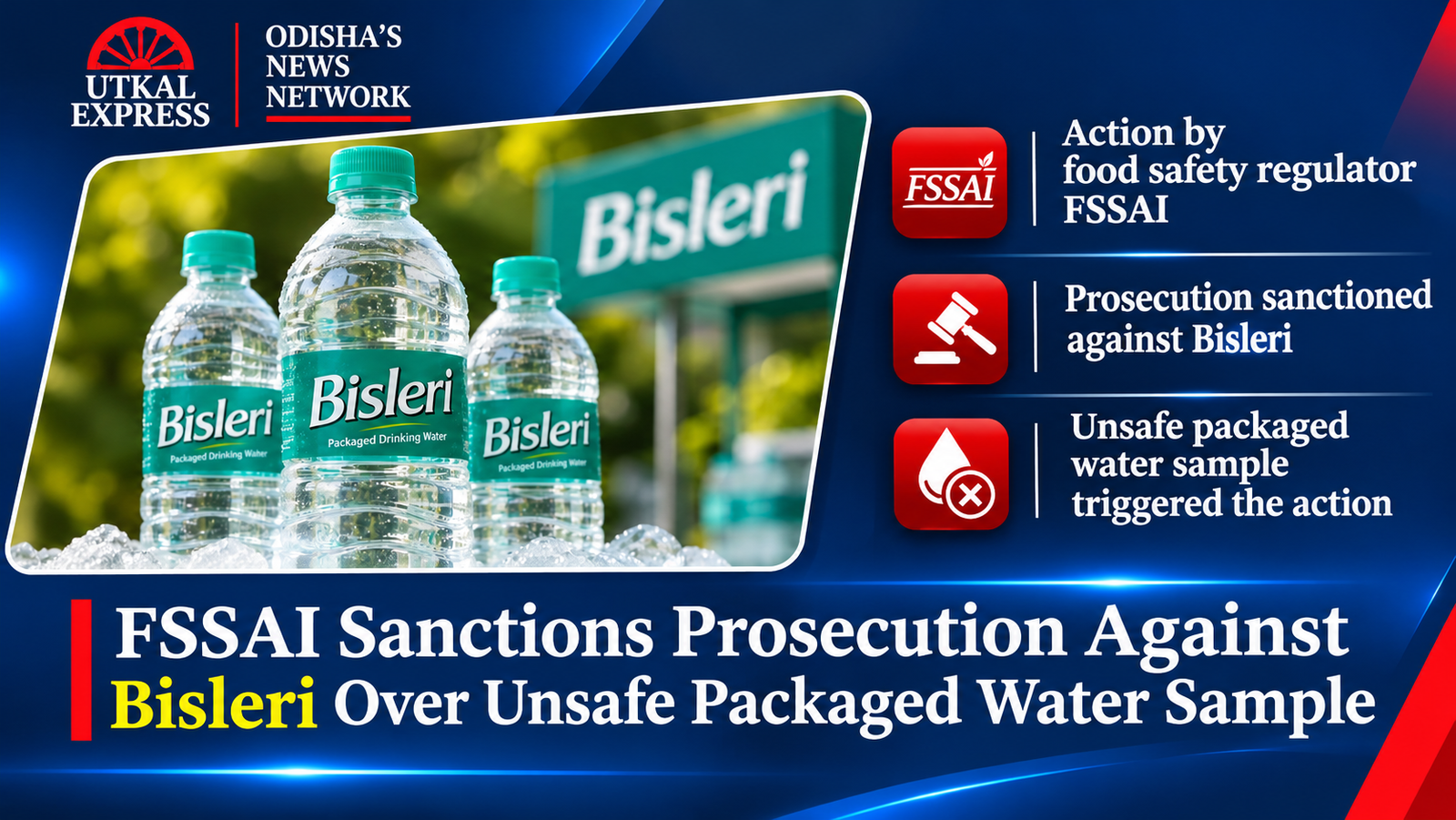
The Food Safety and Standards Authority of India (FSSAI) has sanctioned prosecution against Bisleri International Pvt. Ltd. after a packaged drinking water sample from its Goa facility was declared unsafe under the Food Safety and Standards Act, 2006. The development has renewed concerns over the safety standards, testing procedures and regulatory oversight of India’s packaged drinking water industry.
The action does not amount to a finding of guilt. Bisleri has maintained that its water is safe and said the case relates to a single batch manufactured at its Goa plant in September 2025.
FSSAI Finds Bromate and PAHs in Water Sample
According to the regulator, six samples were collected from Bisleri’s Goa facility on September 30, 2025. Five samples met the prescribed standards, while the sixth showed bromate levels of 12 micrograms per litre (µg/L), exceeding the permitted limit of 10 µg/L.
The sample belonged to the category of packaged drinking water other than mineral water, which includes water sourced from any potable supply, including public water systems.
Bisleri challenged the initial findings in November 2025, following which the sample was sent to a referral food laboratory for further examination. The retest found bromate within the permissible limit but detected polynuclear aromatic hydrocarbons (PAHs).
FSSAI subsequently classified the sample as unsafe because its standards do not permit PAHs at detectable levels. However, the authority has not disclosed the concentration or specific compounds detected. No product recall has been ordered so far.
Bisleri Disputes Findings, Says Water Is Safe
Bisleri has maintained that the matter concerns only one batch produced at its Goa facility in September 2025. The company said retests conducted by approved laboratories found bromate levels within the prescribed limit.
It also stated that the independent laboratory reports were submitted to FSSAI’s Western Regional Office through a letter dated February 2, 2026.
The company claimed that it had not received any formal notice through email or physical communication and therefore believed the matter had been resolved.
Bisleri further said its manufacturing process involves more than 90 quality checks across 10 stages. It operates 143 plants and has assured continued cooperation with the food safety regulator.
Packaged Drinking Water Industry Has Faced Earlier Scrutiny
The latest case comes amid a history of concerns over the quality of packaged drinking water in India.
In February 2003, the Centre for Science and Environment reported pesticide residues in samples collected from 34 bottles representing 17 brands sold in the Delhi region. The brands included major players such as Bisleri, Bailley, Pure Life, Aquafina and Kinley.
The organisation reported that the samples contained, on average, pesticide levels 36.4 times higher than the European limit used in its assessment. The Centre subsequently appointed an inquiry committee, whose recommendations on Bureau of Indian Standards (BIS) requirements were accepted by the government.
In 2015, scientists from the Bhabha Atomic Research Centre tested 18 packaged water brands in Mumbai. Around 27 per cent of the samples reportedly exceeded the bromate limit of 10 µg/L, with some readings reaching 43 µg/L.
Government figures have also highlighted quality concerns. In January 2019, Parliament was informed that 496 of the 1,123 packaged water samples analysed during 2017-18 did not comply with prescribed standards.
More recently, in April 2025, Karnataka Health Minister Dinesh Gundu Rao said that 95 of 255 samples tested in a state survey were unsafe, while another 88 were substandard. He noted that most problematic samples came from local manufacturers, while national brands generally maintained higher standards.
In another incident, a consumer complaint through FSSAI’s Food Safety Connect portal led to an inspection of an alkaline water plant in Savli, Vadodara. The regulator seized stock worth approximately Rs. 31.61 lakh over alleged misbranding, visible particles and the presence of an unauthorised substance.
International Concerns Over Bottled Water Quality
Concerns over bottled water quality are not limited to India.
In 2024, Nestlé Waters admitted to using prohibited filtration methods and ultraviolet treatment on mineral water in France. The company paid a €2 million fine to avoid legal action. A French Senate inquiry in May 2025 alleged that the government had covered up the practices.
Nestlé maintained that the filtration methods it currently uses are permitted and that its water is pure. The controversy centred on treatment methods prohibited under French and European regulations for natural mineral water.
A January 2024 study published in the journal Proceedings of the National Academy of Sciences also raised concerns about plastic contamination in bottled water. Researchers estimated that an average litre of bottled water across three US brands contained around 240,000 plastic fragments, approximately 90 per cent of which were nanoplastics.
The researchers suggested that much of the plastic could originate from the bottles and reverse osmosis filters. However, they acknowledged that the potential health risks of these particles remain unclear. The International Bottled Water Association criticised such reports, saying they unnecessarily alarm consumers.
A 2023 report by United Nations University estimated that global bottled water sales reached around $270 billion, involving approximately 350 billion litres in 2021. It also warned that the industry’s rapid growth could undermine efforts to ensure universal access to safe drinking water.
India’s Packaged Water Regulations and Testing Requirements
Packaged drinking water manufacturers are required to comply with FSSAI standards under sub-regulation 2.10.8.
Until October 2024, manufacturers were also required to obtain BIS certification. The requirement was removed following an industry request to end the system of dual certification.
On November 29, 2024, FSSAI classified packaged drinking water and mineral water as high-risk food categories. Under this classification, manufacturing units must undergo inspections before licensing and at least once every year thereafter.
A new FSSAI testing scheme, effective January 1, 2026, specifies minimum testing frequencies for manufacturers:
-
Microbiological parameters must be tested every month.
-
General chemical parameters must be tested every three months.
-
Pesticide residues must be tested every six months.
-
All parameters must undergo testing at least once every six months.
-
Source water must be tested at accredited laboratories.
Manufacturers whose six-monthly reports fail to meet standards must conduct monthly testing until three consecutive batches comply with the prescribed requirements.
The Food Safety and Standards Act also provides for stringent penalties, including life imprisonment in cases where unsafe food causes death. Where imprisonment is prescribed as a possible punishment, prosecution requires sanction from the Commissioner of Food Safety.
Questions Over Testing Transparency and Regulatory Delays
The Bisleri case has raised questions about the transparency and timeliness of food safety enforcement.
The sample was collected in September 2025, while the prosecution sanction was announced on November 22, 2026. The company has also claimed that it did not receive formal notice about the findings.
Another concern is the absence of publicly disclosed PAH measurements. FSSAI has stated that the compounds were detected, but has not specified which PAHs were found or their concentrations.
The World Health Organization, in a 2019 assessment, said microplastics in drinking water did not appear to pose a health risk at the levels then observed. However, it also highlighted the limitations of existing research and called for standardised methods to measure microplastics.
What Do Bromate and PAHs Mean for Drinking Water Safety?
Bromate is mainly formed when ozone, used in water disinfection, reacts with naturally occurring bromide in the source water.
The International Agency for Research on Cancer (IARC) classifies bromate as possibly carcinogenic to humans under Group 2B, based primarily on evidence from high-dose animal studies.
The World Health Organization’s provisional guideline for bromate is 10 µg/L, the same limit prescribed in India. Health Canada’s guideline also uses this limit, based on kidney tumour findings in rats.
PAHs, meanwhile, are a group of chemicals produced when fuels, oil or organic materials burn incompletely. One of the best-studied compounds, benzo[a]pyrene, is classified by IARC as carcinogenic to humans under Group 1.
However, FSSAI has not identified the specific PAHs detected in the Bisleri sample, leaving questions about the exact nature and extent of the contamination.
What the Case Means for Consumers
For consumers, the case highlights the difficulty of independently verifying the quality of packaged drinking water. Most buyers rely on regulatory standards, laboratory testing and manufacturers’ quality-control systems.
Researchers associated with United Nations University have linked the growing use of bottled water to decades of limited progress in public drinking water infrastructure. India is among the markets witnessing rapid growth in bottled water consumption.
Consumers can report suspected food safety violations through FSSAI’s Food Safety Connect portal, which has previously triggered inspections and enforcement action.
The prosecution proceedings against Bisleri will now bring two sets of laboratory findings under scrutiny: the initial bromate reading above the prescribed limit and the referral laboratory’s finding of PAHs despite bromate being within the limit on retesting.
The case concerns one sample from one of the company’s 143 plants. Its outcome could draw further attention to laboratory testing, regulatory communication and accountability in India’s packaged drinking water sector.