
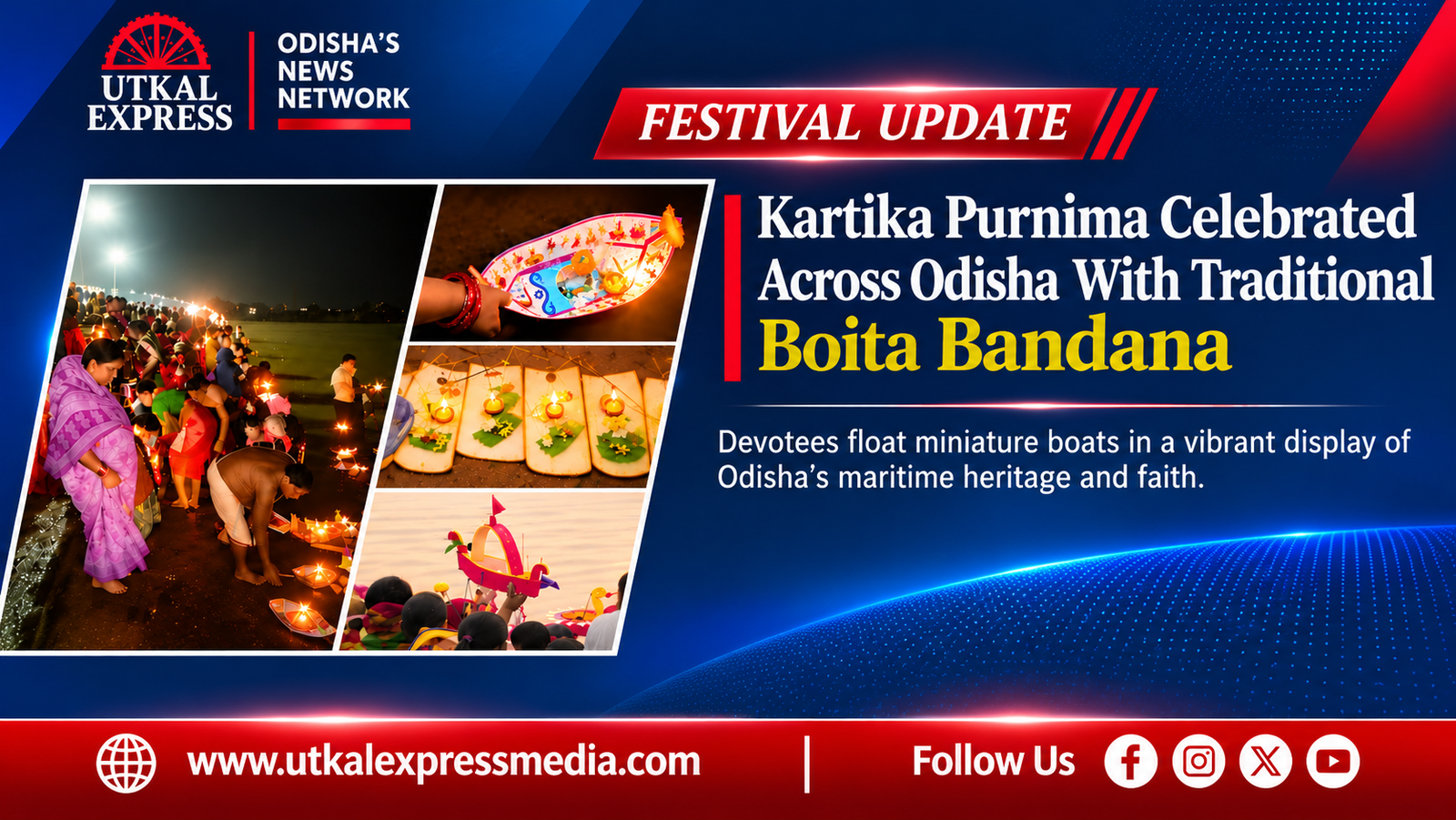
The traditional chant, ‘Aa Ka Ma Bai, Pana Gua Thoi, Pana Gua Tora, Masaka Dharama Mora’, resonated across Odisha on Tuesday as people celebrated Kartika Purnima with religious devotion and festive enthusiasm. Thousands of devotees gathered at rivers, ponds, beaches and temples from early morning to take holy dips, offer prayers and float miniature boats in remembrance of Odisha’s glorious maritime heritage.
Villages and towns across the state witnessed vibrant celebrations as people came together to observe age-old customs deeply connected with Odia culture, faith and identity.
Kartika Purnima marks the culmination of the holy month of Kartika, during which devotees observe fasting, prayers and various religious practices. The full moon day holds special significance, particularly because of the traditional Boita Bandana ritual.
Boita Bandana Celebrates Odisha’s Glorious Maritime Heritage
One of the most significant traditions associated with Kartika Purnima is Boita Bandana, in which people float miniature boats in rivers, ponds and the sea.
These symbolic boats are traditionally made using banana stems and paper and decorated with betel leaves, betel nuts, flowers, grass and small earthen lamps. Devotees set them afloat while chanting traditional verses and offering prayers.
The ritual commemorates the maritime history of ancient Kalinga, when Odia traders and sailors undertook long sea voyages to distant regions, including Bali and Java in present-day Indonesia, for trade and cultural exchanges.
Boita Bandana is observed as a symbolic tribute to those seafarers and their contribution to Odisha’s historical connections with other parts of Southeast Asia.
According to popular belief, observing the holy month of Kartika through religious practices and floating boats on the full moon day brings prosperity, happiness and well-being to families.
Massive Gathering of Devotees at Bhubaneswar’s Bindusagar
In Bhubaneswar, the sacred Bindusagar pond witnessed a massive gathering of devotees from the early hours of Tuesday.
By around 5:30 am to 5:40 am, the pond was filled with miniature boats as people arrived to perform Boita Bandana. Families, elderly people and women devotees participated in the rituals, creating a festive atmosphere around the historic waterbody.
Several women devotees expressed happiness at being able to participate in the annual tradition despite the heavy rush.
One woman said she had reached Bindusagar around 5 am to perform the ritual. Another devotee described how she began her day early by drawing colourful rangolis and worshipping the Chaura plant before visiting the temple.
Although she had to wait in long queues, she said the experience was deeply satisfying. While floating her miniature boat, she also prayed for the happiness and good health of people across the world.
Elderly Devotees Join the Celebrations Despite Challenges
The celebrations also witnessed the determination of elderly devotees who made special efforts to participate in the traditional rituals.
An elderly woman who faced difficulty walking visited Bindusagar to perform Boita Bandana. She said uncertainty about whether she would get another opportunity to take part in the celebrations next year motivated her to make the journey despite her physical difficulties.
Her participation reflected the emotional and religious significance of Kartika Purnima for devotees, for whom the annual observance is more than a ritual.
Kartika Purnima Keeps Odia Traditions Alive
From miniature boats floating across waterbodies to prayers and traditional chants, Kartika Purnima once again brought communities together across Odisha.
The celebration serves as a reminder of the state’s maritime past while preserving customs passed down through generations. For many devotees, Boita Bandana is not only an expression of religious faith but also an opportunity to reconnect with Odisha’s cultural heritage and remember the legacy of its ancient seafarers.