

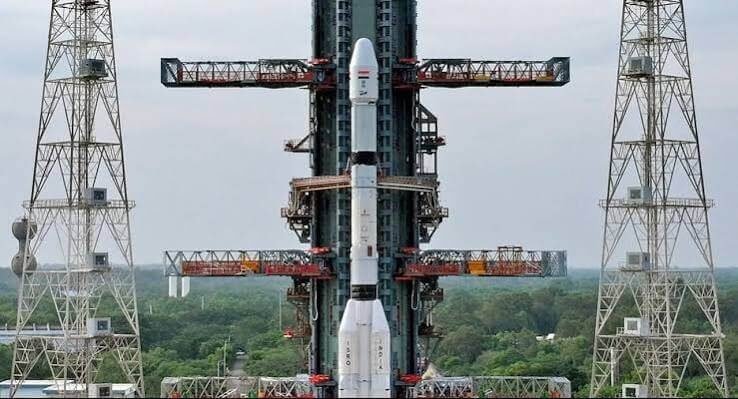
Sriharikota: The Indian Space Research Organisation (ISRO) on Friday successfully launched NVS-03, India’s next-generation navigation satellite, marking another step towards strengthening the country’s independent satellite navigation capabilities.
The satellite was carried by a Geosynchronous Satellite Launch Vehicle (GSLV), which lifted off from the second launch pad at the Satish Dhawan Space Centre (SDSC-SHAR) in Sriharikota.
NVS-03 is part of the Navigation with Indian Constellation (NavIC), India’s indigenous satellite navigation system developed as an alternative to relying entirely on foreign navigation services such as the US-operated Global Positioning System (GPS).
The new satellite is expected to improve NavIC’s civilian applications, particularly through the inclusion of the L1 frequency band, which supports compatibility with modern smartphones and wearable devices.
NVS-03 to Improve Civilian Navigation Services
One of the key features of NVS-03 is its ability to transmit navigation signals across three frequency bands: L1, L5 and S.
The addition of the L1 band is particularly significant for civilian users. Many modern smartphone chipsets and wearable devices are designed to support L1-based satellite navigation signals. Its inclusion is therefore expected to make NavIC more accessible across a wider range of consumer devices.
The satellite will also contribute to strengthening navigation services for applications such as location tracking, transportation, mapping and other services that depend on accurate positioning information.
Indigenous Rubidium Atomic Clock to Provide Precise Timing
NVS-03 carries an indigenous Rubidium atomic clock developed by ISRO’s Space Applications Centre. Atomic clocks are essential components of satellite navigation systems because they provide highly accurate time references.
Precise timekeeping is important not only for determining geographical positions but also for several critical sectors, including banking, stock markets, telecommunications and defence.
Even minor differences in time synchronisation can affect systems that depend on accurate and coordinated operations. The atomic clock onboard NVS-03 is therefore an important component of India’s efforts to strengthen its navigation and timing infrastructure.
India Working Towards an Independent Timekeeping System
Alongside the development of NavIC, India has also been working to establish an independent ground-based timekeeping network to reduce its dependence on foreign satellite navigation systems for maintaining Indian Standard Time (IST).
In June 2025, the government announced plans to move away from GPS-based time references and use a network of five atomic clocks installed in Guwahati, Bengaluru, Ahmedabad, Faridabad and Bhubaneswar.
At the time, the government stated that the clocks had been tested and that the system would become operational soon. Banks and businesses were also expected to use the indigenous timekeeping infrastructure once it became operational.
The initiative is aimed at ensuring greater control over India’s time synchronisation infrastructure, particularly for sectors where precise timing is essential.
NavIC’s Role in Strengthening India’s Strategic Capabilities
NavIC, formerly known as the Indian Regional Navigation Satellite System (IRNSS), is India’s independent regional navigation satellite system. It has been developed to provide positioning, navigation and timing services over India and the surrounding region.
With satellites such as NVS-03, ISRO is working to improve the system’s capabilities and expand its usefulness for both civilian and strategic applications.
The successful launch of NVS-03 adds to India’s efforts to develop indigenous space-based infrastructure and strengthen its technological independence in satellite navigation and precision timing.