
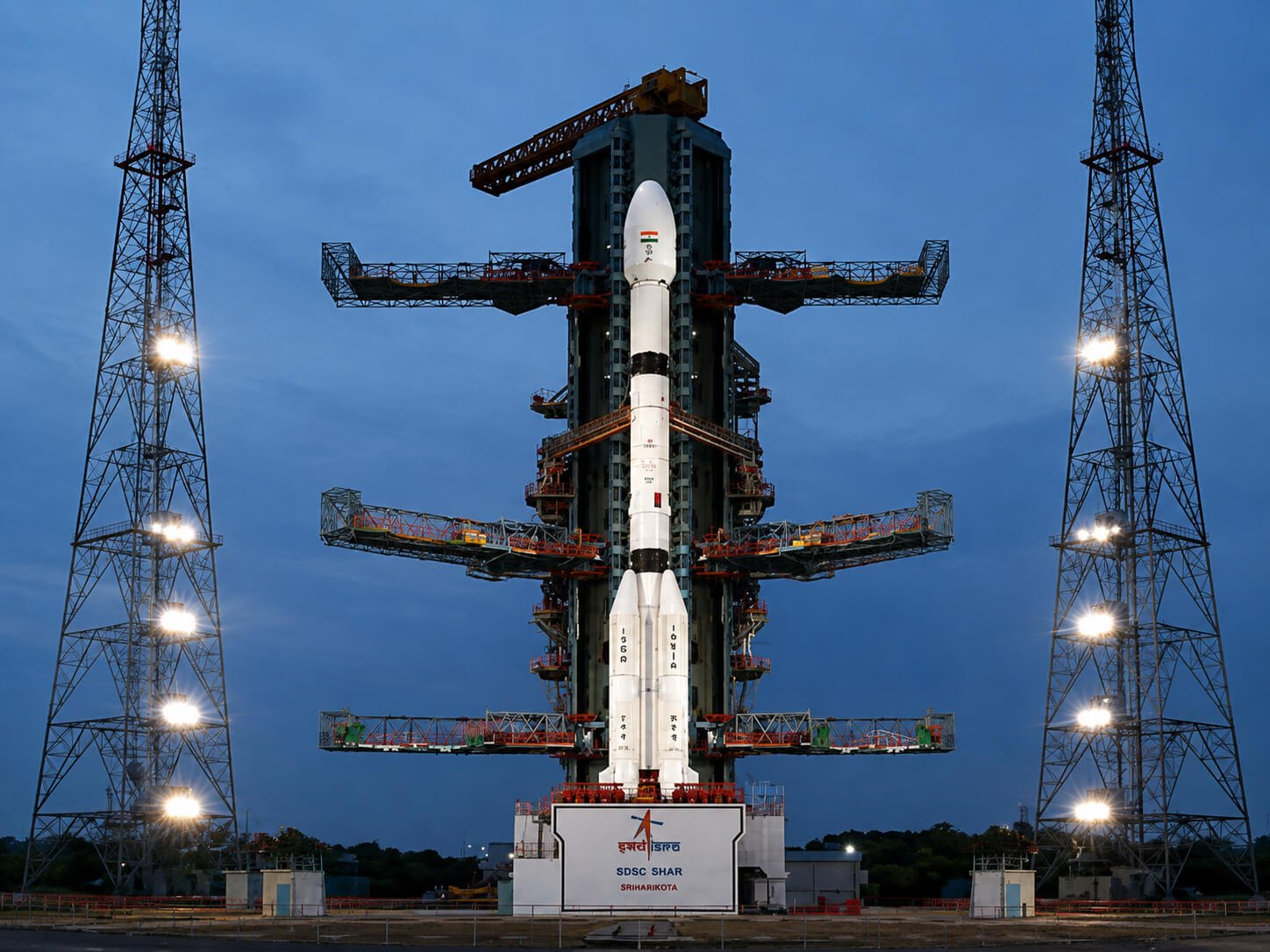
Sriharikota: The Indian Space Research Organisation (ISRO) scripted another major milestone on Friday by successfully launching EOS-05, India’s first dedicated Earth-imaging satellite designed for deployment in geosynchronous orbit. The satellite, weighing around 2,367 kg, was successfully injected into the intended sub-geosynchronous transfer orbit aboard the GSLV-F17 rocket.
The successful mission marked ISRO’s first launch success of 2026 and represented a significant achievement in the country’s Earth-observation and space capabilities.
GSLV-F17 Successfully Places EOS-05 In Orbit
The three-stage Geosynchronous Satellite Launch Vehicle (GSLV-F17) lifted off at 2:55 am from the second launch pad of the Satish Dhawan Space Centre in Sriharikota.
The launch followed a smooth 27-hour countdown, which began at 11:30 pm on Wednesday. Despite the pre-dawn timing and rainfall, a large number of space enthusiasts gathered at the launch centre, with many watching the historic event while carrying umbrellas.
Approximately 18 minutes after liftoff, EOS-05 was successfully placed into its intended sub-geosynchronous transfer orbit.
ISRO Chairman and Secretary, Department of Space, V Narayanan, announced the successful completion of the mission shortly after the launch, confirming that the satellite had been injected precisely into the required orbit.
He said the mission demonstrated the progress made by ISRO in improving the GSLV’s payload-carrying capability over the years.
Heaviest Satellite Ever Carried By GSLV
With a mass of approximately 2,367 kg, EOS-05 has become the heaviest satellite ever launched by a GSLV.
Narayanan recalled that the first GSLV mission, GSLV-D1, carried a payload weighing about 1,536 kg. Since then, ISRO has progressively enhanced the launch vehicle by reducing structural mass and improving propulsion systems.
The GSLV-F17 stands approximately 51.7 metres tall and has a liftoff mass of around 420.5 tonnes. The three-stage vehicle is equipped with a cryogenic upper stage, enabling it to deliver heavier payloads into higher orbits.
The latest mission therefore represents not only the successful deployment of EOS-05 but also a demonstration of the technological evolution of the GSLV programme.
EOS-05 To Strengthen India’s Earth Observation Capabilities
EOS-05 has been described by scientists involved in the mission as a highly advanced and uniquely configured Earth-observation satellite.
Unlike conventional Earth-observation satellites operating in low Earth orbit, EOS-05 is intended to operate from the geosynchronous orbit region, roughly 36,000 km above Earth. From this altitude, a satellite can remain synchronised with Earth’s rotation, enabling it to maintain a consistent view of large areas.
The satellite has been designed to provide near-real-time imagery, which could support a range of national applications, including agriculture, disaster management and other strategic activities.
Mission Director Thomas Kurien said the spacecraft was uniquely configured for near-real-time imaging and described it as the heaviest satellite launched by a GSLV into a GTO or sub-GTO orbit.
Project Director (Satellite) Imteyaz Ahamad described EOS-05 as a complex satellite featuring multi-band operational capabilities.
Satellite Systems Reported To Be Functioning Normally
Following the successful injection, ISRO officials confirmed that the satellite’s systems were functioning normally.
According to Narayanan, satellite data indicated that the spacecraft was healthy and that its solar panel had been successfully deployed.
The spacecraft will subsequently undergo orbit-raising manoeuvres before being positioned in its required operational geostationary platform.
Once operational, EOS-05 is expected to become India’s first dedicated imaging satellite operating from the geosynchronous platform, providing imagery and strategic data for national requirements.
Major Morale Boost For ISRO After Earlier Setbacks
The successful mission has also provided a significant morale boost to ISRO after recent setbacks.
The GSLV-F17/EOS-05 mission is considered a follow-up to the unsuccessful GSLV-F10/EOS-03 mission of 2021. During that mission, the launch vehicle encountered an issue with its cryogenic upper stage, resulting in the spacecraft failing to reach its intended orbit.
More recently, on January 12, 2026, ISRO’s PSLV-C62 mission also encountered an anomaly in its third stage while carrying 16 satellites, preventing the spacecraft from reaching their intended orbit.
Against this backdrop, the successful GSLV-F17 mission represents an important recovery for the space agency and reinforces confidence in India’s heavy-lift launch capabilities.
Prime Minister Modi Hails Historic Achievement
Prime Minister Narendra Modi congratulated ISRO scientists and engineers following the successful launch, calling it a proud moment for the country.
He highlighted the significance of GSLV-F17 carrying EOS-05 and said the mission reflected India’s growing capabilities in space technology, innovation and Earth observation.
The Prime Minister also underlined the expanding partnership between ISRO and Indian industry, noting that greater industry participation was adding scale and strength to the country’s space programme.
Congress Also Congratulates ISRO
Leaders of the Congress party also welcomed the successful mission.
Congress president Mallikarjun Kharge congratulated the ISRO team and said EOS-05 would strengthen India’s Earth-observation capabilities. He also praised Indian scientists, engineers and researchers for their continued contribution to the country’s space programme.
Congress general secretary Jairam Ramesh described the launch as another landmark achievement and said the mission would add to India’s strategic capabilities.
Congress leader Priyanka Gandhi Vadra also congratulated the ISRO team, praising the dedication of the scientists and engineers involved in the mission.
However, the Congress had earlier raised concerns over proposed changes in the role of ISRO and what it described as an aggressive privatisation push in the space sector. The party had argued that the institutional capabilities developed by ISRO over several decades should be protected while expanding India’s private space ecosystem.
107th Launch From Sriharikota
The latest mission also marked the 107th launch from Sriharikota and the 19th GSLV mission, according to ISRO chief V Narayanan.
The achievement reflects the gradual evolution of India’s launch capabilities, from carrying relatively lighter payloads during the early GSLV missions to successfully deploying the 2,367-kg EOS-05.
The mission is expected to further strengthen India’s ability to deploy sophisticated Earth-observation spacecraft into higher orbits and support applications requiring continuous or near-real-time imaging.
A New Chapter In India’s Space Journey
The successful GSLV-F17/EOS-05 mission marks an important step in India’s space programme. Beyond the successful launch itself, the mission demonstrates the growing maturity of India’s heavy-lift launch technology and its ability to deploy increasingly sophisticated satellites.
With EOS-05 expected to provide advanced imagery for national applications, the mission could play an important role in strengthening India’s capabilities in agriculture, disaster response, environmental monitoring and strategic Earth observation.
For ISRO, the successful mission is also a reminder of the organisation’s ability to learn from setbacks and return with improved technology and greater operational confidence.