
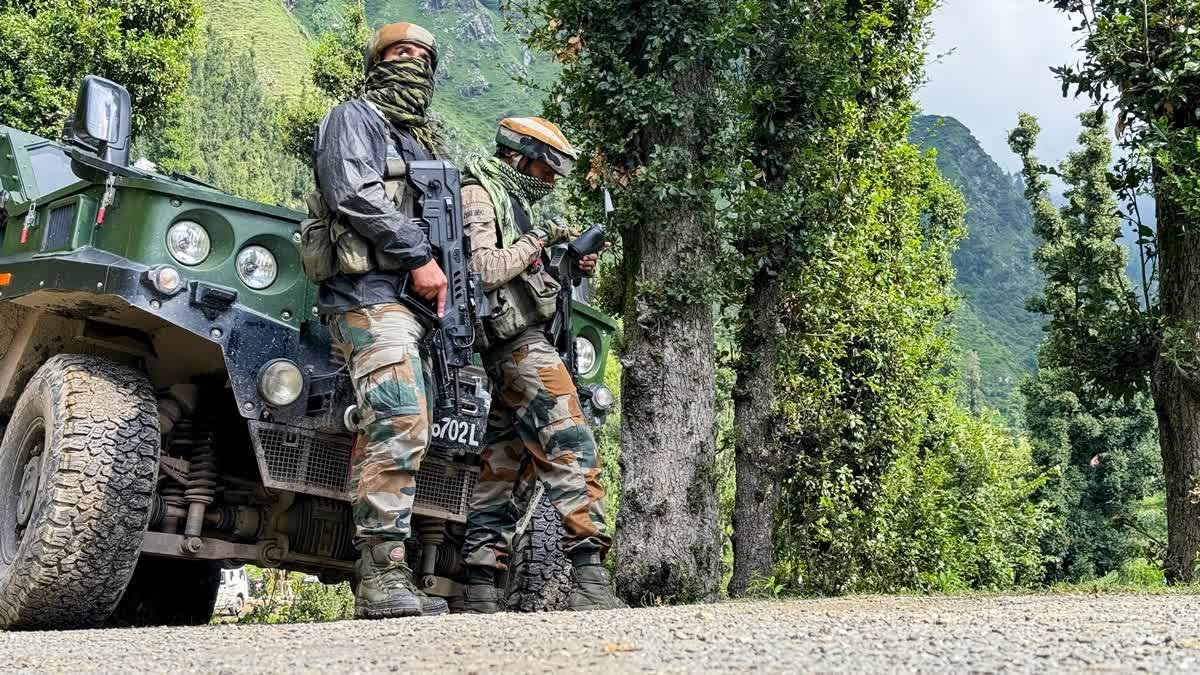
Operation Trashi-1, a prolonged counter-terror mission conducted jointly by the Indian Army, Jammu and Kashmir Police tactical units, and the Central Reserve Police Force (CRPF), has concluded after 326 days of sustained operations in the forests and mountainous terrain of Jammu and Kashmir’s Kishtwar district.
Security forces eliminated seven Pakistan-trained terrorists during the nearly year-long operation, officials said. The militants had reportedly taken advantage of the dense forests, steep slopes and lack of road connectivity in the region to evade capture and regroup after intermittent encounters.
Challenging Terrain and Harsh Weather Conditions
The operation was led by the White Knight Corps of the Indian Army in the high-altitude Chhatru region. Troops operated in extremely challenging conditions marked by heavy rain, snowfall and sub-zero winter temperatures.
Officials noted that the absence of open grounds and limited access routes made sustained tracking operations difficult. Even during harsh winter months, security forces maintained their presence in the area, continuing search and combing efforts without withdrawing.
Frequent gunfights were reported during the course of the mission, with militants often retreating deeper into forest cover. However, coordinated intelligence inputs and long-term surveillance eventually narrowed down their movement patterns.
Elimination of JeM Operative Saifullah
Among those killed was Saifullah, described by officials as a key operative and prominent face of the Pakistan-based terror outfit Jaish-e-Mohammed (JeM). He had reportedly been active in the region for a prolonged period and was accused of orchestrating activities aimed at destabilising peace in the Kashmir Valley.
Security agencies stated that his elimination is expected to significantly weaken the operational network of the group in the area.
Advanced Technology and Joint Coordination
Operation Trashi-1 involved close coordination between the Army, Jammu and Kashmir Police Special Operations Group (SOG), and CRPF units. Authorities credited seamless inter-agency cooperation, accurate intelligence inputs and local support for the success of the mission.
For surveillance and tracking, forces deployed advanced equipment, including first-person view (FPV) drones, unmanned aerial vehicles (UAVs) and satellite imagery. A secure and rugged communication network ensured real-time coordination even in remote mountainous zones.
In a post on X, the White Knight Corps described the outcome as “a massive blow to the terror network,” reaffirming its commitment to safeguarding the region.
Officials said the operation demonstrates sustained counter-terror capabilities in difficult terrain and reflects the continued focus on dismantling militant infrastructure in Jammu and Kashmir.