
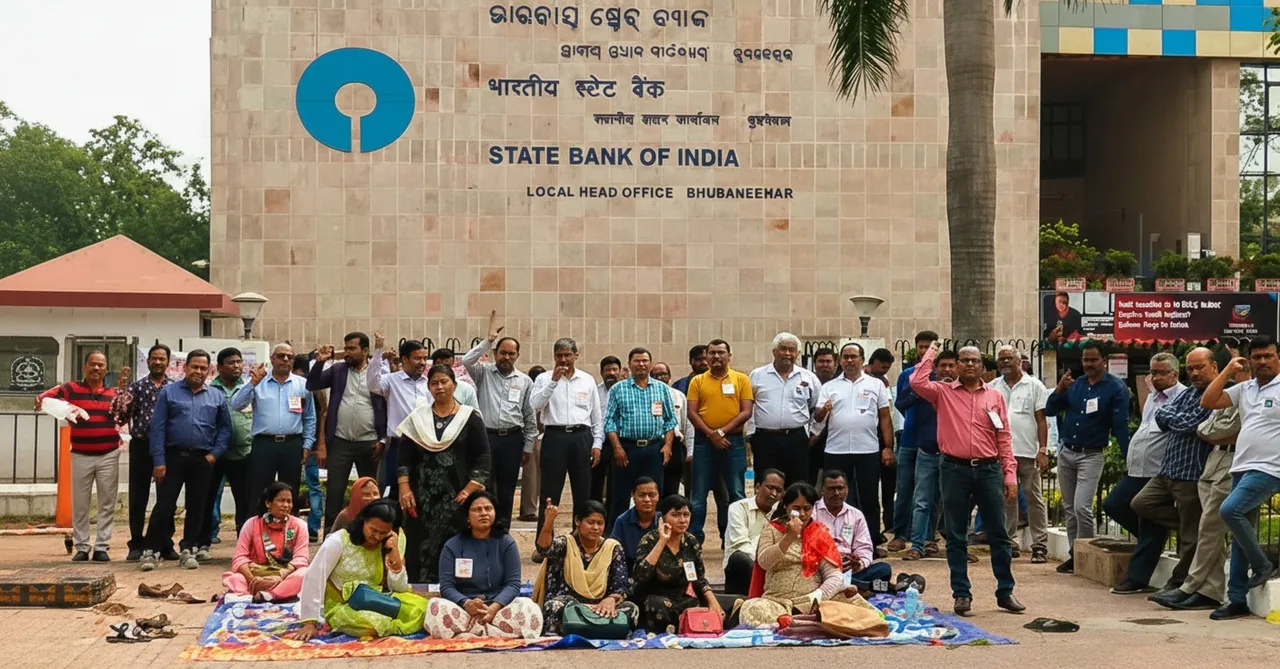
Public sector bank employees across India, including large-scale participation in Odisha, observed a nationwide strike on Tuesday following a call by the United Forum of Bank Unions (UFBU), intensifying pressure on the government over long-pending demands, primarily the implementation of a five-day work week in the banking sector. The agitation led to widespread disruption of banking operations, marking the fourth consecutive day of service interruption in several regions.
Across Odisha, branches of major public sector banks witnessed partial to near-total suspension of services, leaving thousands of customers facing inconvenience in accessing essential banking facilities. Services such as cash deposits, cheque clearance, counter-based transactions, loan processing, account updates, and customer service desks were severely affected as employees stayed away from work in support of the protest.
Long-Pending Demands Trigger Nationwide Action
The UFBU, an umbrella body representing multiple bank employees’ unions, stated that the strike was driven by years of unfulfilled assurances from authorities. Union leaders emphasized that the five-day work week proposal had been discussed and agreed upon at the Indian Banks’ Association (IBA) level, but final approval from the government remains pending.
A protesting bank employee said that assurances regarding a Saturday holiday and a structured five-day work schedule were made nearly five years ago, but no policy decision has been implemented.
“We were assured of a five-day work week long ago. Nothing has changed. Saturday should be declared a holiday. We will continue our agitation until our demands are fulfilled,” he said.
Union representatives added that repeated negotiations, memorandums, and representations to the government failed to produce results, leaving industrial action as the only option.
Heavy Financial Impact and Customer Inconvenience
The strike has caused significant operational and financial strain on the banking system. Union leaders estimated that banking transactions worth nearly ₹10,000 crore in Odisha alone could be affected due to halted operations. Businesses, traders, and small enterprises reported delays in payments, cheque clearances, and fund transfers, directly impacting commercial activity.
While digital banking platforms such as mobile apps, internet banking, and ATMs provided limited relief to customers, services requiring physical verification, documentation, and in-person processing continued to remain disrupted.
UFBU Warns of Escalation if Demands Remain Unmet
Union leaders warned that the agitation could intensify if the government fails to take a policy-level decision. Besides the five-day work week, UFBU is also pushing for reforms related to staff recruitment, workload management, job security, and service conditions across public sector banks.
“The discussions have already happened at the institutional level. The delay is purely administrative. If this continues, stronger protests will follow,” a UFBU representative said.
With banking services forming the backbone of daily economic activity, prolonged disruptions could have serious ripple effects on businesses, governance services, and public convenience, putting. Customers across Odisha and other states have urged authorities to resolve the issue through dialogue to restore normal banking operations at the earliest.