
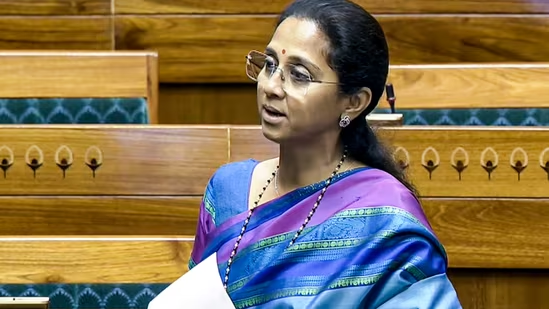
A private member’s bill seeking to give employees the legal right to ignore work-related calls and emails after office hours was tabled in the Lok Sabha on Friday, reigniting debate on workplace expectations in India.
NCP MP Supriya Sule introduced the Right to Disconnect Bill, 2025, which proposes the creation of an Employees’ Welfare Authority. The bill aims to ensure that employees can lawfully decline work communications beyond designated office hours or during holidays, without fear of repercussions. It also outlines provisions empowering workers to refuse after-hours engagement and addresses related welfare issues.
The proposal has come at a time when concerns over long working hours and burnout are widely discussed, particularly after Australia implemented its own Right to Disconnect regulations last year. The Australian law allows employees to decline calls or messages outside work timings, a move widely seen as essential in an always-connected digital world.
Survey Shows Strong Support for “Right to Disconnect” in India
A survey conducted last year by global job portal Indeed highlighted significant support for a formal Right to Disconnect policy in India.
Key findings include:
- 79% of employers favoured the introduction of such a policy.
- 88% of employees said they are contacted outside office hours.
- 85% admitted receiving work messages even during sick leave or vacations.
- 79% felt compelled to respond out of fear of missing deadlines, losing career opportunities, or affecting promotions.
The survey also revealed a generational divide.
While 88% of Baby Boomers felt valued when contacted after work hours, 63% of Gen Z respondents said they would consider quitting if their boundaries were not respected.
Employers, too, acknowledged the shifting expectations. 81% expressed concern over losing skilled employees if work-life balance needs are ignored. However, many admitted they still reach out after hours due to deadlines and client requirements, with 66% fearing productivity would drop otherwise.
Despite this, most employers supported formal disconnect rules, and 81% said they would compensate employees who stay available beyond working hours.
Work-Hours Debate Intensifies in India
The introduction of the Right to Disconnect Bill comes amid ongoing national discussions on work culture. Industry leaders like Infosys co-founder Narayana Murthy and L&T CEO S.N. Subrahmanyan recently advocated 70-hour and even 90-hour workweeks, citing economic growth. Murthy referenced China’s 9-9-6 work model as an example, sparking widespread public debate.
Multiple Private Member Bills Tabled in Parliament
Several other private member bills were also introduced in the Lok Sabha:
- Menstrual Benefits Bill, 2024 by Congress MP Kadiyam Kavya, seeking comprehensive workplace support and infrastructure for women during menstruation.
- Menstrual Leave Bill by LJP MP Shambhavi Choudhary, proposing paid leave and access to menstrual hygiene facilities for working women and female students.
- NEET Exemption Bill by Congress MP Manickam Tagore, seeking to exempt Tamil Nadu from NEET for undergraduate medical admissions.
- Abolition of Death Penalty Bill by DMK MP Kanimozhi Karunanidhi, calling for ending capital punishment in India, except in terror-related cases—aligned with past Law Commission recommendations.
- Journalist Protection Bill, 2024 by Independent MP Vishaldada Prakashbapu Patil, aiming to prevent violence against journalists and safeguard their rights and property.
These proposals, while often unlikely to become law, reflect key social, legal, and workplace concerns currently shaping India’s policy landscape.